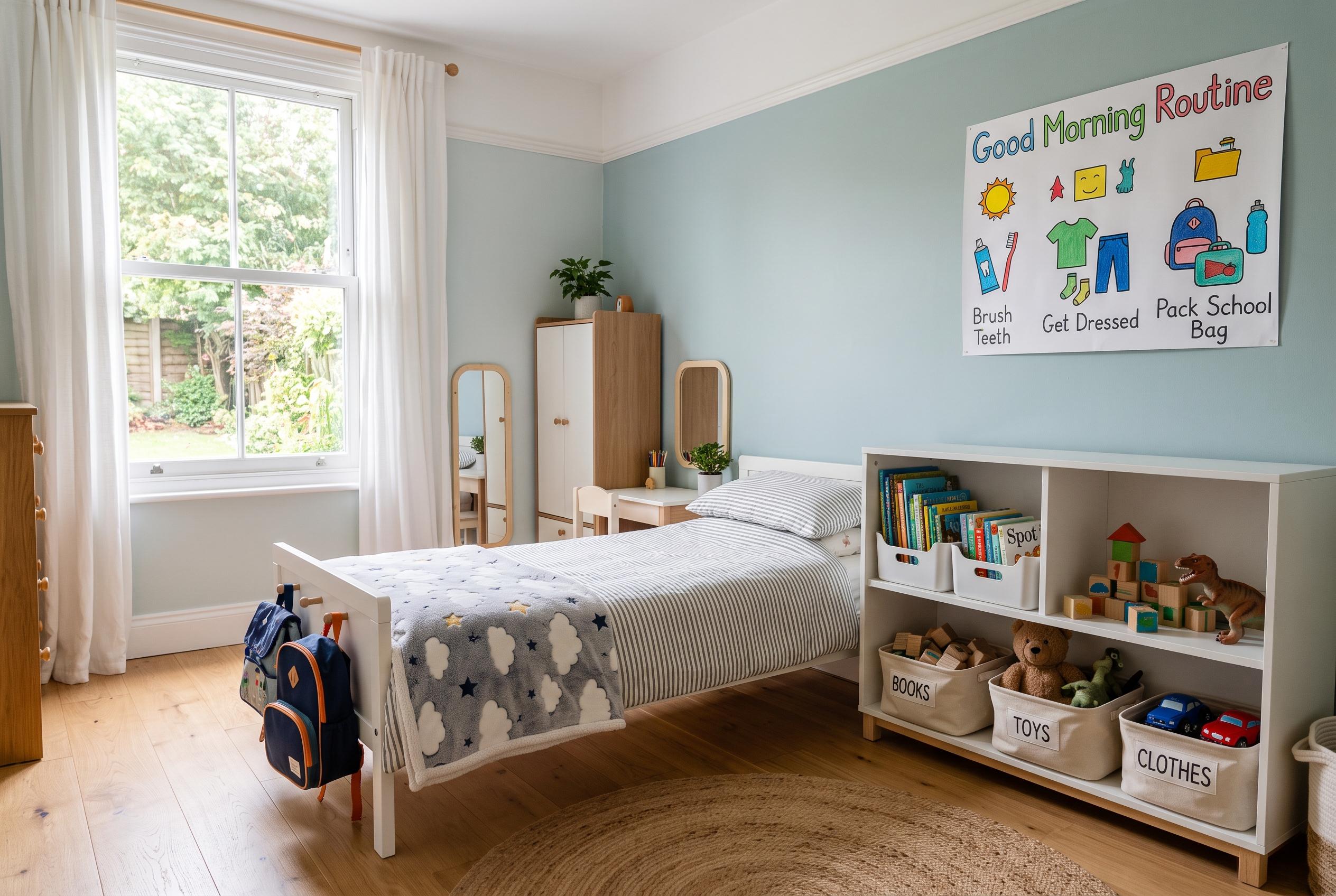

Research shows that external visual reminders and environmental cues can transform chaotic school mornings into smoother routines, especially for children with attention challenges.
For many families, the hardest part of the school morning is not any single task but the constant need for somebody to keep the whole sequence in mind. When a parent has to repeat “shoes”, “bag” and “we need to go” over and over, the routine itself is often the problem. The morning can start to depend on memory alone, and that is a fragile way to run a household.
Research on prospective memory , the ability to remember to do something later , helps explain why. Studies with children suggest that this skill draws on planning, attention and working memory, and that external cues can improve performance. Reviews of the field point to visual reminders in particular as a practical support, while other studies show that some reminder styles work better than others depending on age and setting. The broad lesson is that children do better when the environment helps carry part of the load.
That idea has useful implications for parents of children with attention or executive function challenges. Rather than asking a child to hold five or six steps in mind at once, the better approach is often to make the next step obvious. A checklist near the kitchen, a backpack placed by the door and shoes kept in one fixed spot can do more than another verbal prompt. In practice, the aim is to move the routine out of everyone’s head and into the home itself.
Busy mornings also pile several demands on top of one another. Children have to shift from one activity to the next, estimate time, stop one task before starting another and manage small decisions about clothes, breakfast items and missing belongings. Once stress rises, even a child who knows the routine may struggle to follow it. That is why simply saying the same thing louder rarely solves the issue.
A more effective method is to anchor the routine to something that already happens every day. If breakfast always ends in the kitchen, that moment can become the signal to check the next steps. Parents can then build a short sequence of three to five must-do actions, move one item to the night before and keep the same order each day. The goal is not perfection but repetition, because habits become easier when they are tied to a consistent context.
For families, the shift is from managing every detail to designing a system that does some of the work automatically. That may mean a toothbrush by the sink, socks by the door or a simple card that shows what comes after breakfast. For children who need more support, small changes in the environment can reduce conflict and make independence more realistic. The morning may never be effortless, but it can become less dependent on a parent acting as the household memory bank.
Disclaimer: This content is for informational purposes only and is not intended to be a substitute for professional medical judgment, advice, diagnosis, or treatment.