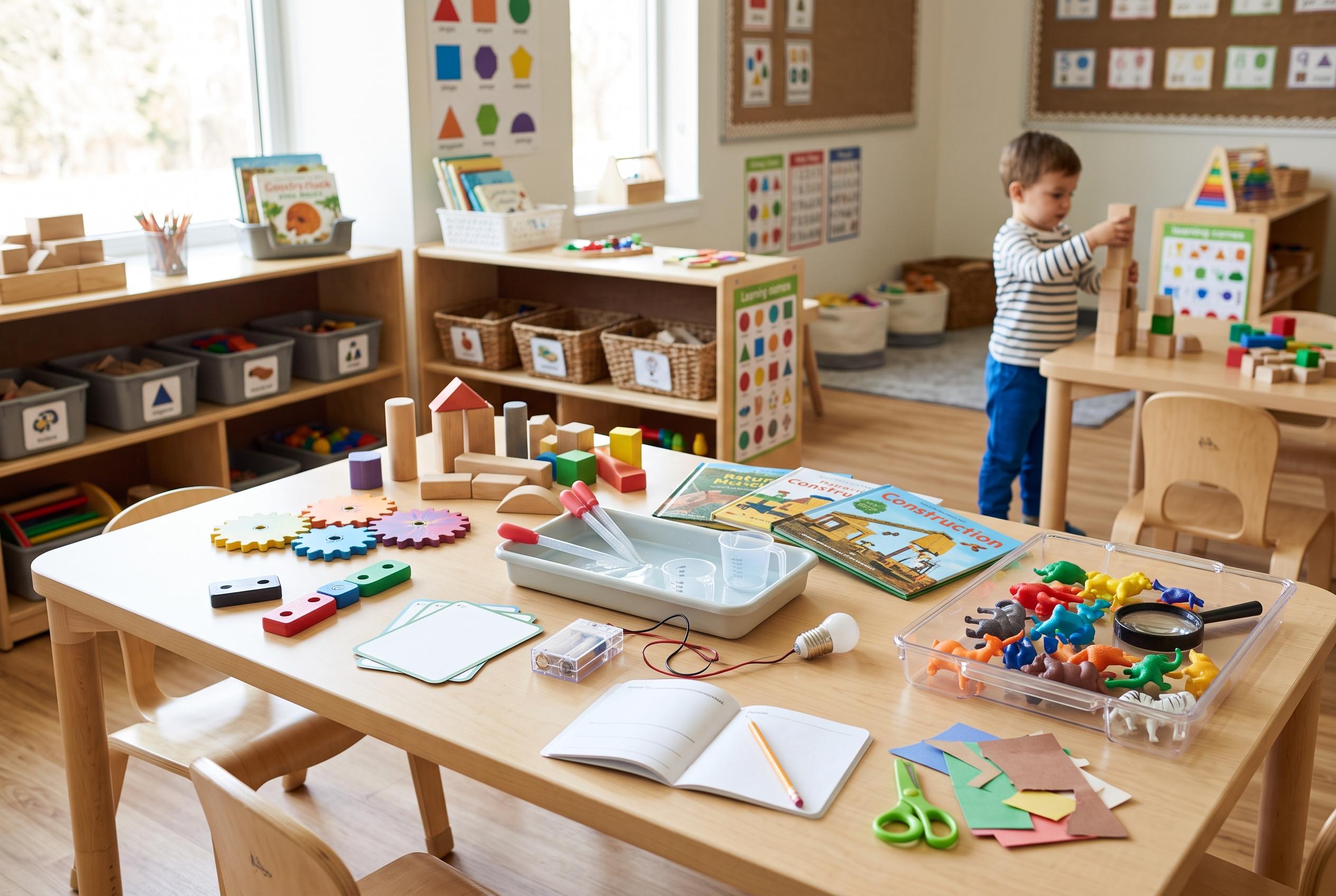

A growing shift towards STEAM-focused early years programmes encourages play-based discovery that fosters critical skills, social-emotional growth, and school readiness, setting children on a path for lifelong learning without the need for expensive equipment.
Parents increasingly want early education that does more than teach letters and numbers, and that is where STEAM has gained ground. The approach, which combines science, technology, engineering, the arts and mathematics, is designed to channel children’s natural curiosity into structured exploration. Rather than pushing formal academic work on very young pupils, it turns play into a way of building habits that support later learning, from asking questions to testing ideas and trying again.
In practice, a STEAM preschool looks less like a classroom of miniature technicians and more like a carefully planned environment for discovery. A child stacking blocks is already learning about balance and shape; a child pouring water is beginning to understand measurement and cause and effect. Research and education guides on early-years STEAM consistently point to the value of hands-on, experiential learning, while a recent study in Springer found that bringing the arts into STEM subjects can strengthen creativity, critical thinking and problem-solving in young children. Another study on STEAM-based learning materials for children aged five and six reported positive effects on critical thinking development.
The wider benefit, according to early-childhood educators, is that STEAM supports both thinking skills and social-emotional growth. Children learn to make predictions, cope with setbacks and revise their work when something does not go to plan. That process helps build resilience and a growth mindset. The inclusion of the arts also matters, because it gives children ways to imagine alternatives, express ideas and connect logic with creativity. Several education providers and reviews have argued that this blend encourages collaboration as well as independent thinking.
For parents, the appeal is practical as well as philosophical. A STEAM-focused nursery or preschool may help ease the move into more formal schooling by developing attention, language, spatial awareness and confidence. The article’s broader message is that these foundations do not depend on expensive equipment or advanced lessons. Everyday routines, from cooking to outdoor walks and building with household materials, can reinforce the same habits at home. The result, advocates say, is not simply school readiness but a stronger base for lifelong learning.
Disclaimer: This content is for informational purposes only and is not intended to be a substitute for professional medical judgment, advice, diagnosis, or treatment.