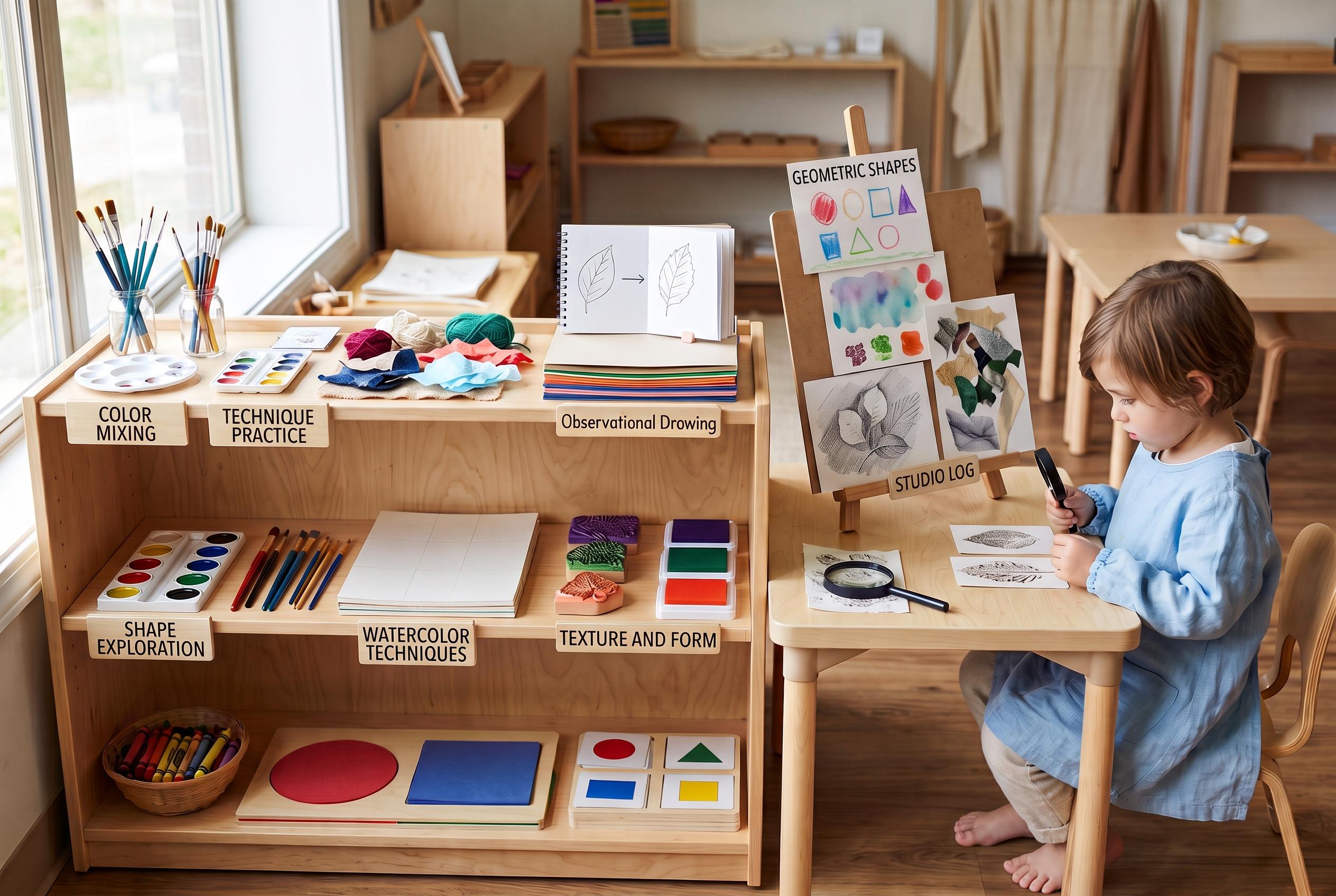

A new approach to teaching visual arts in Montessori classrooms emphasises skill progression and observation over innate talent, offering a clear, developmental framework that enhances independent learning.
A Montessori guide does not need to be a skilled painter or draughtsman to teach visual arts well. The real requirement, according to Montessori-Art.com, is not personal flair but an understanding of how children develop, how materials behave and how to observe work without judging the finished image. In that sense, art teaching sits alongside language, mathematics and practical life: it depends on sequence, not talent.
What often makes art feel difficult in Montessori settings is the absence of a clear curriculum. Montessori-Art.com says many training programmes give teachers detailed albums for other areas, yet leave visual arts underdeveloped, which can push classrooms towards seasonal crafts, holiday activities and other disconnected projects. That approach can undermine Montessori principles because it puts the product first and leaves children without a logical progression of skills.
The stronger alternative is a developmental framework. The same source argues that visual arts should be organised around distinct areas such as drawing, painting, colour work, clay modelling and craft, with each presentation building on the last. Rather than asking what the class should make, guides should ask which motor or perceptual skill a child is practising, what came before, what should follow next and what signs of growth to watch for.
This is where many non-artists can become particularly effective. Montessori-Art.com says teachers who are not focused on their own technique are often better at protecting concentration, watching how a child uses a brush or pencil and treating early scribbles as meaningful stages rather than mistakes. That approach also fits broader Montessori thinking, which places observation at the centre of teaching and views development as unfolding in recognisable planes and sensitive periods.
The absence of artistic confidence, then, is not the real barrier. The deeper issue is whether an adult can prepare a setting where materials are accessible, demonstrations are brief and children can repeat work independently. According to Montessori-Art.com, when art is taught as a sequence of skills rather than a themed activity, it becomes a genuine part of the prepared environment instead of an occasional add-on.
Disclaimer: This content is for informational purposes only and is not intended to be a substitute for professional medical judgment, advice, diagnosis, or treatment.