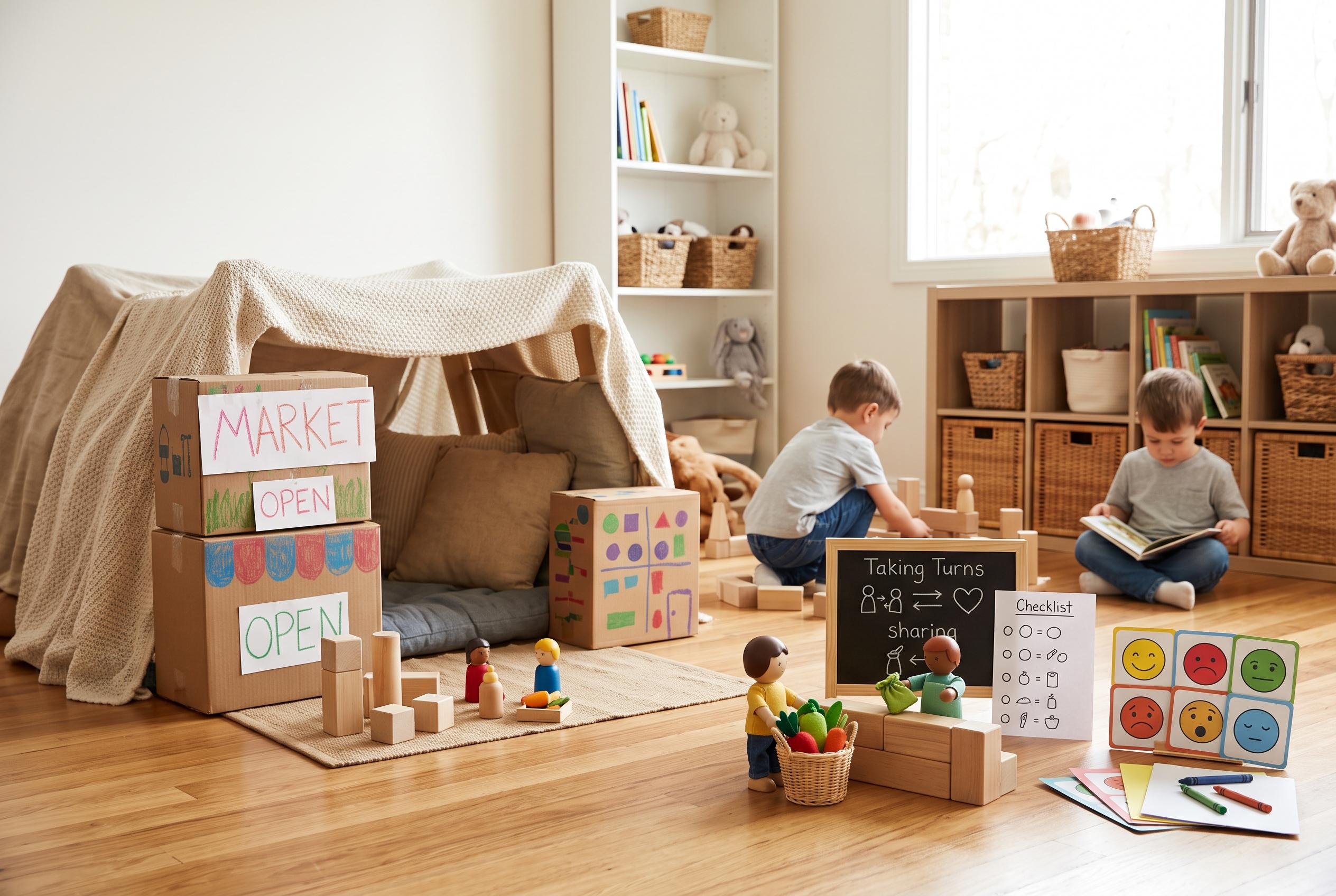

New evidence highlights how imaginative play not only fuels children’s creativity but also fosters vital social, emotional, and cognitive skills, using everyday objects and open-ended scenarios to support their growth.
Imaginative play is more than a way to pass the time. It gives children a chance to turn what they see every day into stories, roles and make-believe worlds of their own. A trip to the doctor, a shopping run or a journey to the airport can all become the basis for new games, helping children rehearse real-life experiences while making sense of them in their own way. The American Academy of Paediatrics says pretend play can support language, social interaction and thinking skills, while also helping children practise how to respond to the people and situations around them.
One of the strengths of pretend play is its flexibility. A stuffed animal can be a patient, a pupil or a travelling companion; a cardboard box can become a boat, a car or a rocket. That open-ended quality encourages children to think creatively and adapt quickly as the story changes. Healthline notes that imaginative play can also support emotional resilience and help lower anxiety, while the LEGO Group says open-ended toys and simple household items often give children more room to invent their own ideas.
Pretend play also helps children explore language and perspective. As they invent characters, settings and plotlines, they practise explaining what is happening and what might happen next. Asking simple prompts such as where a character is going or what they do next can extend the game without taking it over. The British Council says this kind of play helps children see situations from different angles and can support problem-solving and self-regulation, while Healthline links it to stronger emotional competence.
When children play with others, the learning becomes social as well as imaginative. They have to agree on roles, share space, take turns and work through disagreements, all of which help build cooperation. The American Academy of Paediatrics and the LEGO Group both point out that pretend play can strengthen social skills and communication because children must negotiate how their shared world works as they go along.
Imaginative play can also help children handle feelings that may be hard to talk about directly. Through make-believe, they can act out fear, excitement, disappointment or friendship problems at a safe distance. Healthline says this kind of play can support emotional resilience, while the British Council notes that role play can give children repeated chances to practise coping and self-control. For parents, the key is often to listen first and let the child guide the story.
The best part is that families do not need special equipment or a carefully planned playroom. Everyday objects, a few books and some unstructured time can be enough to get started. A blanket can become a tent, a cup can become a telescope and a toy animal can become almost anything a child imagines. The American Academy of Paediatrics and the LEGO Group both suggest that children benefit when adults follow their lead rather than directing every detail, because that leaves space for curiosity, creativity and confidence to grow.
Disclaimer: This content is for informational purposes only and is not intended to be a substitute for professional medical judgment, advice, diagnosis, or treatment.