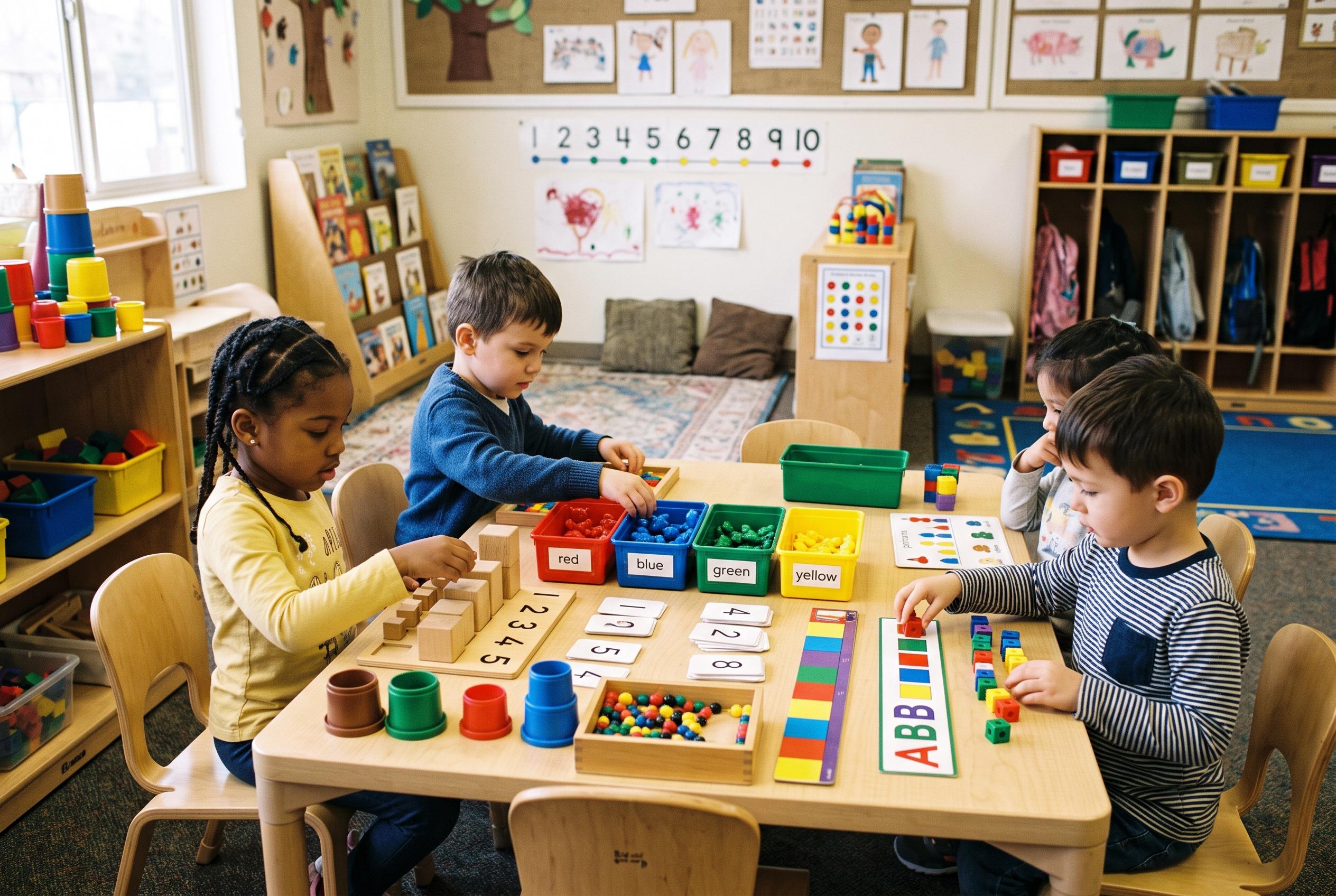

Young children grasp fundamental mathematical concepts best through playful, everyday tasks that involve real objects, pattern recognition, sorting, and measurement, rather than formal instruction.
Preschool maths works best when it feels like play. For children aged three to six, the aim is not formal instruction but early number sense: counting real objects, noticing patterns, sorting by attributes, comparing groups, and beginning to understand shapes, sequencing and measurement. The idea is simple, as Math Pyramid, Montessori Activities at Home and Education.com all suggest: young children learn these concepts more readily through hands-on tasks than through abstract explanation.
Everyday materials are often enough. Blocks, buttons, dice, pom-poms, toy animals, measuring cups and crayons can all become part of a short maths activity. Children can count objects one by one, match numerals to quantities, or roll a die and find the same number on a card. Montessori-inspired activities such as button trays and number hunts build the same skills while keeping the work concrete and familiar.
A key step is one-to-one correspondence, which means matching each number word to one object. That is why moving counters into a cup, placing one block on each square of a ten frame, or laying out counters beside a number card can be so effective. Repetition matters too: a child may count pom-poms one day, search for numbers the next and sort counters later in the week, all while strengthening the same underlying skill.
Sorting and comparing are equally important. Preschool Toolkit notes that children can sort by colour, size, texture or weight, while also learning useful language such as more, less, same, heavier and lighter. A balance scale makes comparison visible, and simple tower-building games help children see which structure is taller, shorter or equal in height. These activities also encourage observation and problem-solving, not just counting.
Measurement and sequencing fit naturally into this stage of learning as well. Children can compare crayons for length, use cubes as informal measuring tools, or scoop and pour to explore capacity. Sequencing tasks, such as ordering picture cards for getting dressed or planting a seed, help children practise first, next, then and last. These routines mirror the kind of simple, structured learning praised by curriculum providers such as Math Pyramid and hands-on activity sites such as Bhanzu and Amabile School of Music.
Shapes and simple games round out the picture. Preschoolers can hunt for circles, squares, triangles and rectangles in the home or classroom, then trace, build or sort them using pattern blocks. Matching games, roll-and-colour activities and memory-style number games add practice without feeling like work. The broader lesson, reflected across the sources, is that preschool maths does not need worksheets to be effective: short, repeated activities using familiar objects can give young children a strong start.
Disclaimer: This content is for informational purposes only and is not intended to be a substitute for professional medical judgment, advice, diagnosis, or treatment.