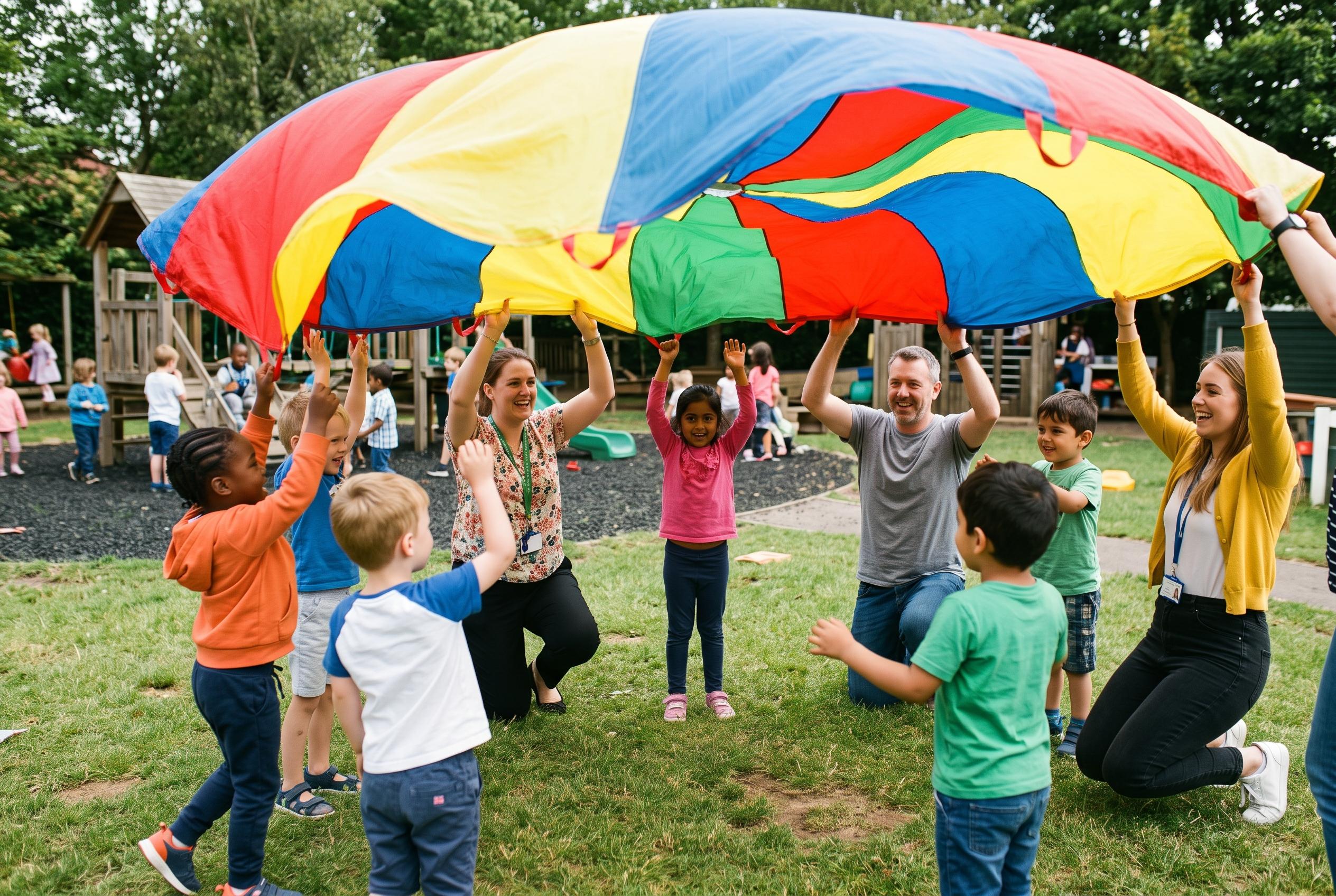

Parachute play continues to be a versatile and essential activity in early years settings, offering adaptable, low-cost options to promote motor skills, teamwork, and social interaction among children of all ages.
Parachute play remains a reliable favourite in early years settings because it turns simple movement into group cooperation. Kids Activities Blog says the appeal is not just the novelty of the fabric itself, but the range of skills it can support, from gross motor development and hand-eye coordination to communication and imaginative play. It also works for mixed-age groups and can be scaled up or down depending on how many children are involved.
One of the reasons parachute activities endure is their flexibility. According to early childhood activity guides from Gryphon House, yourtherapysource.com and SSWW, basic games can be adapted with music, rhythm, different movement patterns and props such as scarves, balloons or foam pieces. That makes the format useful not only for free play but also for structured classroom movement, where children are practising teamwork while following instructions.
Some of the easiest activities need very little specialist equipment. A coffee filter, a LEGO figure, paper, tape or a plastic egg can be turned into a simple parachute-style experiment that introduces children to air resistance and how different shapes fall. These small-scale projects can be especially helpful indoors, where a full-size parachute may not be practical, but the same ideas still teach balance, timing and cause and effect.
Other games focus more directly on group movement. Teaching children to lift, shake or lower the parachute together helps build rhythm and coordination, while games that keep balls or toys moving across the surface encourage turn-taking and shared attention. One variation described by Gryphon House uses a familiar song to guide the action, while other activities encourage children to suggest their own movements, which can make the play more engaging for preschoolers.
For parents and caregivers, the main attraction is how easily parachute play can be turned into an active, low-cost group game. A sheet or light blanket can stand in for a parachute if needed, and the same basic idea can be used for colour sorting, tossing soft toys or seasonal outdoor games. For young children, that mix of movement, social interaction and playful learning is often what makes parachute activities so effective.
Disclaimer: This content is for informational purposes only and is not intended to be a substitute for professional medical judgment, advice, diagnosis, or treatment.