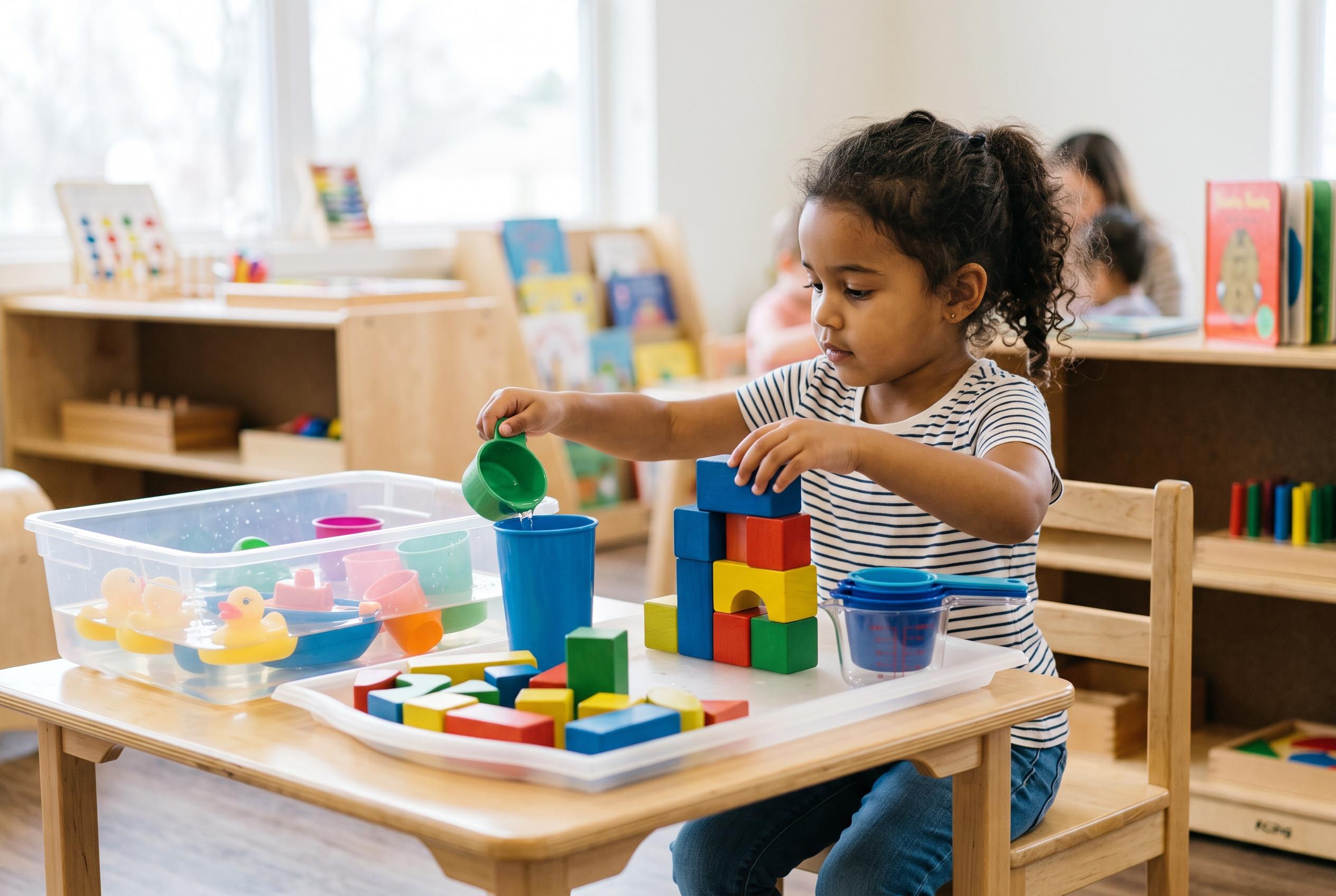

Simple, hands-on activities using familiar objects foster curiosity and problem-solving skills in preschool children, integrating science, technology, engineering, and maths into play-based learning.
Preschool STEM works best when it looks like play, not a lesson. For children aged 3 to 5, the most useful activities are simple, hands-on and built around familiar objects such as blocks, cardboard, cups, craft sticks, toy cars and recycled materials. The goal is to help children ask questions, test ideas, compare results and try again, rather than memorise technical terms. According to Little Bins for Little Hands, that everyday curiosity is the heart of early STEM learning.
The four letters in STEM stand for science, technology, engineering and maths, but in the preschool years each part can be folded into ordinary play. Science is observing and testing. Technology can mean using a tool to complete a task. Engineering is designing, building and improving. Maths appears when children count, measure, sort, compare shapes or look for patterns. The site notes that a child stacking blocks, rolling a car down a ramp or figuring out why a tower falls is already doing STEM.
ChildcareED says the best preschool STEM moments happen when a child notices something, makes a guess, tests it and talks about the result. That approach fits well with short, safe and repeatable activities, especially ones that can be done with kitchen or craft supplies. Messy play is part of the process, not a mistake, because it gives children more to observe and compare.
Engineering activities are often the easiest place to start. Preschoolers naturally enjoy building, so a challenge such as making a bridge for a toy car, a fence for animals, a garage with parking spaces or a shelter for a toy animal can quickly become a problem-solving exercise. Science Buddies and Creative Children’s Center both highlight building tasks and simple experiments such as ramps, bird feeders and sink-or-float activities as effective ways to introduce young children to STEM thinking.
Math can be built into the same activities without making them feel formal. Children can count blocks in a tower, compare which bridge is longer, measure a ramp, sort objects by shape or create repeating patterns with buttons or cars. The Little Bins for Little Hands guide suggests using questions such as “Which one worked better?” or “How could you make it stronger?” to keep the focus on reasoning rather than giving step-by-step instructions.
Technology for preschoolers does not have to involve screens. It can simply mean using a tool to make a job easier, such as a ruler, magnifying glass, funnel, dropper, scale, timer or pair of tweezers. That same idea carries into STEAM, which adds art to the mix. Colour mixing, bubble painting, blow art and shape stamping all give children a chance to see cause and effect while making creative choices about colour, motion and design.
The most practical preschool STEM activities are the ones that can be repeated in different ways. A ramp can be raised or lowered, a bridge can be rebuilt with different materials, and a tower can be tested again after a change. According to the sources, that cycle of plan, build, test and improve is what matters most. For parents and caregivers, the simplest rule is also the most useful: offer open-ended materials, ask a few curious questions and let children explore.
Disclaimer: This content is for informational purposes only and is not intended to be a substitute for professional medical judgment, advice, diagnosis, or treatment.