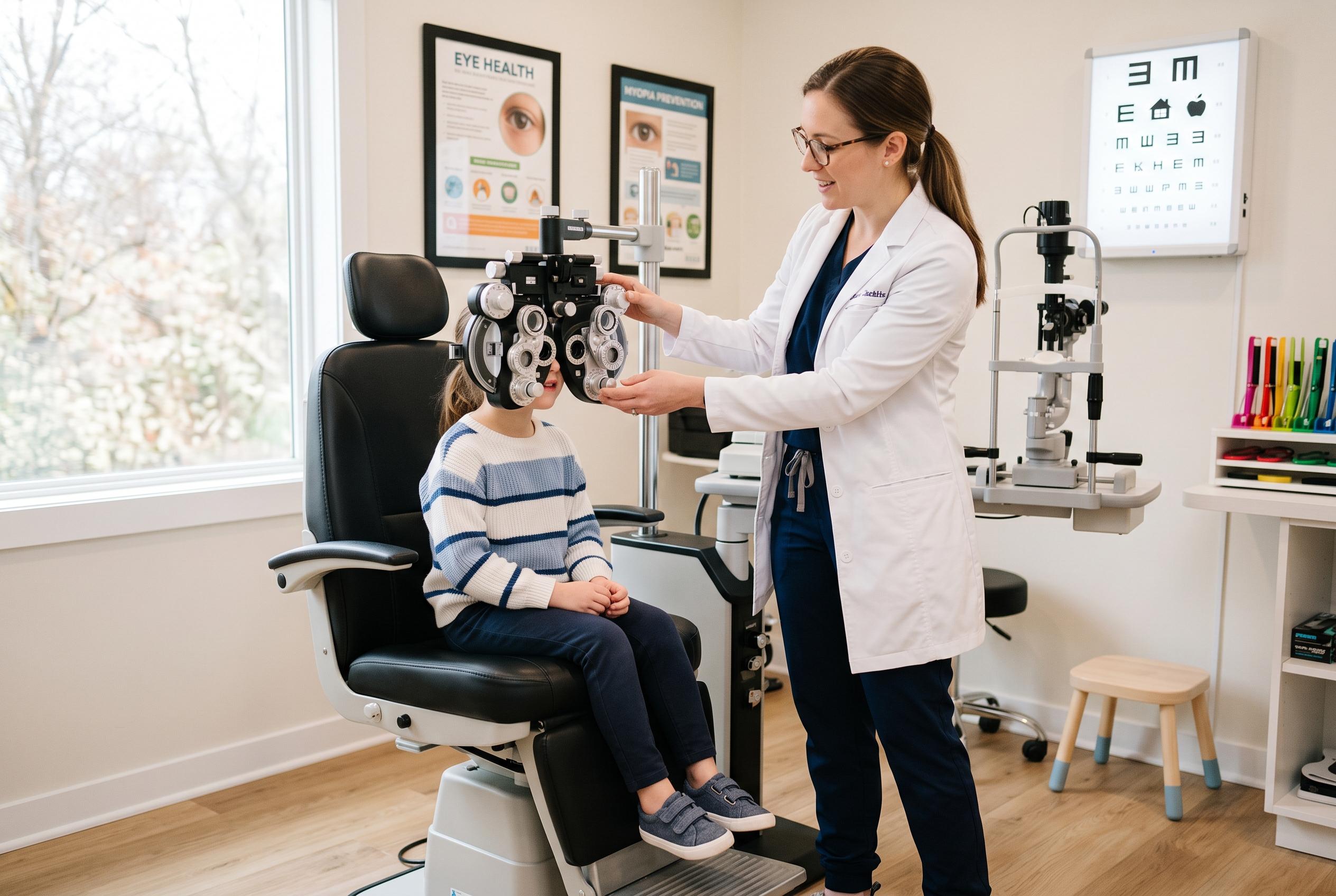

As children return to school, experts emphasise the importance of early eye examinations amid rising rates of myopia linked to increased screen time and decreased outdoor activity, with potential impacts on learning and development.
As the school year begins, vision is one of the most overlooked parts of a child’s preparation. Parents often focus on uniforms, stationery and books, yet clear sight can be just as important to classroom performance, confidence and day-to-day development. The Centres for Disease Control and Prevention says uncorrected vision problems can interfere with learning and that routine eye examinations help support academic success.
One condition drawing particular concern is myopia, or short-sightedness, which allows children to see close objects clearly but makes distant objects blurry. The National Eye Institute says myopia is increasing among children and happens when the eye grows too long from front to back. Research reviewed by the National Center for Biotechnology Information links the rise to more screen time, more close-up work and less time outdoors.
The problem is that children do not always realise they are struggling. A child may squint at the board, sit too close to the television, hold a book or phone very near their face or complain of headaches and blurred vision. Vision Plus Mag quoted Dr Amod Nayak of Dr Agarwals Eye Hospitals in Bengaluru as saying that parents often assume a child who does not complain must be seeing normally, when in fact children may adapt to changes and fail to notice them.
That matters because untreated vision problems can have consequences beyond the eyes. A systematic review in the National Library of Medicine found that refractive errors, including myopia, can be linked to learning difficulties, behaviour issues and weaker academic performance. The CDC likewise says early detection and treatment are important because sight affects a child’s broader educational potential.
Experts say simple habits can help protect children’s eyes. More time outdoors, less unbroken screen use and regular breaks from close work are all encouraged. One widely used approach is the 20-20-20 rule: every 20 minutes, look at something 20 feet away for 20 seconds. Dr Rahul Jain of Dr Jain’s Eye Clinic told Vision Plus Mag that eye health should be treated with the same seriousness as other back-to-school essentials.
Public-health research also suggests the issue is large and growing. The National Eye Institute says about 41.6% of Americans are nearsighted, up from 25% in 1971, while studies in the National Library of Medicine show especially high rates among children in East and South-East Asia. The message for families is simple: an eye test before term starts can help spot problems early and give children the visual support they need to learn comfortably.
Disclaimer: This content is for informational purposes only and is not intended to be a substitute for professional medical judgment, advice, diagnosis, or treatment.