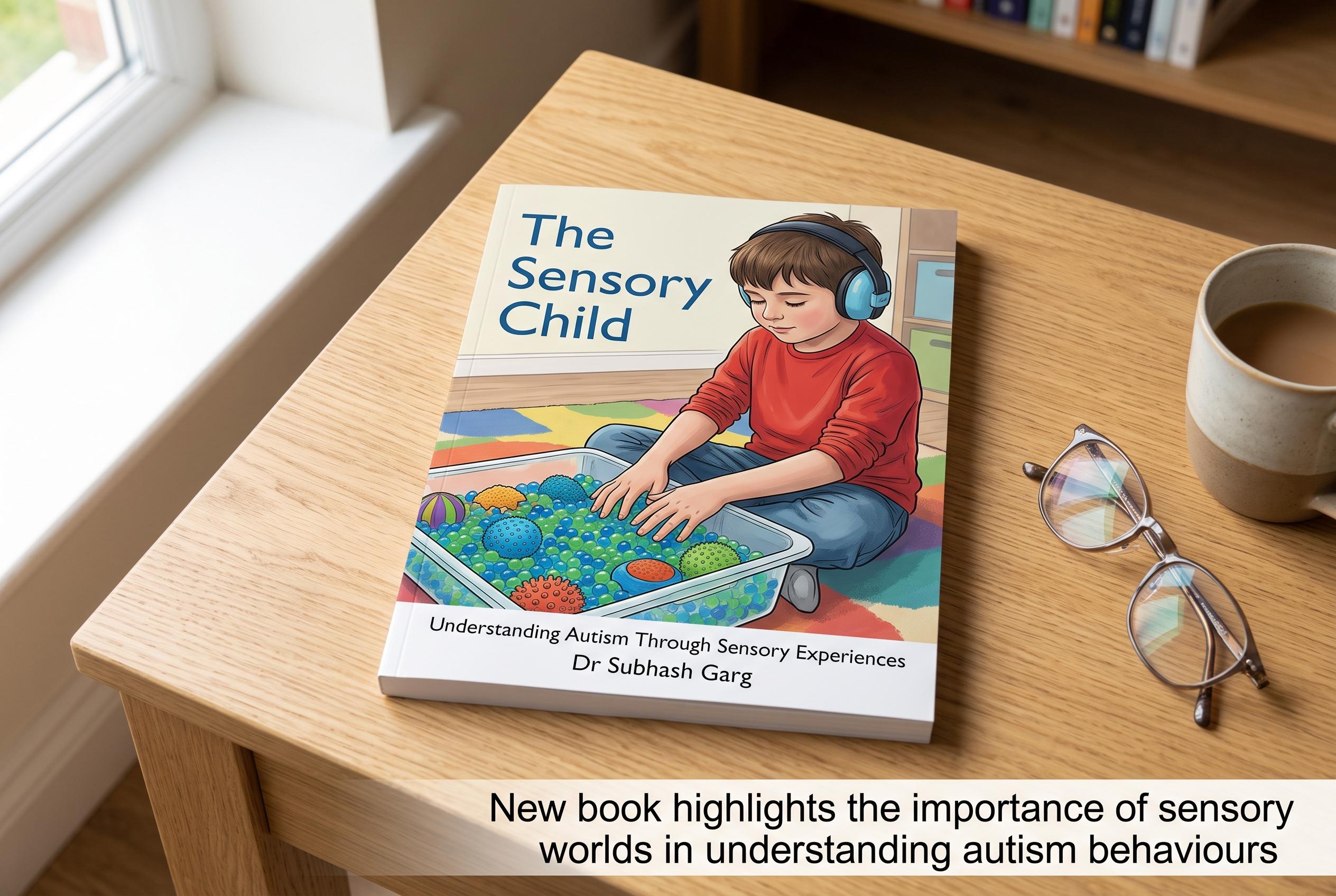

Dr Subhash Garg’s latest publication, The Sensory Child, challenges conventional perceptions of autistic behaviour by emphasising the crucial role of sensory experiences, offering a practical guide for better support and understanding.
Dr Subhash Garg’s new book argues that autistic behaviour cannot be understood properly without first understanding the sensory world a child is living in. The Sensory Child: A Practical Guide to Understanding Autism Spectrum Beyond Behaviour, published by AGPH Books, was launched in Indore on Tuesday and aims to help parents, teachers and caregivers look past surface behaviour to the triggers beneath it.
The central idea is straightforward: what can look like defiance, distress or withdrawal may instead be a response to sound, touch, light, food, movement or other sensory input. The National Autistic Society says autistic people may experience sensory information as either heightened or reduced, while Autism Central, a National Health Service resource, notes that these differences can affect how children manage daily life and need to be factored into support. Garg’s book builds on that understanding by urging readers to ask not just what a child is doing, but what the child may be experiencing.
That emphasis reflects wider research. A review in Pediatric Research found that atypical sensory responses in autism are common and can involve auditory, tactile and visual stimuli, while Nature Index has described sensory profiles in autism as varied and closely linked to development and everyday functioning. Medical News Today has also noted that sensory difficulties can appear in autism and in sensory processing disorder, though the two are not the same diagnosis. In that context, Garg’s message is less about labelling every challenging moment and more about recognising that behaviour often has a sensory dimension.
The book is presented as a practical guide rather than a clinical manual. It is meant to help families make sense of routine struggles, from food aversions and sleep problems to overwhelm in busy environments, without reducing a child to a checklist of behaviours. By placing sensory processing at the centre of the conversation, The Sensory Child seeks to offer a more humane and useful way of supporting autistic children in daily life.
Disclaimer: This content is for informational purposes only and is not intended to be a substitute for professional medical judgment, advice, diagnosis, or treatment.