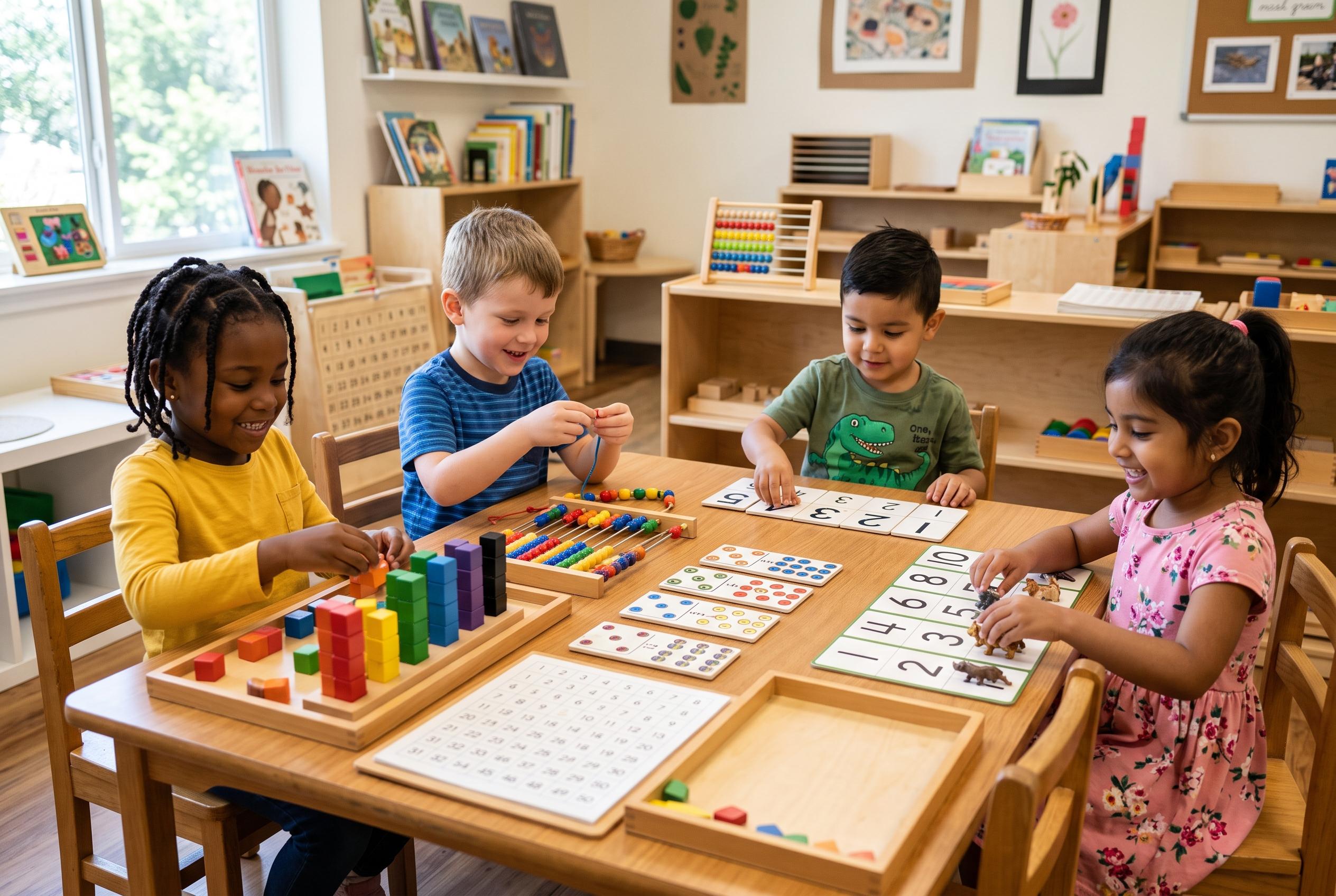

Research emphasises the importance of tactile, conversational, and routine-based learning to foster intuitive understanding of numbers in young children, highlighting practical strategies for educators to strengthen early numeracy skills beyond rote memorisation.
A child may be able to recite numbers to 20 without grasping what they stand for, and that gap matters. In early maths, number sense is less about speed or memorisation than about helping children connect numerals with quantities, relationships and meaning. Researchers and teaching guides alike describe it as a flexible, intuitive understanding of how numbers work, built through counting, comparing, estimating and seeing how numbers can be broken apart and put back together.
That understanding develops best through hands-on experience. Stanford’s pre-kindergarten and kindergarten materials note that number sense grows over time when children are encouraged to think about, explore and discuss mathematical ideas, while practical classroom guides stress that manipulatives, games and number talks do far more than worksheets alone. In other words, children need repeated chances to touch, move, see and talk about numbers before they can be expected to write them confidently.
The most effective teaching often begins in ordinary routines. Counting the children at a table, the crayons in a tray or the steps to the playground gives pupils regular practice with one-to-one correspondence, the idea that each number word matches one object. Teachers can strengthen that skill by asking simple follow-up questions such as how many there are, what happens if one more is added or which group has more or less.
Children also need chances to build numbers in different ways. A group of 6, for example, should not be confined to a traced numeral. It can be shown with cubes, counters, fingers, playdough, tens frames or other objects, helping children understand that a number can be represented in more than one form. Teaching guides on kindergarten maths also recommend spending extra time on numbers to 5 before rushing into larger sets, because a firm grasp of small quantities supports later work with 6 to 10 and beyond.
Tools such as tens frames and subitising activities are particularly useful because they help children see quantity at a glance rather than count every item. Educators describe subitising as recognising a small group instantly, much as adults recognise the dots on a die. When children explain how they saw a number, teachers can hear whether they are thinking in parts and wholes, such as 2 and 2 or 5 and 2, rather than simply reciting count order.
Number sense also grows through comparison, conversation and repetition. Asking children to compare two groups using words such as more, less and equal builds the idea of magnitude, while short math talks give them a low-pressure way to explain what they notice. Guidance from kindergarten and preschool resources consistently points to the same conclusion: a few minutes of purposeful practice each day, woven into centres, whole-group talk and small-group work, can do more for early numeracy than a long worksheet ever will.
For children who are struggling, the answer is usually to step backwards into concrete experience. If a child cannot understand 7 on paper, seven counters, seven movements or seven dots arranged in a frame can help bridge the gap. The sequence matters: build it, see it, talk about it, draw it and only then write it. That progression, not speed, is what turns counting into true number understanding.
Disclaimer: This content is for informational purposes only and is not intended to be a substitute for professional medical judgment, advice, diagnosis, or treatment.