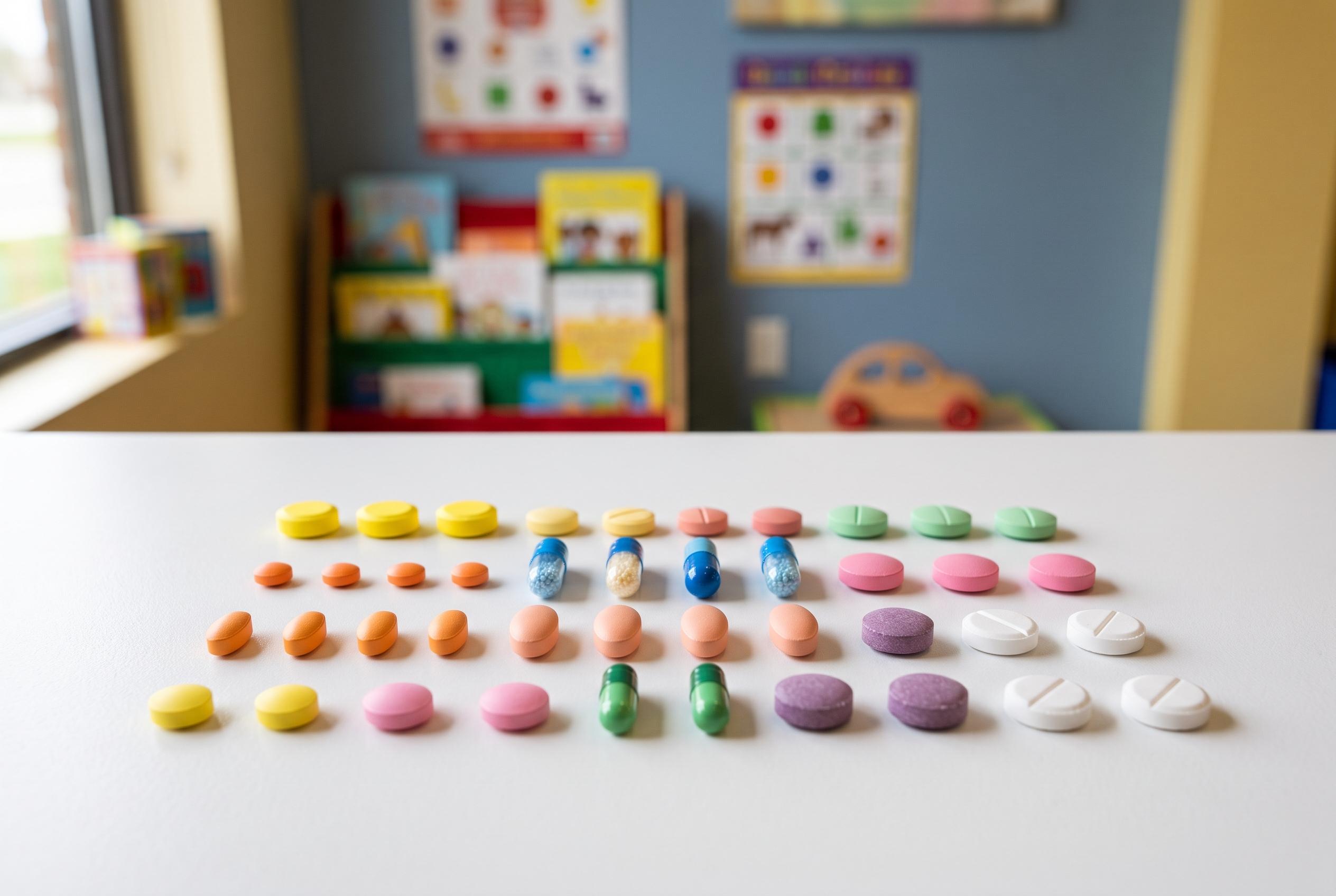

A new Israeli study finds that the visual appearance of pills, specifically size and shape, may influence children’s willingness and ability to swallow medication, highlighting a potentially overlooked factor in paediatric medicine compliance.
A new Israeli study suggests the way a pill looks may matter almost as much as what it contains when it comes to children taking medicine. Researchers at Kaplan Medical Center in Rehovot, part of Clalit Health Services, found that size and shape were the strongest visual cues shaping whether children thought they could swallow a tablet, while colour and transparency had little effect.
The work, published in the Journal of Child Health Care and presented at the Annual Israeli Conference of Otolaryngology, surveyed 50 children and teenagers aged 8 to 15. Half had already learned to swallow pills, while the rest had never managed it or still struggled. Rather than asking them to take medicine, the researchers showed photographs of 44 common paediatric drugs and asked the children to judge how hard each would be to swallow.
Their answers pointed to a clear pattern: bigger pills were seen as harder, and long tablets were judged more difficult than round ones of similar volume. Children with little or no pill-swallowing experience found every tablet more intimidating than those who had succeeded before, but both groups broadly agreed on which shapes looked easier. That fits with earlier research, including a feasibility study in children aged 4 to 12 that found 8 mm tablets were the most acceptable size overall, and a separate review of U.S. paediatric medicines showing that tablet sizes vary widely across common drugs.
The findings also echo older work on pill expectations, which found that shape can strongly influence how hard a tablet seems to swallow, and a larger U.S. study published in BMJ Open that linked the physical properties of oral medicines, especially size and shape, with adherence problems. In practice, that matters because children who cannot swallow tablets are often given liquid versions instead, even when pills may be more suitable, or have tablets crushed, which can affect dose accuracy and how the medicine works.
Dr Yael Shapira Galitz, who led the study, said the first barrier to adherence may be visual rather than chemical. Clinical pharmacist Dotan Shaniv said many medicines are available in several generic forms with the same active ingredient, meaning a pharmacist may be able to suggest a smaller or more manageable version. The researchers argue that pharmaceutical manufacturers should pay more attention to physical design, not just formulation, because a rounder or smaller tablet could make treatment easier for families and improve the chances that children take their medicine as prescribed.
Disclaimer: This content is for informational purposes only and is not intended to be a substitute for professional medical judgment, advice, diagnosis, or treatment.