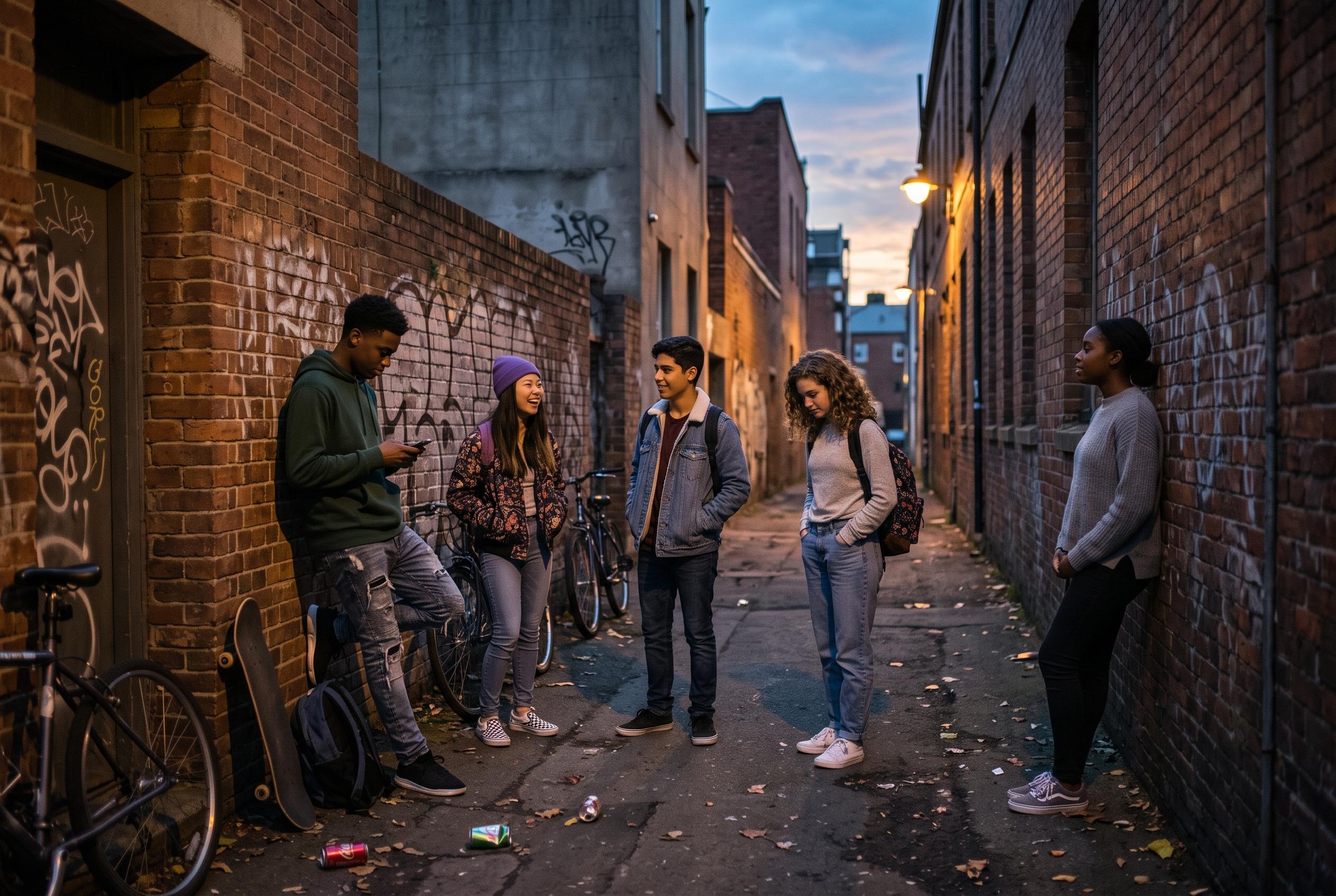

A global study involving over 58,000 teenagers reveals that more unstructured free time outside of supervised activities is associated with higher rates of offending and victimisation, prompting calls for better recreational and online safeguards.
A large international study has found that adolescents who spend more time in unstructured free time are more likely to report offending and exposure to violence, adding weight to arguments that how young people spend their hours outside school matters as much as how much free time they have.
The research, published in PLOS ONE in May, drew on anonymous survey data from 58,425 adolescents aged 13 to 17 in 21 countries across Europe, North America and South America. According to the study summary on PubMed, unstructured out-of-home time was the clearest and most consistent predictor of self-reported offending, while structured time at home was linked to lower levels of offending.
Marina Rezende Bazon, a psychologist and professor at the University of São Paulo’s Ribeirão Preto faculty, said the findings show that unstructured free time is a key factor in understanding youth involvement in violence. She described it as the period when teenagers choose what to do without adult supervision or organised activity, whether that means being at home online or spending time in streets, neighbourhoods or other public spaces.
The Brazilian team in the International Self-Report Delinquency Study surveyed about 1,900 students in Ribeirão Preto and Sertãozinho. The consortium uses anonymous questionnaires rather than police records, a method researchers say captures behaviour that often never reaches official statistics. The survey also examined victimisation, including offences linked to race, religion, sexual orientation and physical appearance, both in person and online.
Among the more striking findings was a rise in girls’ participation in online offences, particularly those targeting physical appearance. Bazon said that may reflect changes in supervision, with online life narrowing some of the differences between boys and girls. The study also found that girls were more likely to fall into a victim-offender overlap group, in which young people both suffer violence and commit it, and that this group showed stronger signs of psychological distress, family problems and academic difficulty.
The researchers said the strongest single predictor of offending remained association with delinquent peers, but unstructured free time was a close second and mattered across countries. Their simulation analysis suggested that a modest reduction in unstructured out-of-home time could be associated with lower offending levels. Bazon argued that the findings support wider access to recreational, sporting and cultural programmes that are genuinely attractive to teenagers, while also pointing to the need for better digital supervision, online protection and platform accountability.
The study also cautioned that the most vulnerable young people may be undercounted because it did not include those out of school or in the youth justice system. Bazon said prolonged school dropout is now one of the clearest signs of vulnerability, and noted that youth violence cuts across social class even if poorer teenagers are more heavily policed and more likely to be institutionalised. The consortium is now preparing a fifth wave of research, with plans to look more closely at misogyny, online hate and adverse childhood experiences.
Disclaimer: This content is for informational purposes only and is not intended to be a substitute for professional medical judgment, advice, diagnosis, or treatment.