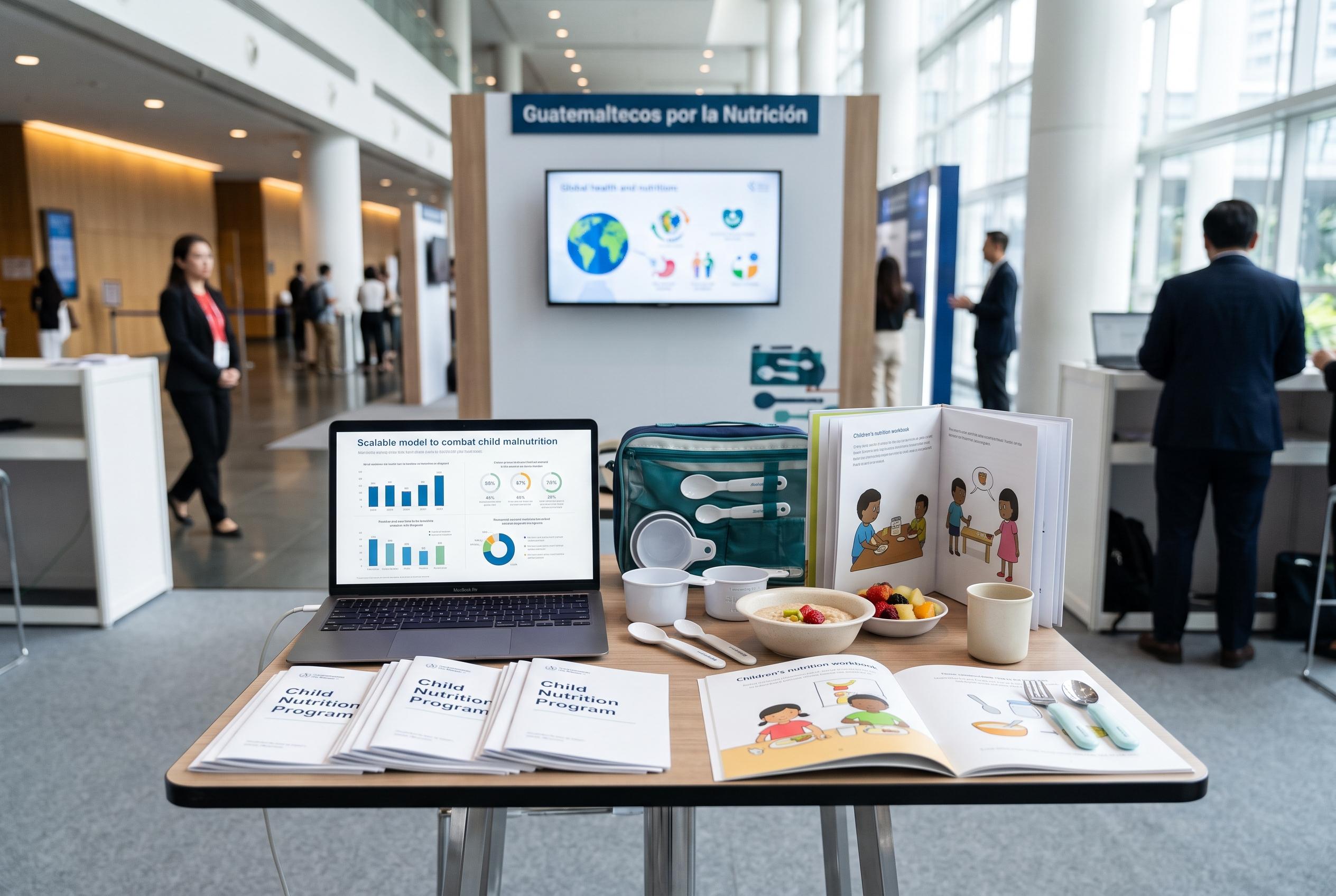

Guatemaltecos por la Nutrición, backed by Castillo Hermanos, presented its innovative approach to reducing child malnutrition at the Public Health World Conference 2026 in Singapore, gaining international recognition for its impactful results and scalable strategy.
Guatemaltecos por la Nutrición, the social programme funded by Castillo Hermanos, used a presentation at the Public Health World Conference 2026 in Singapore to showcase what it describes as a scalable model for tackling child malnutrition in rural Guatemala. The event, held from July 17 to 19, brought the initiative before public health researchers and international specialists, giving it a platform far beyond its usual operating area.
The presentation was delivered by Diego Monzón, the programme’s technical deputy director, who took part as a keynote speaker on the scaling of integrated health systems built around processes. Monzón said the international forum showed that sustainable responses to undernutrition are possible when the problem is addressed at its roots.
The programme’s figures are central to that case. According to earlier reporting on the initiative, acute malnutrition among children under 5 in the communities it serves has fallen from 6% to 0.38% through mobile camps and a broader approach that combines health care with clean water, sanitation and related support. The organisation has also reported a 17 percentage-point drop in chronic malnutrition, alongside gains in maternal health, early childhood development and access to better living conditions.
The conference appearance follows a year in which the programme has pushed to broaden its reach and funding base. In February, Castillo Hermanos organised a charity race in Guatemala City that drew more than 2,500 participants and was intended to support improvements for 2,000 participating families, including latrines, improved stoves, healthier flooring and rainwater collection systems. The programme says it was launched in 2022 with an initial investment of $15 million and now works in vulnerable communities in Huehuetenango, reaching more than 5,500 families and 15,000 people.
The initiative said its research was included in the conference’s official abstract book, placing it alongside academics and practitioners from institutions including Stanford, UC San Francisco and Simon Fraser University. José Silva, the programme’s executive director, said the participation helped position Guatemala within a wider global discussion on how innovative anti-malnutrition strategies might be adapted elsewhere.
Disclaimer: This content is for informational purposes only and is not intended to be a substitute for professional medical judgment, advice, diagnosis, or treatment.