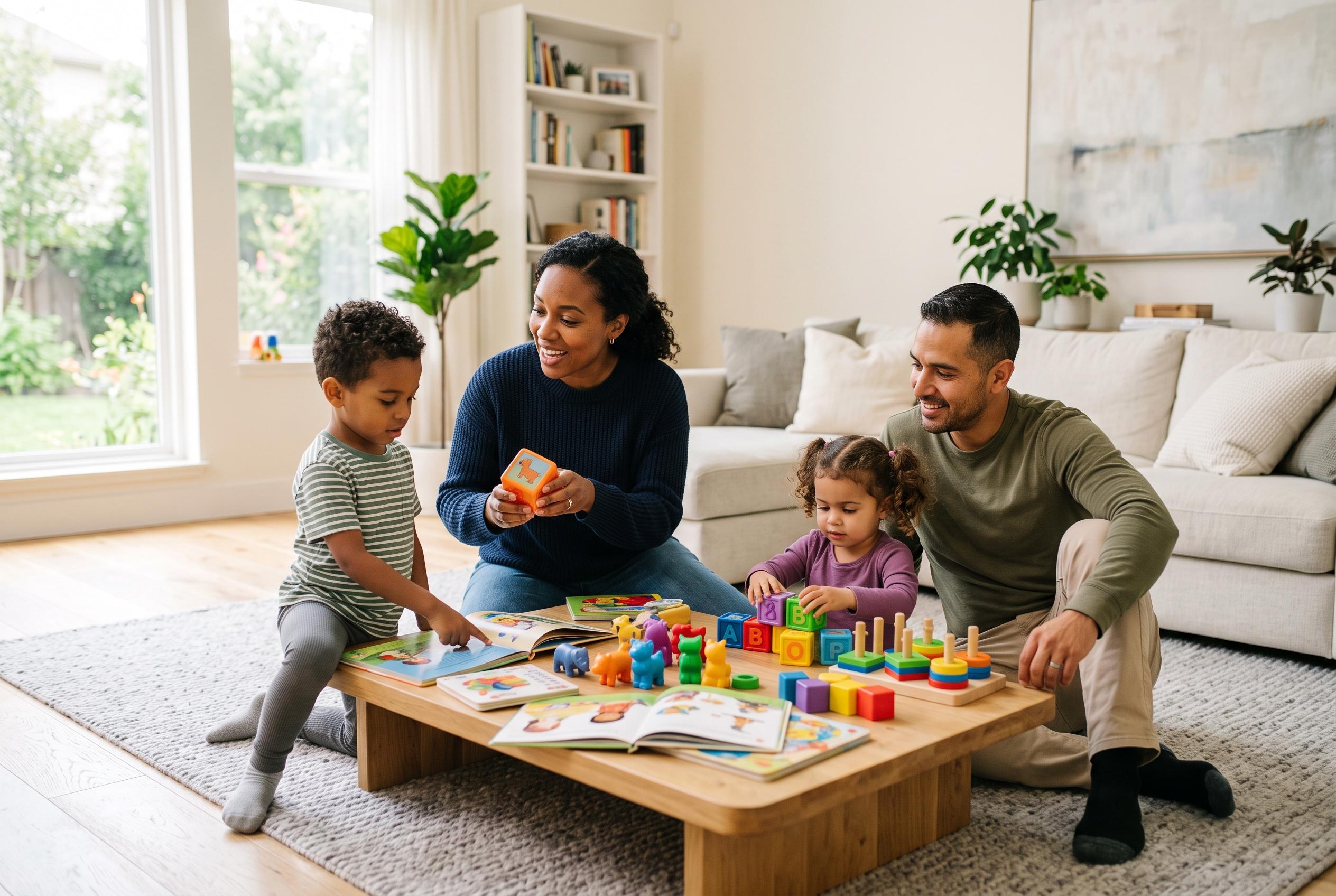

Research and practical experience show that playful, interactive games can significantly enhance young children’s language skills, offering a gentle alternative to formal lessons.
For parents looking to build early language skills without turning the living room into a classroom, the basic lesson from several education and speech-development guides is clear: children learn best when they are playing, not being quizzed. Fay School, KLA Schools and Speech Blubs all point to simple, interactive games as a practical way to build vocabulary, sentence structure and confidence in speaking. Research on game-based learning backs that up, with studies suggesting that playful, repeated practice can support language growth in young children.
That theory came to life in one family’s four-week experiment with a four-year-old boy who could label objects but struggled to turn them into full sentences. Instead of flashcards, the household used short sessions of games, each lasting about 10 to 15 minutes, and watched closely for signs that he was talking more, using new words or asking to play again. The most reliable clue was simple enthusiasm: if he wanted the game again, it was more likely to keep working.
The strongest result came from a treasure-hunt style activity built around household objects. The child pulled items from a cloth bag, named them and gradually learned to add a sentence about each one. That format reflects the kind of hands-on, language-rich play recommended by several early-learning guides, which emphasise that children need a reason to speak if adults want longer answers. Over time, the game shifted from naming things to describing use and function, which helped build sentence structure as well as turn-taking.
A variation on that idea, the mystery bag, proved especially useful for texture words such as “soft”, “bumpy” and “sticky”. KLA Schools specifically highlights mystery-bag activities as a way to strengthen vocabulary and descriptive language, and the experiment showed why: touch-based guessing pushed the child towards words that rarely come up in everyday conversation. Even a pine cone, the account found, could do more linguistic work than a basket of familiar toys.
Other games worked less through object naming and more through listening. Freeze dance, for example, mixed movement with spoken commands so the child had to process verbs while excited, not just while calm. Speech Blubs recommends games like I Spy for the same reason: they ask children to pay attention, discriminate between clues and use descriptive language under a little pressure. In the experiment, those kinds of games helped expand action words and listening skills without feeling like formal lessons.
Digital play was not dismissed outright. One app, 123 Magic Number Fun: Math Kid, was used as a quieter, solo-style activity that still encouraged spoken language because the child repeated number words aloud and explained what he was doing. Research on mobile game-based learning and preschool educational software has found that digital games can support both language acquisition and early literacy when they are used well, although the family’s experience suggested that screen time worked best when an adult stayed nearby and kept the conversation going.
Not every game made the cut. A repetition exercise felt too much like a test and quickly lost appeal, until it was made sillier and more playful. Picture-based storytelling, by contrast, grew stronger over time because it encouraged the child to explain what was happening and why, not just to name objects on the page. That distinction matters: language gains are often greatest when children have to connect ideas, not merely repeat them. Studies of game-based instruction for preschoolers have found similar patterns, with interactive methods helping children move beyond single words towards fuller language use.
The wider lesson is less about any single game than about the conditions that make speaking worthwhile. The child talked more when language helped him win a round, solve a clue or move a story along. He talked less when adults turned speaking itself into the point. That matches what early-childhood educators advise: keep the exchange playful, model the right words without constant correction and leave pauses long enough for a child to think.
After several weeks, the clearest improvement was not mastery of a particular word list but a shift in habit. Talking became part of the game rather than a separate task. For families hoping to support early language at home, the most practical approach appears to be modest: choose a couple of games, use them often and let interest do the heavy lifting.
Disclaimer: This content is for informational purposes only and is not intended to be a substitute for professional medical judgment, advice, diagnosis, or treatment.