
The article explores how adolescent fiction like ‘Stranger Things’ mirrors teenage emotional turbulence, the role of therapy, and the lasting effects of pandemic upheaval on young people’s sense of reality and identity.
Adolescence has always been portrayed as a period of split realities, and Margot Waddell argued in her 2018 book On Adolescence that young adult fiction often moves between ordinary teenage life and a darker, stranger register shaped by fear, guilt, desire and violence. Tony Tanner made a similar point decades earlier in his study of American teen fiction, describing adolescent characters as living in an “edge-city” between opposing states: sanity and madness, fantasy and reality, intimacy and perversity. The appeal of such stories, the article suggests, is that they echo the emotional instability many young people already feel.
That idea is easy to see in Stranger Things, where the Upside Down functions as a mirrored, corrupted version of the everyday world. According to Netflix’s series description, the show follows adolescents in 1980s Hawkins as they confront supernatural forces, trauma, depression, social isolation and survivor guilt. The article argues that, even though the drama is science fiction horror, its emotional core is recognisably teenage: a place where danger, confusion and self-discovery are all tangled together.
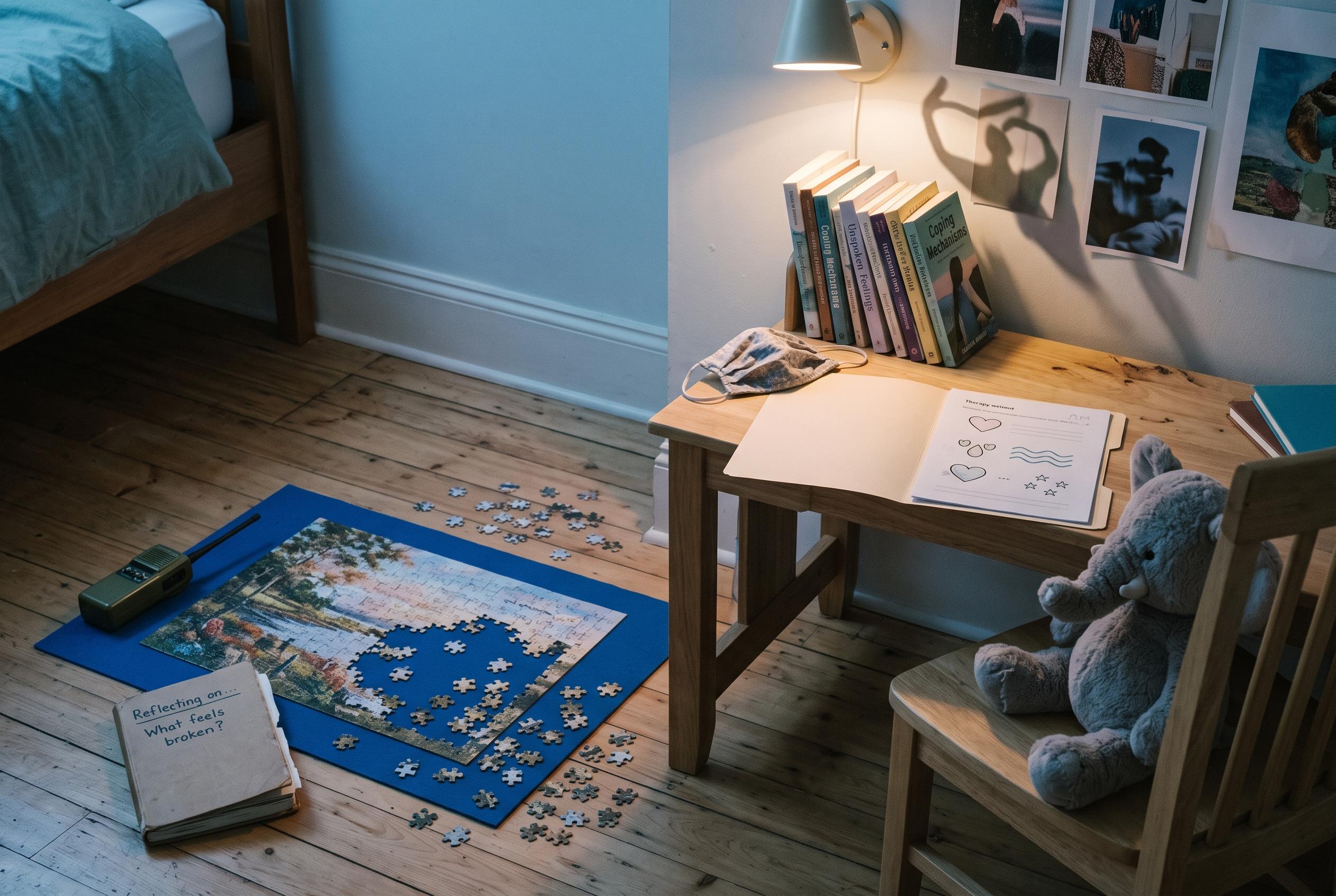
The author also links that fictional terrain to therapy. In the season four finale, Vecna’s line about finding “a means to realise my potential” is presented as an especially apt expression of adolescence, when identity can feel both fragile and expansive. The piece suggests that psychotherapy can play a similar role by helping young people make sense of themselves and move towards possibility rather than collapse.
The article then turns to a more philosophical question: whether reality is ever fully fixed. Drawing on Donald Winnicott, it argues that the external world is shaped through relationships and meaning, and that what matters must in some sense survive destructive fantasy. For adolescents, that can feel at once reassuring and frightening, because it implies that identity and connection are not simply found but made, tested and held together through love and endurance.
The pandemic, the author writes, made those uncertainties more acute. Covid-19 disrupted daily life for everyone, but Gen Z and the so-called Covid Kids experienced the upheaval during a formative stage, losing confidence in institutions and in the idea that the world is stable or reliable. Revisiting those experiences, the article says, can help young people feel more grounded, even if the process is uneasy.
Disclaimer: This content is for informational purposes only and is not intended to be a substitute for professional medical judgment, advice, diagnosis, or treatment.