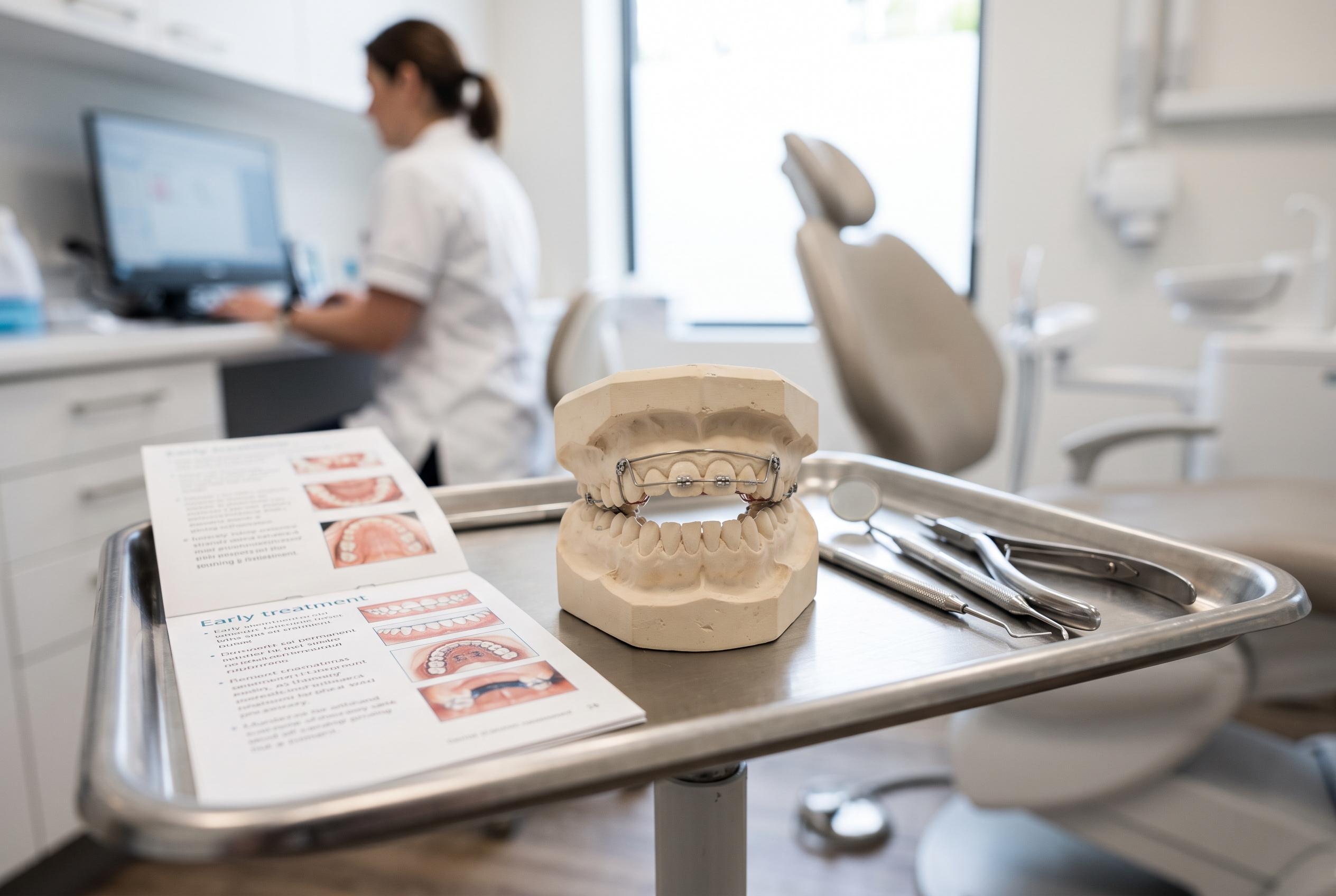

Guidelines from the American Academy of Pediatric Dentistry suggest that children can begin orthodontic treatment during mixed dentition if clinically necessary, challenging the notion that all baby teeth must be lost first.
Children do not always need to lose every baby tooth before starting orthodontic treatment. The American Academy of Pediatric Dentistry says timing should be guided by diagnosis and by the stage of dentition, which can range from primary teeth through mixed dentition, adolescence and adulthood. In practice, that means some children may begin treatment while baby teeth are still present if a specific problem is already developing.
Orthodontists typically look at eruption patterns, bite relationships, jaw growth and available space rather than counting how many baby teeth remain. The American Association of Orthodontists says treatment can begin during mixed dentition, when both primary and permanent teeth are present, and that early care is sometimes appropriate for issues such as crossbites or severe crowding. The key question is not age alone, but whether a defined orthodontic problem is already affecting function or tooth position.
Early treatment is usually aimed at a particular issue, not at making every tooth straight as quickly as possible. The AAO describes phase-one treatment as potentially involving partial braces, removable appliances or upper jaw expanders, depending on the problem being addressed. The academy’s guidance also notes that some children are simply monitored for a period of time before any active treatment begins, allowing growth and eruption to clarify the best next step.
Evidence does not support routine early treatment for every child. A 2025 systematic review and meta-analysis covering 18 studies found no consistent long-term advantage to starting universally at a younger age, though earlier care can still help when there is a clear clinical reason. That makes early braces a case-by-case decision: a child with a developing crossbite may benefit from prompt intervention, while another with only mild crowding may be better served by observation.
The American Association of Orthodontists recommends a first orthodontic check no later than age 7, which is a screening milestone rather than a promise that treatment will start then. Parents should also know that phase-one care does not guarantee that braces will not be needed later; some children need a second round after more permanent teeth erupt, while others do not. Before starting early treatment, families should ask what problem is being treated, why now is better than later and what outcome the orthodontist expects.
Disclaimer: This content is for informational purposes only and is not intended to be a substitute for professional medical judgment, advice, diagnosis, or treatment.