
Hillsborough and Pasco County schools are reducing digital platform use in early classrooms to restore a more age-appropriate balance, signalling a shift ahead of state policy updates on screen time in Florida schools.
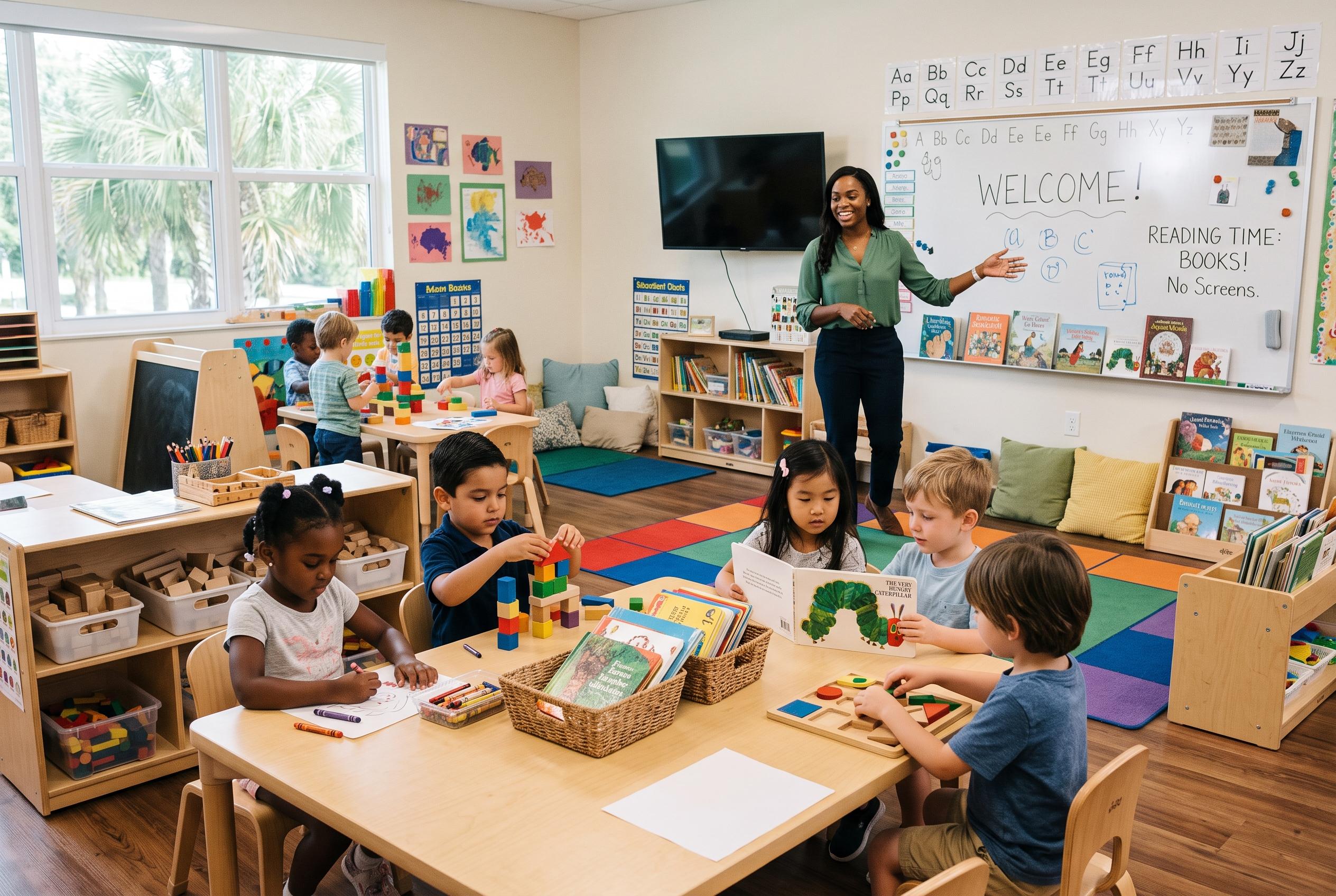
When Hillsborough County schools reopen on Monday, the district will begin trimming back screen-based instruction in its youngest classrooms, marking a notable shift after years in which digital programmes expanded sharply across the school day. Kindergarten through second-grade pupils will no longer use i-Ready, Amira and Imagine Learning as part of daily teaching, with more time instead devoted to printed books, handwriting, classroom conversation and hands-on materials.
The change is not a ban on technology. In grades 3 through 5, digital platforms will still be used, typically for 30 to 45 minutes a week per programme, while laptops remain available for testing and lessons where teachers judge them to be useful. District officials say the aim is to restore a more age-appropriate balance in early education rather than remove devices altogether.
Sarah Garcia, the district’s executive director of elementary education, told WUSF that schools had not fully reversed the habits created during remote learning. One device per child remained common, and the number of programmes as well as the time assigned to them kept increasing. Hillsborough, the nation’s seventh-largest school district, is now presenting the shift as a return to teaching that is better suited to young children.
Pasco County is making a similar move under Superintendent John Legg, a Republican former state lawmaker who once chaired education committees in both chambers of the Florida Legislature. Its new guidance, “Learning First: Limited Screens, Maximum Learning”, stresses direct teaching, paper-and-pencil work, reading and discussion. Kindergarten and first-grade pupils are expected to spend about 30 minutes a day on computers, with room kept for diagnostic testing, research and assistive technology.
The two Tampa Bay districts are acting before Florida’s state policy catches up. The Department of Education’s latest Digital Classrooms update, published in December, describes the spread of one-to-one devices, adaptive platforms and digital dashboards, but it stops short of setting age-based limits or measuring classroom screen time. At the same time, Florida has already been stricter on pupils’ personal phones than on school-issued laptops, and the state’s own progress monitoring still depends on computers. That leaves local leaders trying to answer a question the state has not yet settled: how much routine teaching should happen on a screen, especially in the early years.
Disclaimer: This content is for informational purposes only and is not intended to be a substitute for professional medical judgment, advice, diagnosis, or treatment.