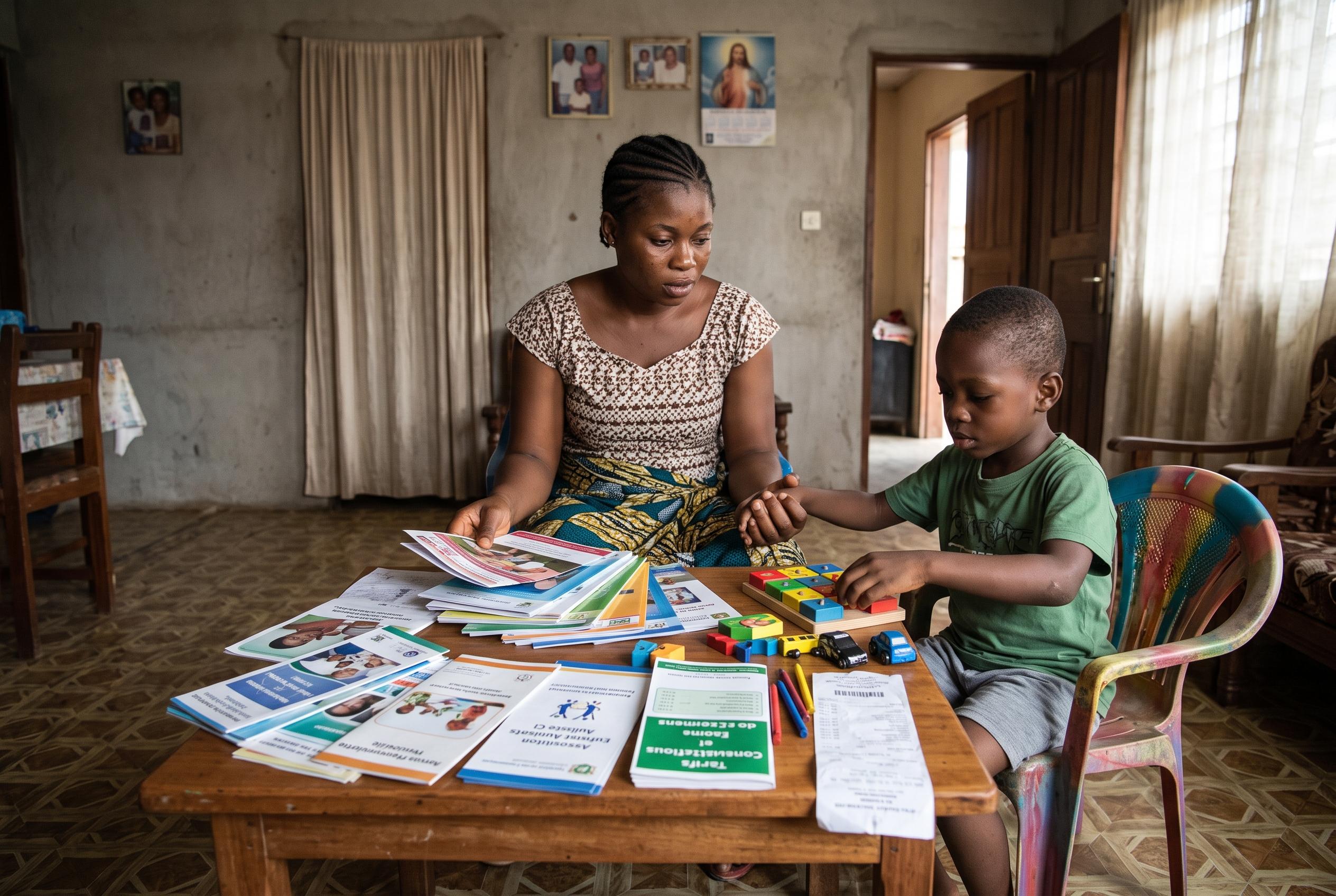

Families caring for children with neurodevelopmental disorders in Côte d’Ivoire are overwhelmed by scattered services, high costs, and a lack of coordinated care, risking long-term setbacks for vulnerable children.
Families caring for children with neurodevelopmental disorders in Côte d’Ivoire are being pushed into a relentless routine of travel, expense and emotional strain, as they move between clinics, specialists and schools in search of care that remains fragmented and hard to afford. An AIP investigation published in Abidjan on August 8 found that parents often spend years chasing diagnoses, then struggle to keep treatment going because services are scattered, specialist numbers are thin and support for adults with disabilities is barely organised. The picture fits a wider pattern described in international medical literature, which says neurodevelopmental disorders are often recognised late and treated in systems that lack standard tests, trained staff and coordinated services, especially in lower-income countries.
For Hamed Namory Coulibaly, life is organised around the needs of 15-year-old Inaya, who has Williams-Beuren syndrome and epilepsy, and 13-year-old Rayane, who has Cri du chat syndrome and depends entirely on constant supervision. Their home in Grand-Bassam functions less like a household than a care unit, with medication schedules, special meals, spare clothes and medical files prepared before dawn. AIP reported that the family regularly travels into Abidjan and surrounding districts for appointments, sometimes visiting several areas in one day. The burden is not only physical: Coulibaly said the family spends at least 8 million CFA francs a year on medicine, tests and follow-up, even with insurance, while also paying for carers and losing income because one parent stopped working.
The same pressures weigh on Kouassi Sophie, whose 19-year-old son David is autistic and non-verbal. According to AIP, David went without specialised follow-up for four years because the family could not keep paying for care. Sophie said the costs quickly became overwhelming, with orthophonic therapy, rehabilitation, transport and food all adding up to a level many households cannot sustain. She eventually stopped treatment to resume work in the public sector, a choice that secured income but, she said, left her son worse off and more difficult to manage. Experts in Côte d’Ivoire say such interruptions are common, with many families abandoning or spacing out sessions after about a year because of expense, exhaustion and distance.
That strain is amplified by the country’s limited public provision. AIP’s fact-checking on child mental health services says the Centre de Guidance Infantile remains the only public service in Côte d’Ivoire dedicated to child and adolescent psychopathology, while a study from Cocody University Hospital in Abidjan found that many children with epilepsy also face intellectual disability and need early cognitive assessment. A separate report from Le Monde noted that the government has been trying to clean up a private clinic sector in which many facilities operate illegally, a problem that helps explain why families still struggle to find reliable care close to home. In practice, parents must stitch together their own pathway through neurology, speech therapy, rehabilitation, schooling and social support.
Against that background, advocates are pressing for integrated centres that bring diagnosis, therapy, family support and follow-up under one roof. Corine Ouattara, president of Chronix, told AIP that digital tools alone are not enough and that physical centres are needed to bridge the gap between screening and treatment. The project she describes, called NURIA, would combine speech therapy, psychiatric support, parent groups, distance follow-up and training for older children, while aiming to keep fees low. AIP also quoted Pr Koua Asséman Médard, the head of the national mental health programme, as saying the country needs more specialists and a stronger public-private partnership, with community centres able to open relatively quickly if properly funded and staffed.
For the families already living this reality, the issue is no longer abstract policy but daily survival. Coulibaly warned that the greatest fear is not the next bill but what will happen to Inaya and Rayane when their parents can no longer provide round-the-clock care. Sophie voiced the same anxiety for David’s future integration into society. Both believe that a more coordinated system would reduce travel, lower costs and prevent children from slipping backwards whenever care is interrupted. As AIP’s reporting makes clear, the problem is not a lack of parental commitment but a shortage of structures that can match that commitment with continuity, dignity and hope.
Disclaimer: This content is for informational purposes only and is not intended to be a substitute for professional medical judgment, advice, diagnosis, or treatment.