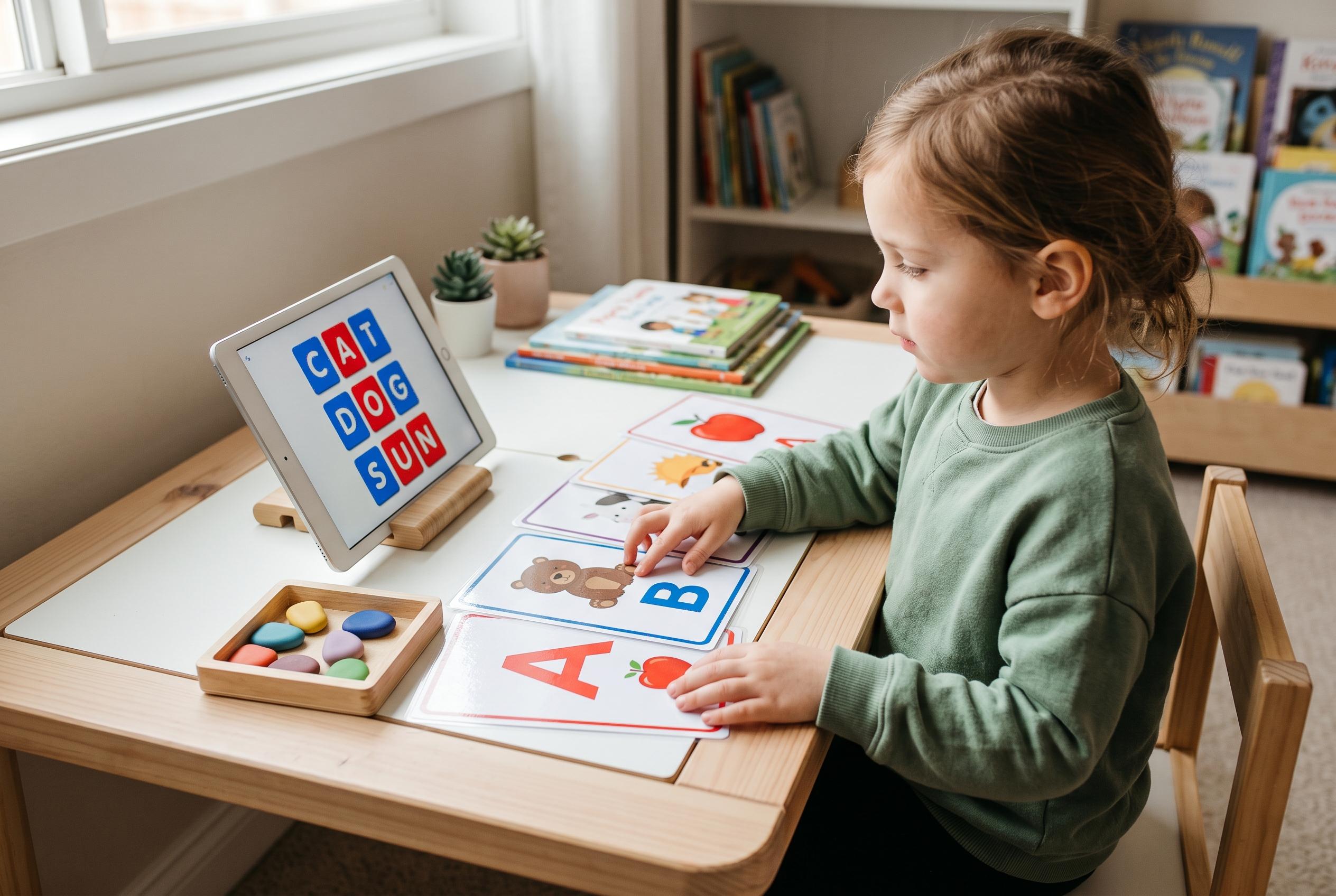

A new approach to teaching letter sounds, focusing on usefulness over tradition, may help children read more quickly by prioritising high-value consonants and vowels, supported by digital tools and careful instructional pacing.
Teaching letter sounds in sequence, rather than in alphabetical order, can give young readers a faster route into decoding. The argument for a structured phonics order is simple: children need a small set of high-value consonants and short vowels before they can make sense of real words. Editorialge argues that starting with letters grouped for usefulness, not tradition, helps beginners move beyond isolated drills and into reading within the first fortnight of practice.
The clearest example is the SATPIN approach, which introduces s, a, t, i, p and n first. That set gives children two short vowels and several common consonants, allowing them to form words such as sat, pin, tap and ant almost immediately. From there, the sequence can widen in stages, adding hard c and k, then short e, before moving on to g, o, u, l, f and b. By the time the full short-vowel set is in place, children can decode a far larger range of simple words with less guessing.
This method also reflects basic reading principles. Sounds that can be stretched, such as /s/, /m/, /f/ and /a/, are easier for beginners to blend than stop sounds like /t/ and /p/. Keeping visually similar letters such as b and d apart, and delaying close vowel contrasts such as short e and short i, reduces confusion. Just as importantly, teachers are urged not to withhold vowels until the end of the alphabet, since that leaves children unable to build the CVC words, or consonant-vowel-consonant words, that underpin early reading.
A daily routine matters as much as the sequence itself. Editorialge recommends saying the sound cleanly, tracing or writing the letter, blending it straight away with known sounds and then using dictation to check recall. That sort of repeated practice is designed to stop children over-relying on letter names and to keep their attention on sounds. The article also says teaching should move at a measured pace, usually two or three sounds a week, with reading material restricted to decodable books that use only the letters already taught.
The piece also points to digital practice as a useful supplement, not a replacement, for classroom instruction. It highlights Alphabet Magic Trace and Phonics as an app that combines tracing, audio prompts and matching games to reinforce letter recognition and sound recall. The app is available on both the App Store and Google Play, while another phonics programme, Sweet Phonics, says it offers 101 short lessons built around systematic decoding and progress monitoring for parents. Taken together, these examples suggest that technology can support a structured phonics routine when it is used to reinforce, rather than replace, direct teaching.
The practical message for parents and teachers is that sequencing matters. Start with the sounds that unlock the most words, introduce short vowels early, keep troublesome letter pairs apart and insist on immediate blending rather than endless sound drills. Used consistently, that approach can help children progress from recognising individual letters to reading simple, meaningful words with growing confidence.
Disclaimer: This content is for informational purposes only and is not intended to be a substitute for professional medical judgment, advice, diagnosis, or treatment.