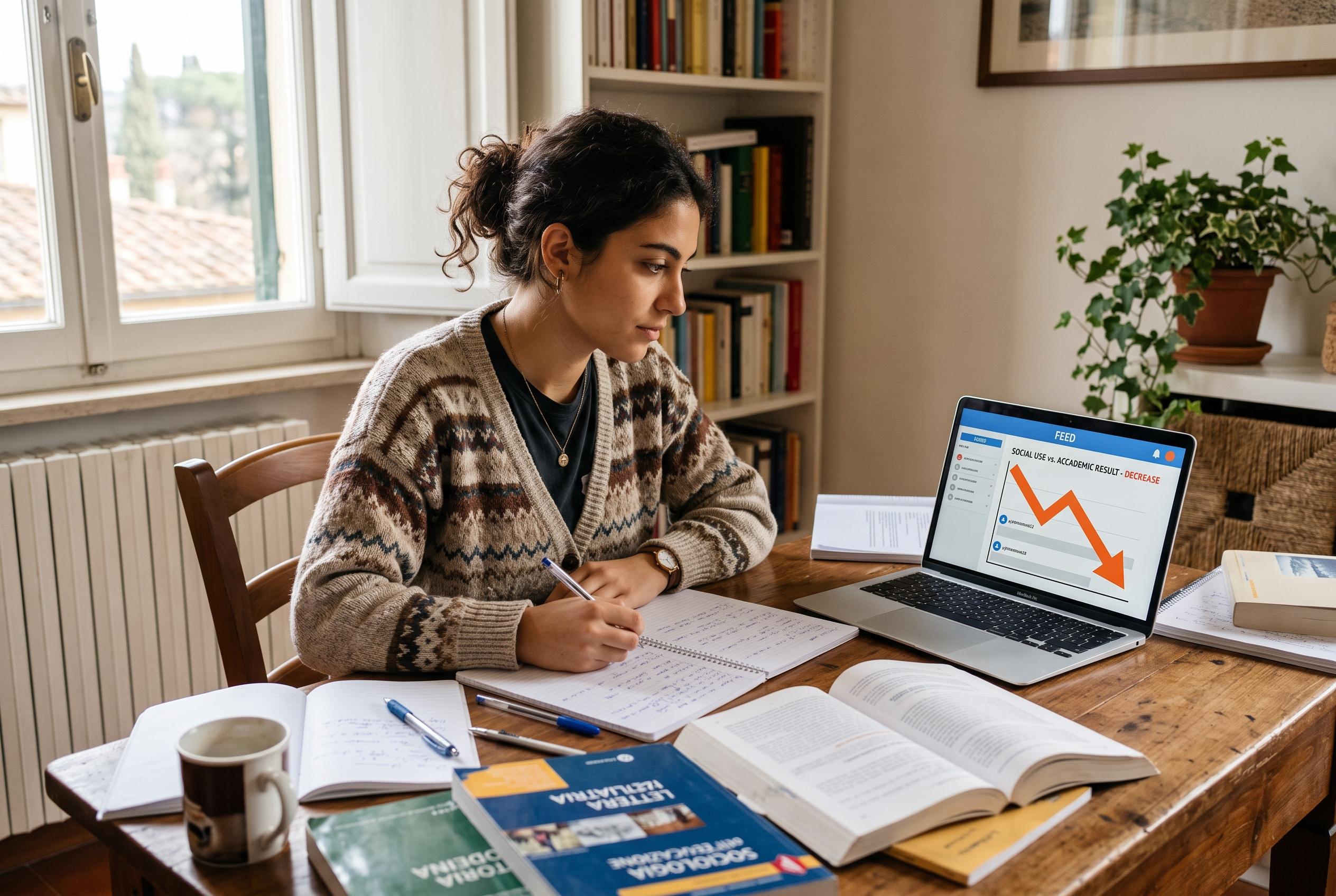

A study from Italy reveals that children who open social media accounts before ninth grade tend to perform worse academically, sparking calls for age restrictions and responsible digital education.
A new study from Italy suggests that children who open a social media account before the ninth grade tend to perform worse at school than those who wait until they are older.
Researchers led by Marco Gui at the University of Milano-Bicocca in Milan surveyed more than 5,000 pupils in northern Italy and tracked when they first created a social media profile. They then compared later results in standardised tests in mathematics, Italian and English. The study, published in Nature Human Behaviour, found that pupils who had accounts in 6th, 7th or 8th grade generally scored lower than those who delayed until 9th grade or later.
The gap was not uniform across subjects. In English, early users performed about as well as their peers, which the researchers said may reflect the constant presence of English-language material on platforms such as TikTok, Instagram and Facebook and the possibility that young people pick up the language informally. In the other subjects, the pattern was more negative, and early users were also more likely to repeat a school year.
The authors said they had accounted for family background, including parents’ education and household social and economic conditions, which strengthens the case that social media itself may be part of the problem. They did not test the mechanism directly, but pointed to several plausible explanations already raised in earlier research: distraction from endless scrolling, less time available for homework and cognitive overload from constant streams of information.
The findings land in the middle of a broader policy debate over whether children should face legal age limits for social media. France is preparing to ban access for under-15s, according to reporting in t3n, while Germany, Spain, Greece and Austria are also weighing age-based restrictions. Advocates of tighter rules often cite mental health and addiction risks, but the same concerns now extend to concentration, sleep, wellbeing and classroom performance.
Other experts said the study fits with a wider body of evidence. Klaus Zierer of the University of Augsburg told t3n that the results were consistent with earlier work and that a difference amounting to roughly half a school year was significant. Christian Montag of the University of Macau argued that repeated smartphone notifications may be one reason attention suffers. María Paz Prendes Espinosa of the University of Murcia was more cautious, saying bans alone would not solve the issue and that children need education in how to use technology responsibly.
Disclaimer: This content is for informational purposes only and is not intended to be a substitute for professional medical judgment, advice, diagnosis, or treatment.