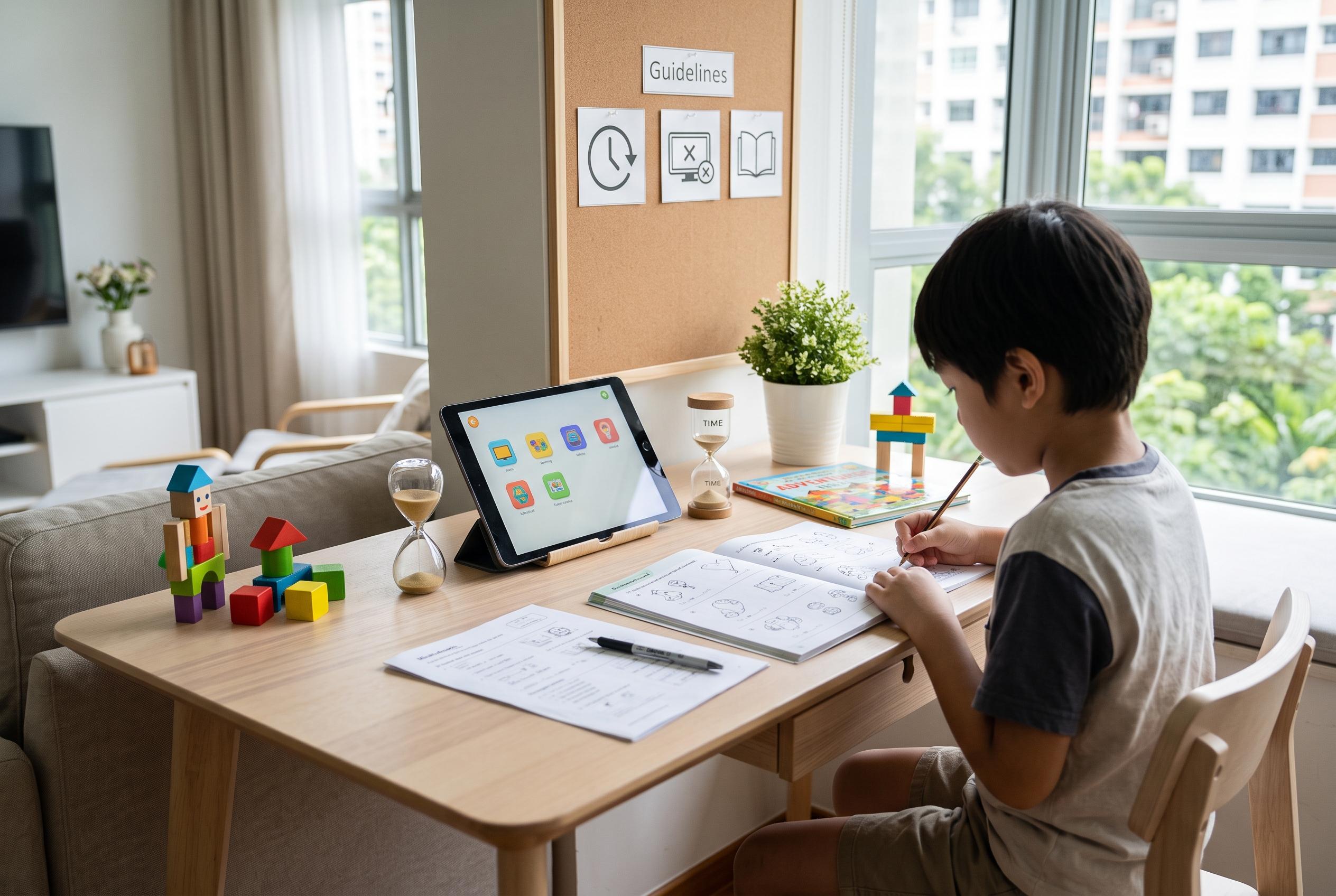

As children increasingly rely on devices for both education and entertainment, Singapore grapples with balancing necessary screen use with health guidelines, highlighting the blurry line between learning and leisure in the digital age.
On a home-based learning morning, the problem is not whether children should use screens at all but how quickly one device can become a family fixture. In one household described in a Channel NewsAsia Voices piece, an iPad meant for a 9-year-old’s Student Learning Space lessons is soon being watched by an 8-year-old and a 2-year-old as well, turning schoolwork into a shared screen session before the day has properly begun.
That frustration sits uneasily alongside Singapore’s own advice. Under Grow Well SG, the Ministry of Health recommends less than 2 hours of screen time a day for children aged 7 to 12, excluding schoolwork. The wider health push, developed with the Ministry of Education and the Ministry of Social and Family Development, is meant to encourage healthier habits early and to tackle concerns including too much screen time, too little physical activity, poor diet and inadequate sleep.
The school platform itself is designed to be useful. According to the Ministry of Education, Student Learning Space is the core digital teaching tool in Singapore schools, offering videos, simulations and reading materials selected by teachers. For some subjects, particularly Chinese, the system can be genuinely helpful: pronunciation support and instant marking make it easier for children to practise on their own. But the same features that make online homework efficient can also invite distractions, from fiddling with playback speed to the general drift that comes with staring at a screen.
That is the tension at the centre of the complaint. School-related device use is treated as unavoidable, even virtuous, while parents still have to manage the practical and behavioural consequences. The result is a blurry line between learning and leisure, where even the “good” kind of screen time can still mean eye strain, shorter attention spans and more time spent trying to pull children back into the room around them.
Disclaimer: This content is for informational purposes only and is not intended to be a substitute for professional medical judgment, advice, diagnosis, or treatment.