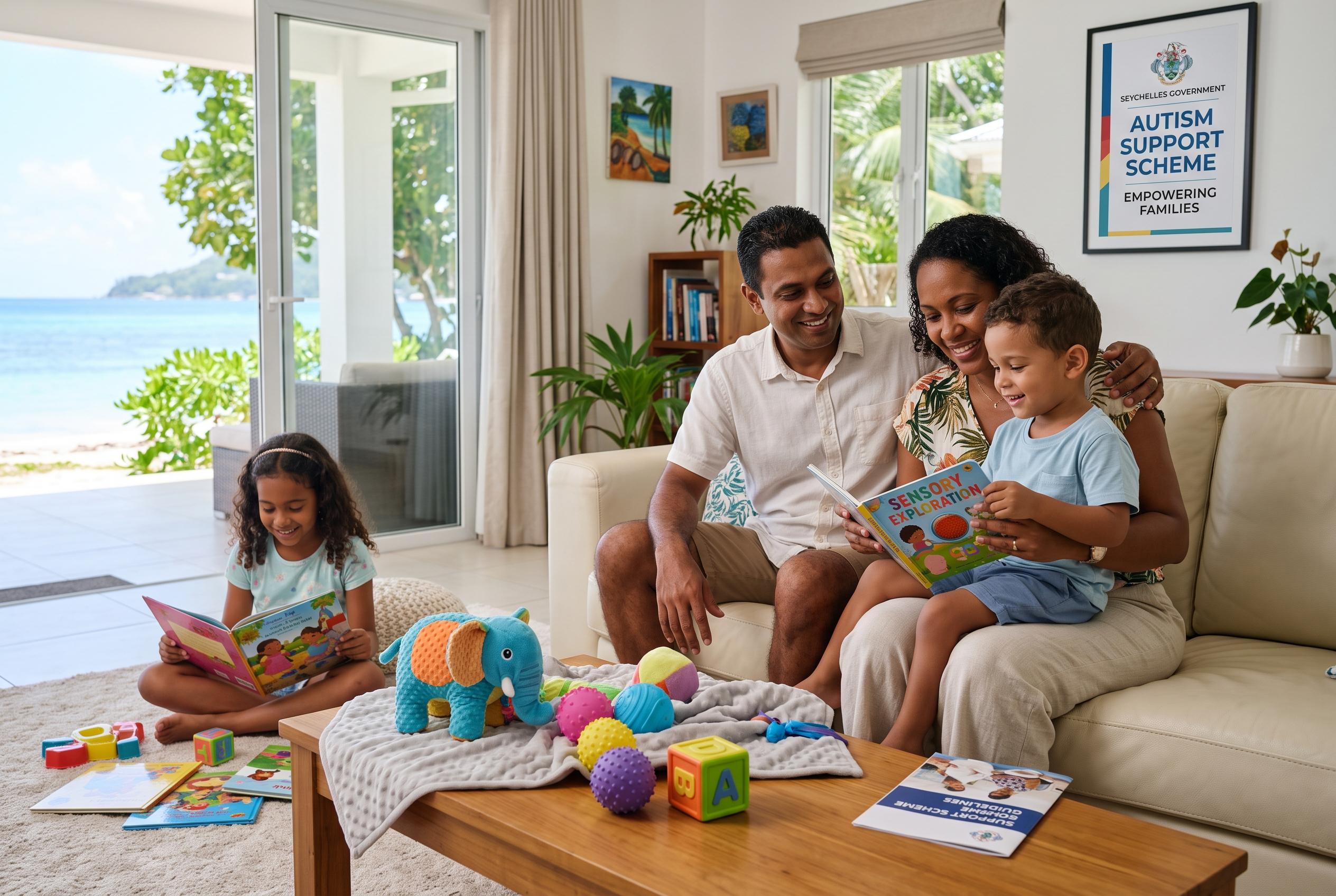

The Seychelles government has launched a new state-backed programme to assist children with autism and related neurodevelopmental disorders, filling a long-standing gap for families whose children do not qualify for existing disability benefits.
Seychelles has launched a new state-backed support scheme for children with autism and related neurodevelopmental conditions, after the government moved to fill what ministers described as a gap for families whose children need long-term help but do not qualify for existing disability payments. The programme was approved by Cabinet on July 9 and is being run by the Agency for Social Protection.
Social Affairs, Family and Equality Minister Pamela Charlette told the National Assembly that the scheme is aimed at children under 18 with invisible disorders, including autism spectrum disorder and ADHD, whose needs can still be substantial even when they do not present with visible physical impairments. She said support would be based on extra costs linked to food, therapy, caregiving and transport, with payments ranging from R4,400 to R6,500 after means testing.
According to Charlette, the new arrangement follows a review of cases in which 70 children on the autism spectrum were removed from disability benefits between November 2024 and June 2026 after reassessment by the Functional Capacity Assessment Board. She said the ministry had intervened to challenge some of those decisions and had already seen more favourable outcomes in certain cases. The scheme took effect on August 1, and the social protection agency is now contacting parents in batches so they can complete registration and, where relevant, receive backdated payments.
The policy has emerged against a broader push in Seychelles to improve awareness and services for autistic people. Autism Seychelles held an information session for parliamentarians and staff on July 8, part of the “A Parliament for All” project, while the President, Patrick Herminie, used World Autism Awareness Day on April 2 to call for greater inclusion. The government’s longer-term priorities now include better coordination between agencies, stronger school support, more specialists in speech, occupational and behavioural therapy, and a national strategy covering care, education and future employment.
Disclaimer: This content is for informational purposes only and is not intended to be a substitute for professional medical judgment, advice, diagnosis, or treatment.