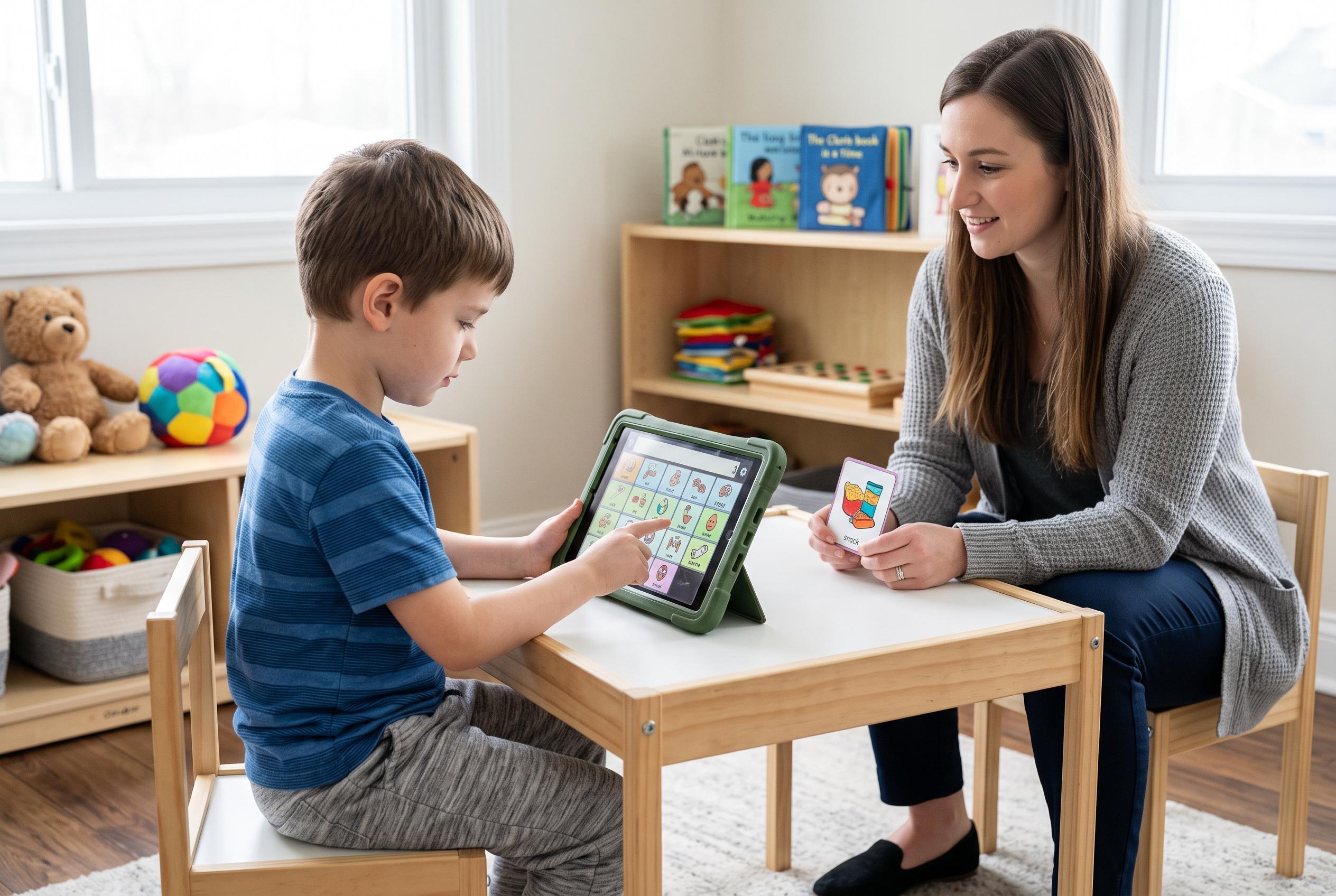

A recent study demonstrates that integrating speech-generating devices into targeted communication programmes significantly boosts social and language skills in minimally verbal children with autism, supporting more personalised intervention strategies.
A new study suggests that adding a speech-generating device to a developmental communication programme can materially improve communication in minimally verbal children with autism spectrum disorder, a group that has often been difficult to include in intervention research. The trial followed 61 children aged 5 to 8 in a sequential, multiple-assignment randomised design, or SMART, which allowed researchers to test different treatment paths over time.
All of the children first received a package combining joint attention, symbolic play, engagement and regulation with enhanced milieu teaching. According to the study, the strongest gains came when that approach was paired with a speech-generating device from the outset. Children in that pathway showed significant improvements in spontaneous communicative utterances and in initiating joint attention, a key social-communication skill linked to later language development.
The findings add to a broader body of research suggesting that language development in autism is highly variable and that progress may depend on more than a child’s current spoken vocabulary. Earlier studies have identified distinct language trajectories, receptive-expressive gaps and different subgroups within the minimally verbal population, while recent reviews have argued that researchers and clinicians need more precise ways to describe communication abilities than broad labels such as “non-verbal” or “minimally verbal”. The American Psychiatric Association’s 2022 DSM-5-TR also reflects the clinical importance of careful assessment, providing updated diagnostic criteria and coding guidance for autism spectrum disorder and related conditions.
The study is also notable because it tested an adaptive model rather than a one-size-fits-all intervention. That matters in autism research, where communication profiles can change over time and where families often face limited evidence on which treatment sequence is most likely to help. By showing that early use of a speech-generating device can improve outcomes within a structured developmental programme, the research offers support for a more individualised approach to intervention planning.
Disclaimer: This content is for informational purposes only and is not intended to be a substitute for professional medical judgment, advice, diagnosis, or treatment.