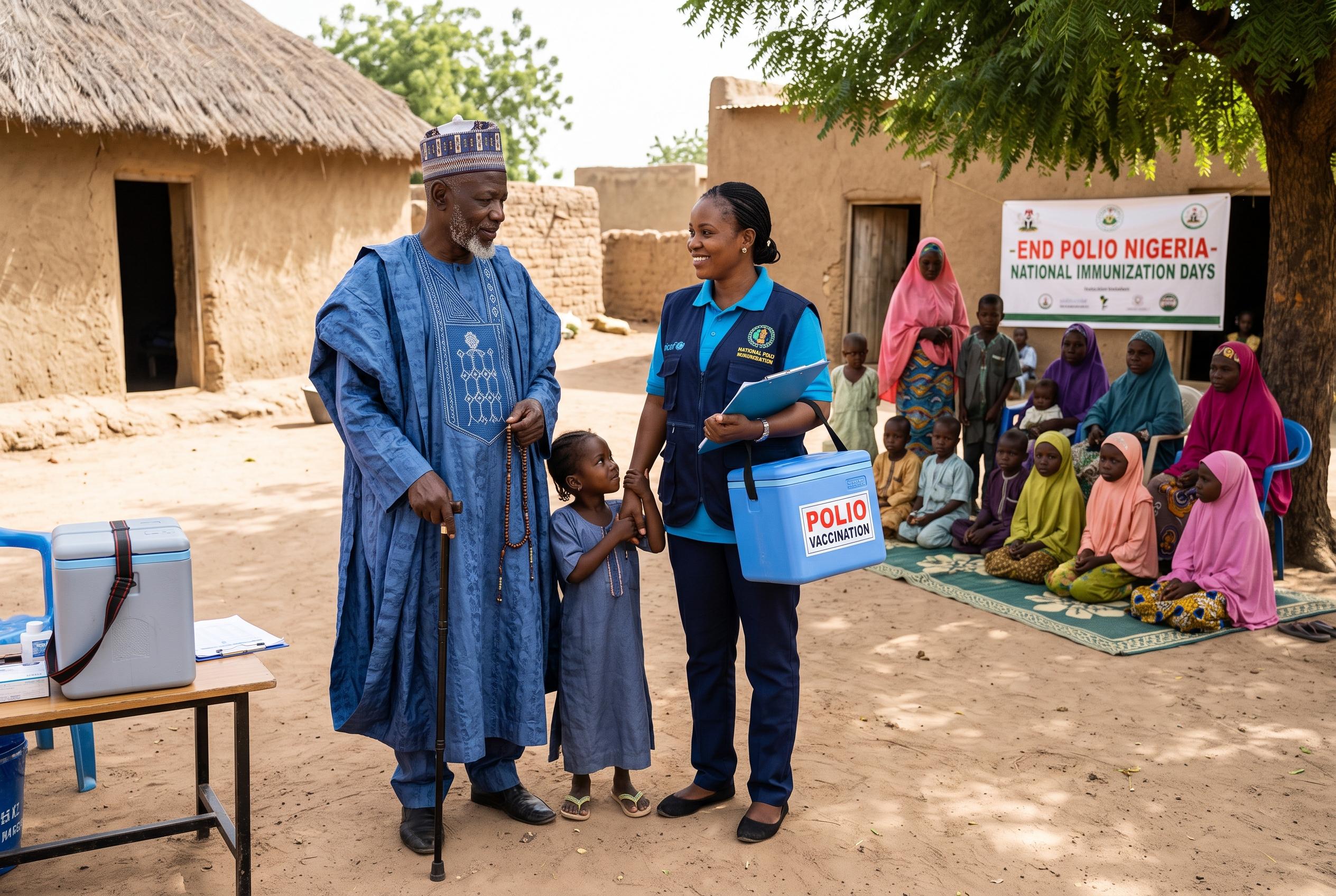

Traditional leaders in northern Nigeria are increasingly vital in bridging mistrust and boosting vaccination coverage amid persistent poliovirus cases, as health officials intensify community engagement and seek additional funding for immunisation programmes.
Traditional leaders in northern Nigeria are being cast as a crucial bridge between sceptical families and the country’s polio eradication effort, after health officials said trust remains one of the biggest factors in getting children vaccinated.
In Abuja, a quarterly review meeting of the Northern Traditional Leaders Committee brought together officials from the Federal Ministry of Health and Social Welfare, the National Primary Health Care Development Agency, the World Health Organisation, UNICEF, Rotary International and the Gates Foundation. The gathering came against a backdrop of uneven progress: Nigeria is estimated to record about 8 million births a year, yet roughly 2.1 million children have still not received any routine vaccine, while coverage among children aged 12 to 23 months stands at an estimated 57% nationally and 41.5% in the north.
The scale of the challenge is reflected in surveillance data as well as immunisation figures. The World Health Organisation says 719 wards, or 8.1% nationwide, were classed as “silent wards” in week 30 of 2026, meaning no suspected cases were being detected or reported. Health officials say this often points to weak surveillance rather than an absence of disease and can leave outbreaks hidden for longer.
Dr Pavel Ursu, WHO’s representative in Nigeria, told the meeting that vaccines are delivered by health workers and supported by partners, but that traditional leaders are the ones who help deliver trust. That role has been central for years. In August 2025, the National Primary Health Care Development Agency praised the Northern Traditional Leaders Committee for 16 years of support for routine immunisation, polio eradication, disease control and primary health care, saying their influence helps ensure no child is left behind.
The latest figures suggest progress is being made, but not quickly enough. Dr Muyi Aina, the NPHCDA’s executive director, said Nigeria had reduced circulating variant poliovirus type 2 cases from 48 to 39 by July 2026, but also reported seven variant poliovirus type 3 cases that require urgent action. The agency says 70% of detected cases are concentrated in Sokoto, Kebbi and Zamfara, where immunity remains low, and in Sokoto inactivated polio vaccine coverage is just 10%. Of 121 confirmed cases analysed, more than 80% of affected children were zero-dose children and 90% had not received a routine inactivated polio dose.
Health officials say the answer is to pair outbreak response with stronger routine services, backed by financing and local leadership. Dr Muhammad Ali Pate, the coordinating minister of health and social welfare, said a US$615 million immunisation financing package planned for 2026 to 2030, including US$515 million from Gavi and US$100 million in federal counterpart funding, could help improve cold-chain systems, delivery and frontline capacity. Traditional leaders, he and others argued, will remain essential to counter rumours, reach missed children and keep pressure on every level of government until no community is left behind.
Disclaimer: This content is for informational purposes only and is not intended to be a substitute for professional medical judgment, advice, diagnosis, or treatment.