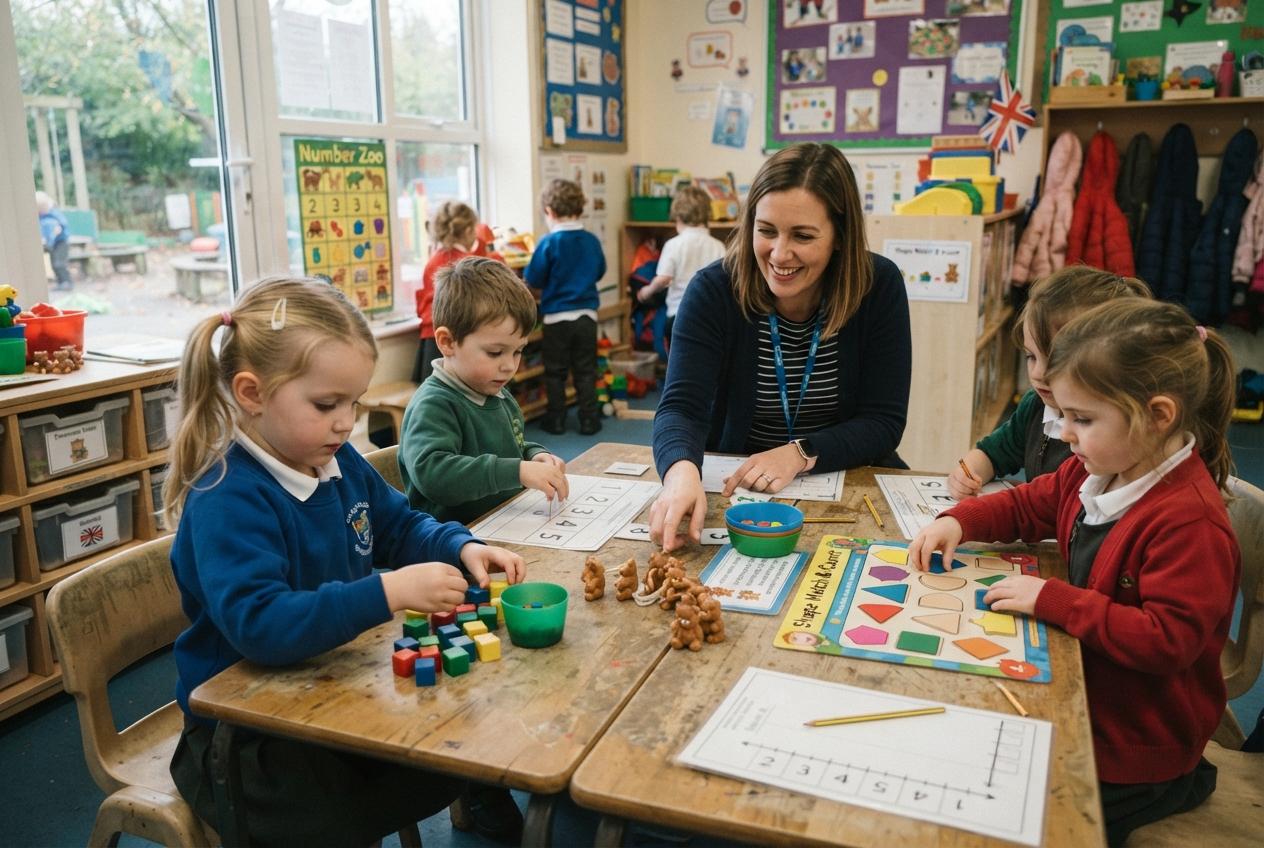

A growing body of research underscores the value of integrating maths into daily routines for preschoolers, helping to foster confidence, curiosity, and foundational skills that set the stage for lifelong learning.
In a Lewiston after-school programme, a 4-year-old sat counting Goldfish crackers and noticed that a friend had fewer on the plate. The reply came quickly: “But I already ate some.” Jayashree Sonti, co-founder and executive director of the Early Math and Language Initiative, uses that kind of everyday moment to argue that young children are already thinking mathematically long before they encounter formal lessons.
That argument is increasingly backed by research. Studies cited by education groups and academic reviews show that early numeracy is closely linked to later achievement in mathematics, while also supporting broader learning outcomes, including reading, reasoning and even completion of later schooling. Researchers have found that preschoolers are able and eager to make sense of concepts such as more and less, counting, patterns and space, and that those abilities can be strengthened through early exposure and intervention, particularly for children from lower-income households.
Sonti’s broader point is that maths should not be treated as a subject that waits until primary school, or as something separate from language and social development. The same daily routines that adults use for reading, such as story time and conversation, can also be rich with mathematical language: comparing, sorting, estimating, noticing shapes, and describing position or quantity. In that sense, folding clothes, preparing food, shopping or playing in a park are not interruptions to learning; they are part of it.
Early childhood specialists say the value of this approach is not simply academic. When adults bring “math talk” into play and routine, children tend to build confidence, curiosity and a more positive relationship with the subject. That matters because attitudes towards maths can harden early, with some children absorbing the idea that it is difficult or reserved for the naturally gifted. The case for early numeracy, then, is not only that it prepares children for school, but that it helps shape how they see themselves as learners.
Disclaimer: This content is for informational purposes only and is not intended to be a substitute for professional medical judgment, advice, diagnosis, or treatment.