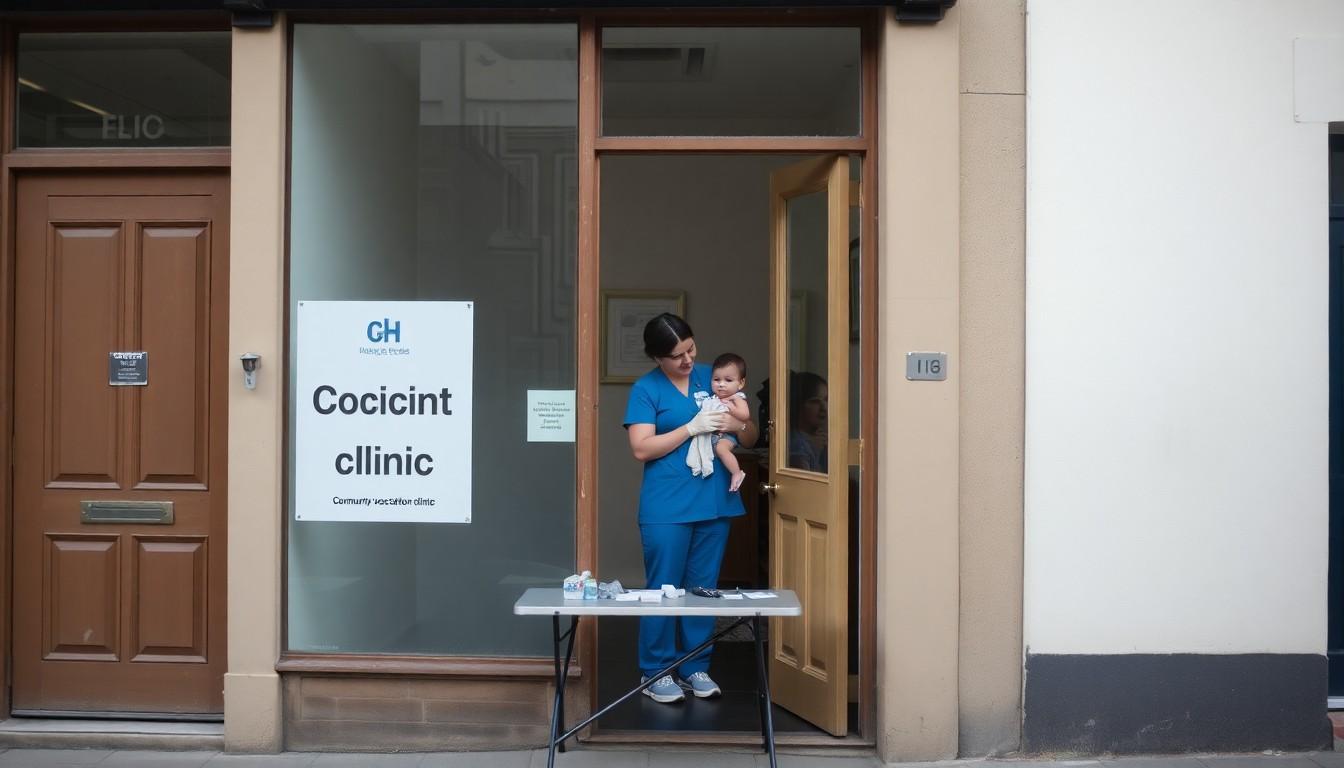

A new model of community-based immunisation in a vacant shop in Keighley demonstrates how bringing services closer to families can reverse declining childhood vaccination rates amid concerns over disease outbreaks in England.
Twenty-week-old Grayson might easily have joined the large number of British children who miss routine jabs on time. His mother Lily supports vaccination in principle, but after a difficult birth and weeks of post-partum depression, the journey to a surgery felt overwhelming. By the time she discovered a clinic close to home, his polio and diphtheria appointments were already overdue.
That clinic is in Keighley, west Yorkshire, and it operates from a vacant unit in the Airedale shopping centre, a symbol of retail decline turned into a public health asset. Staff say the setting matters. Rather than asking exhausted parents to negotiate a distant appointment, a long phone queue or an online booking form, the service puts immunisation alongside baby weighing, walk-ins and other family support. In practice, that has helped bring in parents who might otherwise have delayed or simply not turned up.
The need for such improvisation is clear. Official data show that childhood vaccination coverage in England has been slipping for years, and recent NHS figures for 2023-24 recorded falls across all 14 standard childhood vaccines, with none meeting the World Health Organisation’s 95% target. Coverage for the first MMR dose remained below what public health specialists regard as safe, while a significant minority of children reached their fifth birthday without both recommended MMR injections. The BMJ reported in 2022 that vaccination coverage for young children fell in 13 of 14 routine programmes across the UK the previous year, underlining that the problem is not confined to one region or one vaccine.
Experts argue that social media misinformation plays a part, but not the central one. More important, they say, is that many parents now have fewer contact points with health professionals who can remind them, reassure them and offer the jab there and then. The Nuffield Trust has said vaccination coverage is the clearest indicator of protection against vaccine-preventable disease, while the Royal College of Paediatrics and Child Health has warned that each year of decline leaves more children exposed to illnesses such as measles and polio. That concern has sharpened after recent measles outbreaks and child deaths in England.
Keighley’s clinic shows what a more accessible model can look like. Nurses offer vaccinations in a welcoming space, sometimes persuading parents who had arrived for something else to take up immunisation on the spot. The practice says its local approach has improved uptake, with first-dose MMR coverage among registered children rising from 78% three years ago to 88% by March this year. Public health workers see that as evidence that location, familiarity and convenience can matter as much as persuasion.
That has prompted wider debate about whether Britain needs to be bolder. Some politicians have floated ideas such as “opt-out” vaccination or financial incentives, while other countries use stricter rules, from school-entry requirements to fines and benefit restrictions. Yet many specialists remain wary. They argue that coercion could deepen mistrust, and that the better answer may be to rebuild the ordinary relationships between families and the NHS that once made routine vaccination feel simple rather than burdensome.
For now, the Keighley model offers a more modest lesson: if parents are tired, anxious or simply short of time, the system may have to come to them. In that sense, a vacant shop on a struggling high street may be doing more for childhood health than many grander schemes.
Disclaimer: This content is for informational purposes only and is not intended to be a substitute for professional medical judgment, advice, diagnosis, or treatment.