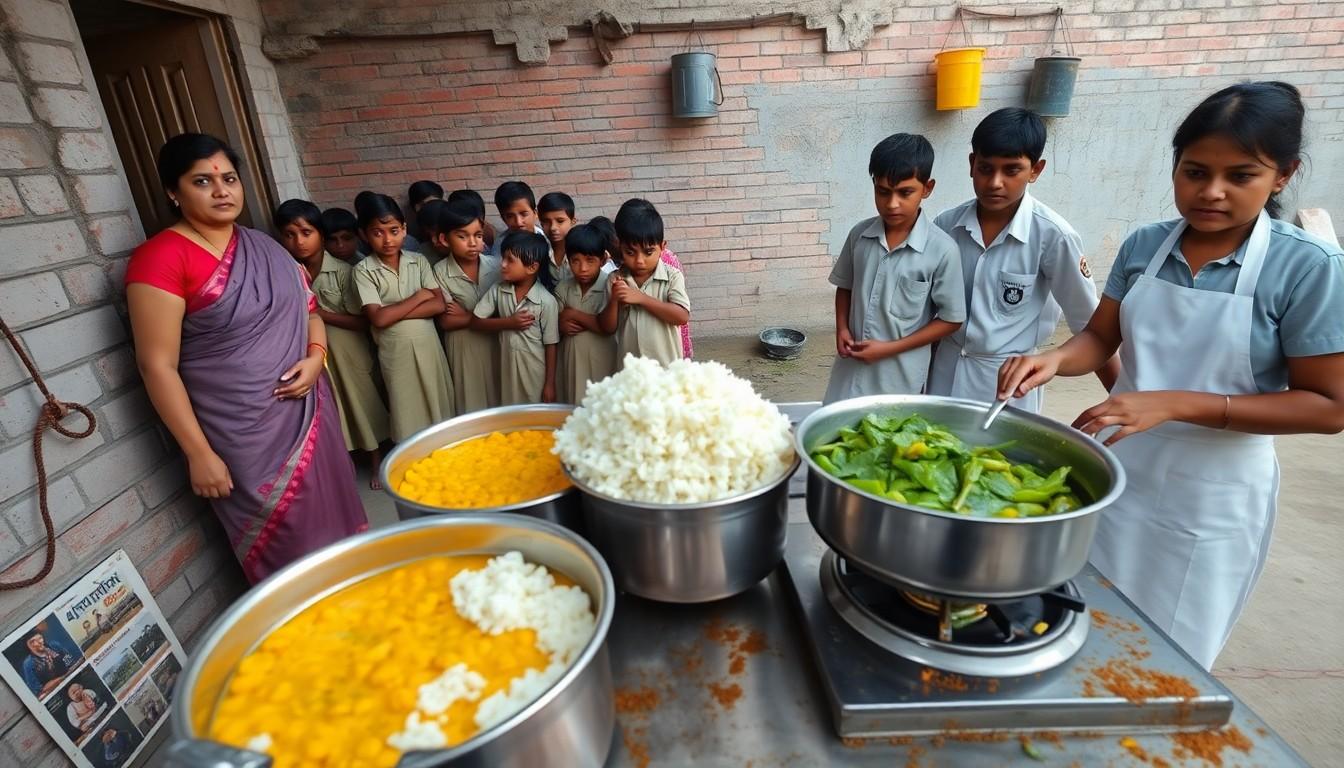

A recent roundtable in India examined how incorporating plant-based and biomass-fermented ingredients could enhance nutritional quality in school meals amidst ongoing concerns over malnutrition and scheme irregularities.
Nearly one in three Indian children under five is stunted and almost a third are underweight, according to the country’s latest National Family Health Survey, figures that have sharpened scrutiny of the state’s school and child-feeding systems. A closed-door roundtable convened by the Observer Research Foundation and Good Food Institute India set out to examine whether plant-based proteins and biomass-fermented ingredients could help improve the nutritional quality of the country’s largest public meal programmes, rather than simply filling stomachs with calories from cereal-heavy diets.
The discussion brought together officials and experts from the Food Safety and Standards Authority of India, the Department of Biotechnology, the World Bank and the World Food Programme, alongside academics, civil society groups and industry representatives. At the centre were PM-POSHAN and the Integrated Child Development Services, which provide school meals and take-home rations to millions of children. According to recent analysis cited by Business Standard, cereals still account for a large share of protein intake in India, especially in rural areas, where they make up 45.9% of protein consumption, compared with 38.7% in urban areas. That imbalance has fuelled debate over how to diversify diets without losing sight of cost and access.
Participants argued that India’s own agricultural ecosystem could supply much of the answer. Pulses, millets, broken grains, defatted oilseed meals and other underused by-products were identified as potential raw materials for affordable protein ingredients. The value chain, they said, would need better crop characterisation, crop-specific processing tools and tighter quality control if it is to move beyond pilot projects. The idea is not only to improve nutrition, but also to create demand for farmer producer organisations, women’s self-help groups, rural processors and small enterprises.
Yet the roundtable also underlined the gap between laboratory promise and public distribution. Before any alternative protein can be used in government feeding schemes, it must meet food-safety rules and show evidence on allergenicity, digestibility, bioavailability and real-world health outcomes. Speakers also stressed that community acceptance would matter as much as technical approval. India’s BioE3 policy, which includes smart proteins among its biomanufacturing priorities, was cited as one possible route to support both research and scale-up, but GFI India has warned elsewhere that skills shortages could slow the sector’s growth.
The conversation took place against a backdrop of recurring concerns over the quality of meals already reaching children. In Assam, nearly 24% of PM POSHAN food samples reportedly failed nutrition tests, while a Comptroller and Auditor General audit in Odisha found serious irregularities in the scheme’s implementation, including unfit rice being served to anganwadi children. Separate reporting has also shown that eggs and fruit are disappearing from some state menus, narrowing dietary variety at a time when experts say children need it most. Against that backdrop, alternative proteins are being pitched not as a silver bullet, but as one possible way to make public feeding programmes more reliable, more varied and more nutritionally credible.
Disclaimer: This content is for informational purposes only and is not intended to be a substitute for professional medical judgment, advice, diagnosis, or treatment.