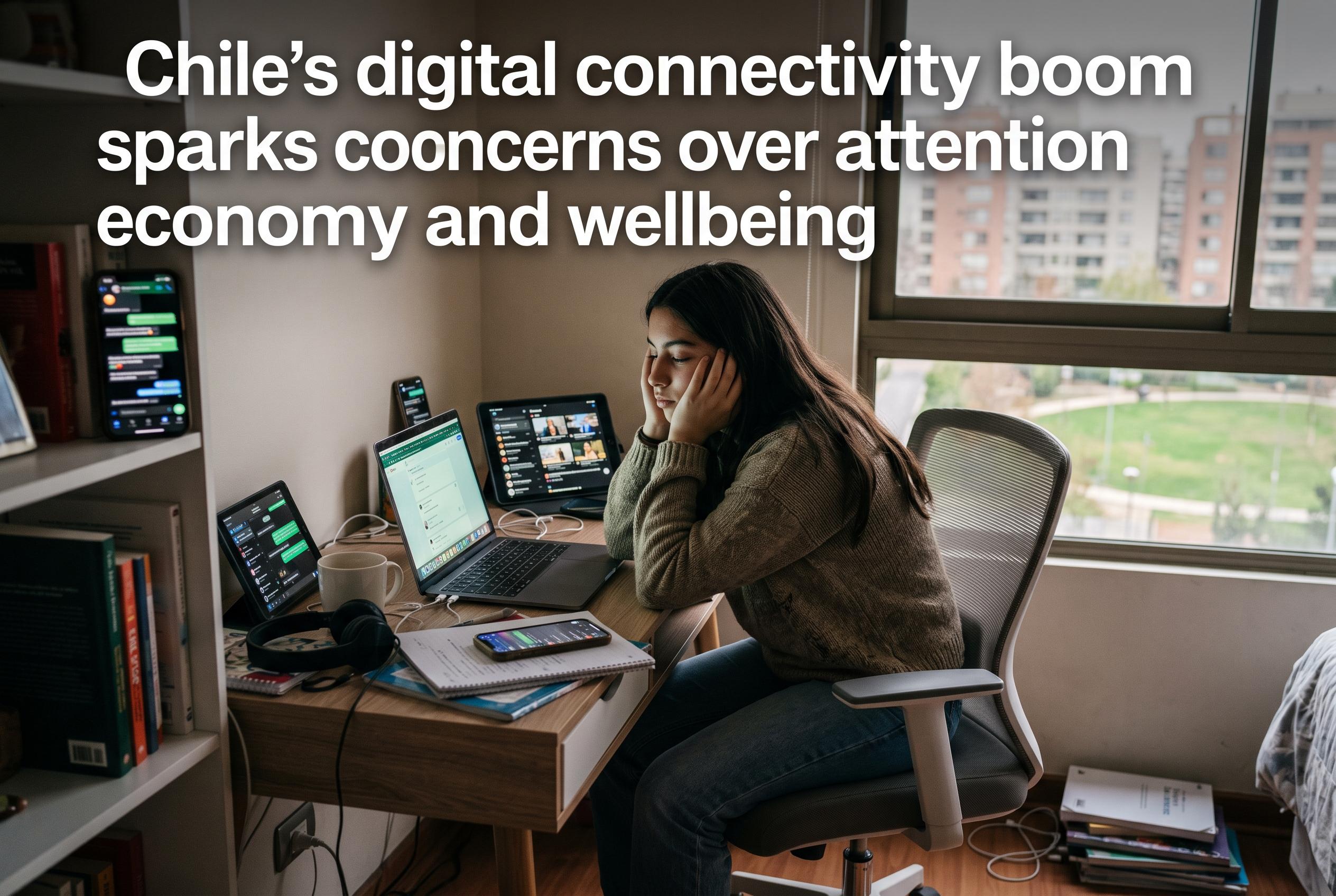

Chile’s astonishing rise in internet access and social media use is transforming daily life, raising questions about the impact on concentration, sleep, and social rhythms among its population, especially youth.
Chile has never been so connected, and the scale of that shift is visible in the latest national survey from the telecommunications regulator Subtel. The XII Encuesta de Acceso y Uso de Internet found that 96.6% of households have internet access at home, 87.3% use WhatsApp, 76.1% are on social media and 75.6% consume audiovisual content online. Those figures point to a country in which digital platforms have become part of everyday life, not an occasional convenience.
At the Universidad Católica de Temuco, academics say the implications go well beyond usage statistics. Julio César Rojas, an informatics lecturer, said the recommendation engines that shape what people see are built on profiles assembled from behaviour and preference, a process he described as clustering. In practice, that means streaming services and social networks do not simply display content; they constantly test what holds attention for longest, fitting neatly into what researchers call the attention economy.
Ana María Salinas, from the same university’s psychology school, said hyperconnectivity begins when screen time starts to crowd out face-to-face contact, rest and other essential activities. She warned that children and adolescents are especially exposed to the effects of short, highly stimulating content, which can make it harder to sustain concentration in class or during reading. She also said chronic sleep loss linked to late-night device use can affect cognitive development and emotional wellbeing, particularly in younger users.
The concern is not that technology should be abandoned, the academics argue, but that it should be used with more awareness. Salinas said many online habits are tied to basic human needs such as companionship and recognition, which is why healthier routines matter: sport, reading, hobbies and family time. Subtel’s own earlier surveys show how rapidly Chile’s digital habits have changed, with household internet access rising from 62% in 2014 to 94.3% in 2024, underscoring how quickly connectivity has moved from expansion to saturation. For researchers at the UCT, the challenge now is to ensure that permanent connection does not displace learning, rest and human relationships.
Disclaimer: This content is for informational purposes only and is not intended to be a substitute for professional medical judgment, advice, diagnosis, or treatment.