
As digital entertainment dominates childhood routines, new-generation playgrounds are redefining outdoor spaces by prioritising physical activity, social interaction, safety, and sustainability to foster healthier, more resilient children.
Outdoor play has become more than a pleasant extra in childhood; for many educators and health bodies, it is a core part of development. As digital entertainment and indoor routines have expanded, organisations such as UNESCO and UNICEF have warned that children are spending less time outside, even though unstructured play remains closely linked with movement, curiosity, social learning and confidence. The case for playgrounds is therefore not only about recreation, but about creating conditions in which children can grow in healthier and more rounded ways.
That is why outdoor playground equipment has taken on a broader role in schools, parks, housing schemes and childcare settings. According to the supplied lead article, modern playgrounds are designed to do far more than entertain: they are meant to support physical activity, imaginative play and social interaction while also being safe and accessible. Research summaries from Purdue Global, HealthyChildren.org and UNICEF reinforce that outdoor play helps children build strength, coordination, problem-solving ability and emotional resilience.
The physical benefits are especially clear. Climbing frames, swings, balance features and obstacle courses all ask children to use different muscles and movement patterns, building stamina, agility and motor control in ways that feel natural rather than prescriptive. Medical News Today and the Israeli Ministry of Health both note that outdoor play supports movement, strength and coordination, while also encouraging regular exercise that can help counter sedentary habits and wider health risks.
Just as importantly, playgrounds can sharpen thinking. The lead article highlights the way children test distance, assess risk and adapt to changing surfaces or routes, all of which exercise planning and decision-making. UNESCO and Purdue Global both point out that unstructured outdoor play encourages creativity and problem-solving, and HealthyChildren.org adds that it can support curiosity and critical thinking as children invent games and reimagine simple structures as castles, ships or space stations.
Social development is another major part of the picture. Shared play gives children repeated chances to negotiate rules, wait their turn, cooperate and recover from disappointment. UNICEF says outdoor play can strengthen cooperation and conflict resolution, while Medical News Today notes that it also creates opportunities for friendship and broader social interaction. These are everyday lessons, but they are foundational ones, shaping how children communicate and relate to others.
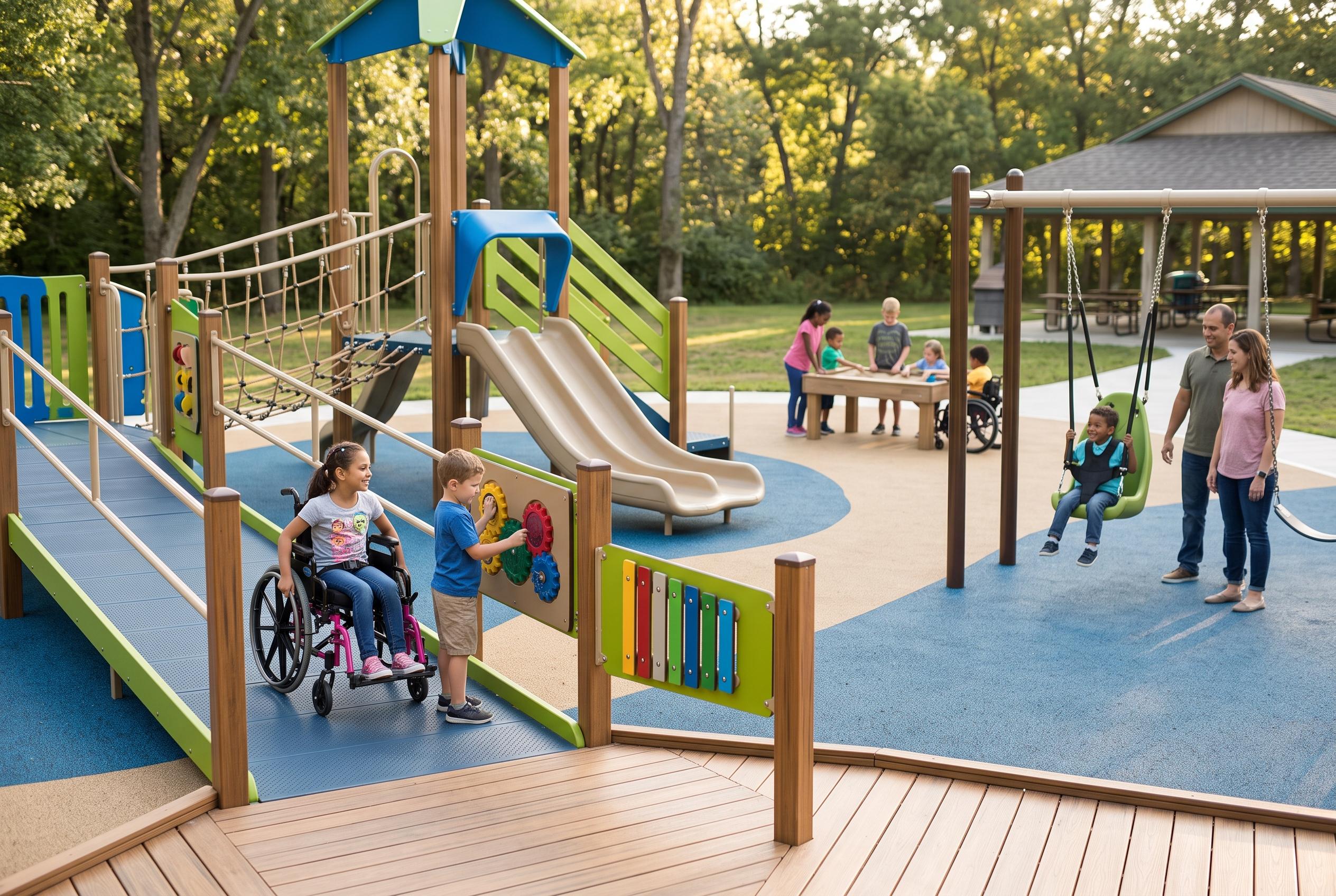
Design matters because not every playground serves the same purpose. Schools often need equipment that can handle large groups and support active breaks in the school day, while residential developments may favour mixed-age spaces and childcare centres may look for features that combine movement with early learning. The lead article also stresses that accessible pathways, ramps, adaptive swings and sensory panels are essential if playgrounds are to be genuinely inclusive rather than merely open in name.
Safety, maintenance and durability remain central to good design. The article’s account of rounded edges, non-slip surfaces, secure platforms and impact-absorbing ground cover reflects a wider consensus that playgrounds should encourage challenge without unnecessary risk. Regular inspections, maintenance of fastenings and surfacing, and the use of weather-resistant materials all help extend the life of the equipment while keeping it usable and dependable for families.
There is also a growing emphasis on sustainability and long-term value. The lead article points to recycled materials, responsibly sourced components and landscape features such as shade trees and permeable surfaces, which can reduce environmental impact and improve comfort. Taken together with the wider research on outdoor play, the message is clear: well-planned playgrounds are not decorative additions, but practical investments in children’s health, learning and social development.
Disclaimer: This content is for informational purposes only and is not intended to be a substitute for professional medical judgment, advice, diagnosis, or treatment.