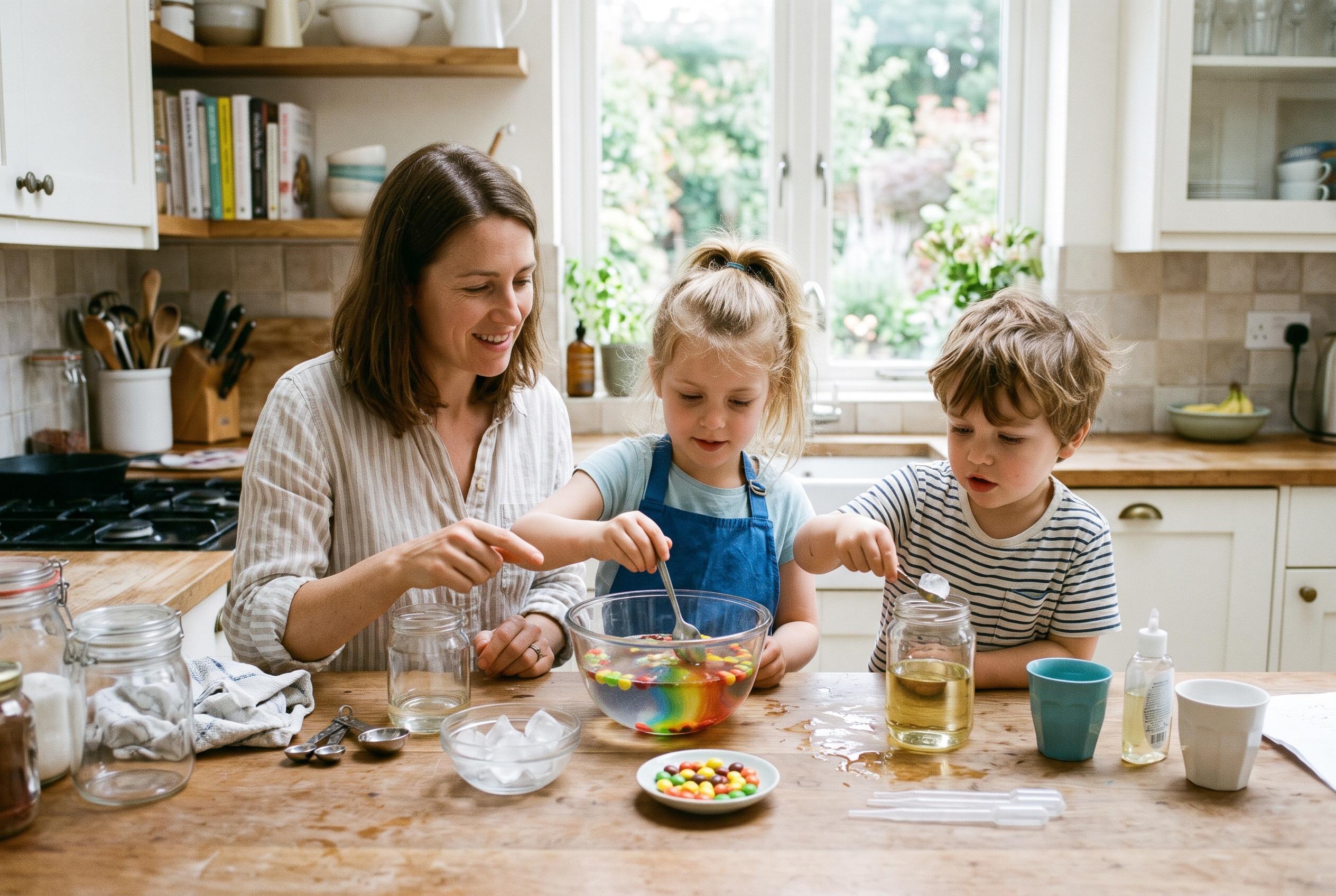

Simple experiments with ice, sweets, soap and household ingredients are giving young children hands-on lessons in curiosity, observation and cause and effect.
For parents of three- and four-year-olds, science works best when it feels like play. A set of simple experiments using everyday household items can turn water, ice, soap and sweets into quick lessons about observation, cause and effect, and asking questions. The original collection from Kids Activities Blog is built around that idea: short, colourful activities designed to hold a preschooler’s attention while introducing basic scientific thinking.
The projects range from growing crystals on rocks to watching sweets lose their colour in water, and from a makeshift pulley to a fizzy reaction made with lime juice and baking soda. The idea is not to explain every scientific principle in detail, but to let children see a change happen and talk about what they notice. That approach is echoed by Education Corner, which recommends similarly straightforward experiments using items families already have at home, including activities that explore buoyancy, colour mixing and density.
Several of the activities also show how preschool science can be tied to everyday life. Frozen dinosaurs rescued with salt teach children that materials behave differently in cold conditions, while the milk-and-food-colouring experiment offers a vivid way to introduce surface tension. Other parenting sites suggest the same kind of hands-on learning. My Kids Time highlights ice and salt experiments as especially effective for showing how salt affects melting, and Science Sparks points to sink-or-float games as an easy way to begin explaining density and buoyancy.
The broader lesson is that preschool science does not need to be formal to be memorable. Activities such as catching snowflakes, freezing bubbles or looking at germs through a simple home test can create those early “wow” moments that make children want to ask why things happen. For families looking to build curiosity without complicated materials, these experiments offer a practical starting point and a reminder that discovery often begins with something as simple as a bucket, a spoon or a bowl of milk.
Disclaimer: This content is for informational purposes only and is not intended to be a substitute for professional medical judgment, advice, diagnosis, or treatment.