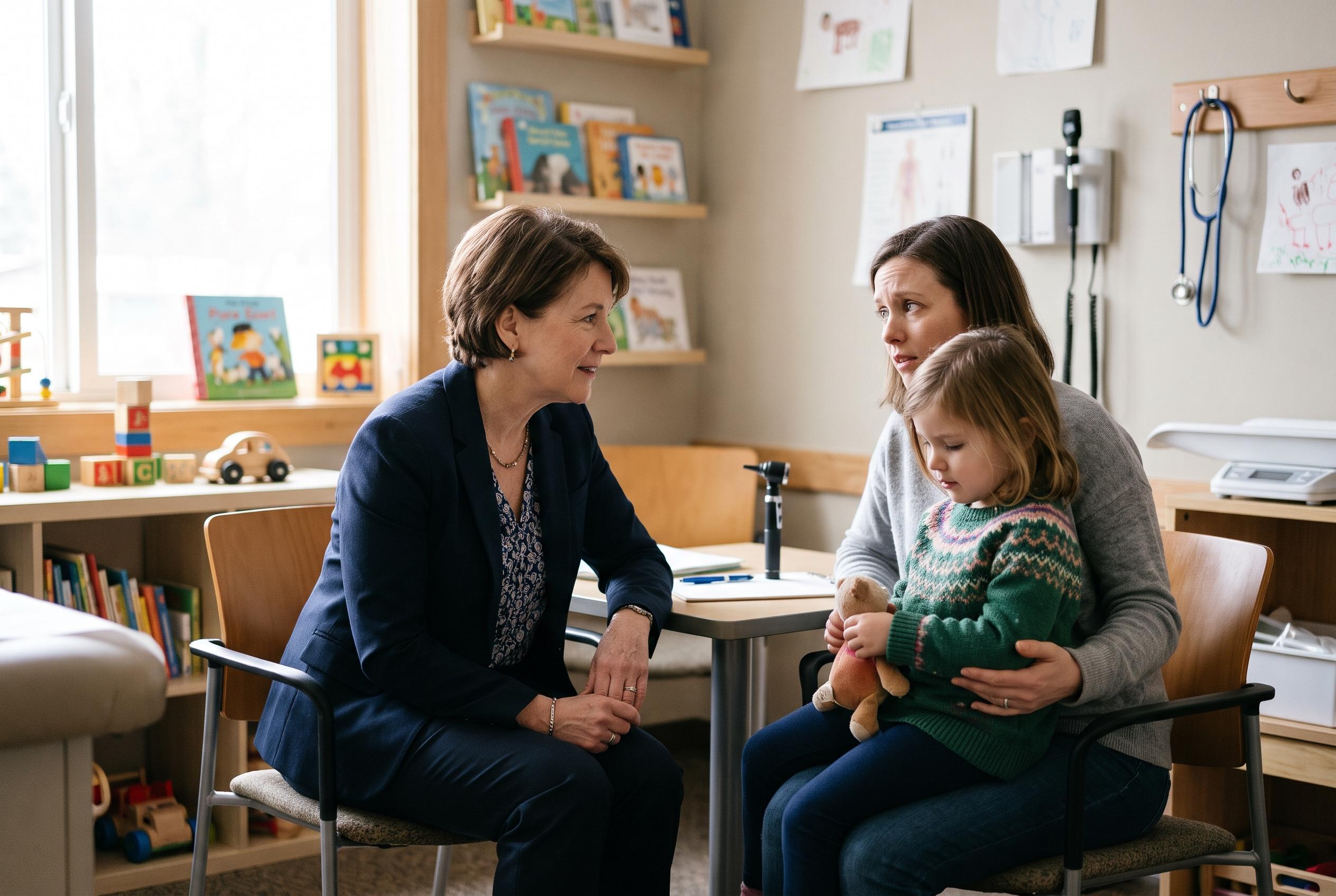

As specialist shortages and long waits leave families struggling to find care, paediatricians are increasingly expected to diagnose and treat anxiety and depression despite limited training and time.
The growing burden of children’s mental health is pushing paediatricians into a role many were never fully trained for. At a conference in Los Angeles on anxiety and depression, doctors and other paediatric professionals were urged to do more than spot problems: they were asked to diagnose, treat and follow children whose emotional needs once might have been referred elsewhere. That shift reflects a broader reality in American medicine, where families increasingly turn to primary care because specialist access is limited and wait times can stretch for months. According to research published in JAMA Network Open, mental-health-related visits in Massachusetts primary care rose sharply from 9.5% of paediatric visits in 2014 to 16.2% in 2023, with anxiety driving much of the increase.
Experts say the pressure on paediatricians is being driven by a shortage of child mental-health specialists, uneven insurance networks and a system that still often treats emotional care as separate from routine paediatrics. Megan Cole Brahim of Harvard Medical School said families frequently struggle to find in-network help, and even when they do, appointments can be far off. The American Academy of Paediatrics has argued that paediatricians are uniquely placed to help because they already see children regularly and often serve as the medical home for families. Its guidance also says paediatricians can be key links between schools, parents and other care providers when children need support.
Training, however, has not kept pace with demand. A 2022 survey of graduating paediatric residents found many felt uncertain about handling mental-health concerns, particularly anxiety and depression. Clinicians interviewed for the article described abbreviated exposure during residency and said a few lectures or a brief rotation are not enough to build confidence in an area that now shows up in everyday practice. In July 2025, the Accreditation Council for Graduate Medical Education said paediatric residents would need an additional four-week rotation in mental and behavioural health, but some doctors and researchers say that still falls short of what is needed.
Time is another major obstacle. The American Academy of Paediatrics says many doctors are seeing too many patients too quickly to address complex emotional concerns properly. Amanda Furr, a paediatrician and chief medical officer of Zarminali Pediatrics, said standard appointments can be as short as 15 to 30 minutes, leaving little room for the sort of detailed conversations mental-health care requires. That pressure can make it difficult to assess a child thoroughly, speak privately with parents and decide whether medication, therapy or both may be appropriate.
The article’s account of a West Coast family illustrates how paediatric care can work when it is paired with practical tools. A mother described how her 10-year-old daughter developed severe bedtime anxiety after a family health crisis and weather damage to the home. The child’s paediatrician used the SCARED questionnaire, a standard anxiety screening tool, to help gauge severity and confirm that the symptoms met the threshold for an anxiety disorder. The doctor then discussed treatment options, recommended therapy, and suggested SPACE, a parent-focused programme designed to help families respond to anxiety without reinforcing it. The example shows how screening, counselling and parent coaching can substitute for a specialist that may not be readily available.
The American Academy of Paediatrics has been urging a broader, systems-based response. Its mental-health initiatives stress early identification, better screening and stronger partnerships with schools and community providers. It has also highlighted the value of paediatricians in crises, when children may need help coping with trauma or disruption. But the article suggests that while better training and more coordinated care could help, the profession is already being asked to practise differently. For now, many paediatricians are learning on the job, building confidence case by case, while families increasingly depend on them to notice what is wrong and help chart a way forward.
Disclaimer: This content is for informational purposes only and is not intended to be a substitute for professional medical judgment, advice, diagnosis, or treatment.