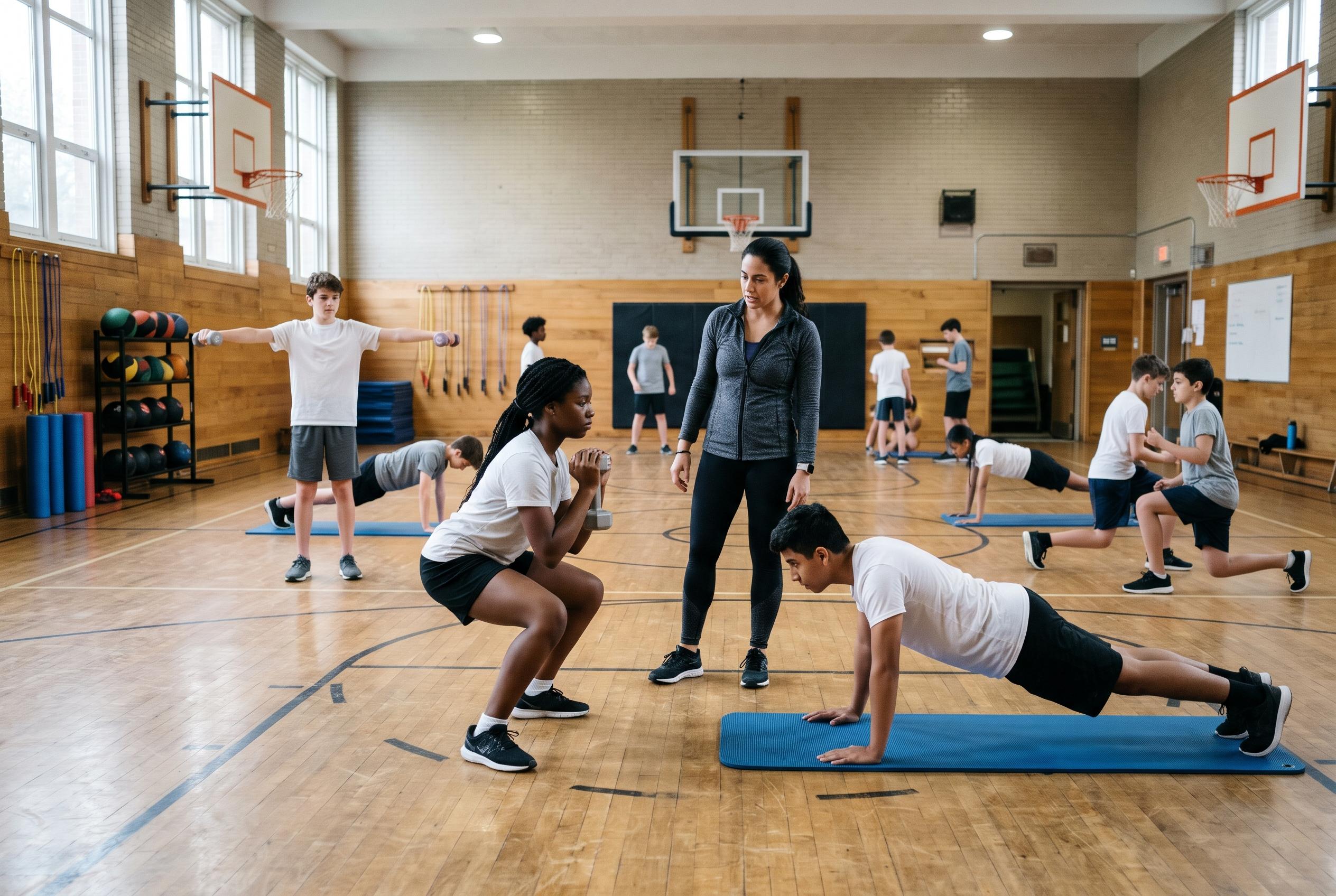

Well-supervised strength training can build pupils’ physical literacy, confidence and safety awareness , but lessons should assess control and decision-making rather than repetitions or weight lifted.
In physical education, strength training should not be treated as a contest over who can lift the most or complete the biggest number of repetitions. Its real value lies in teaching pupils how to move with control, select an appropriate challenge and understand how to build strength safely. That means the learning goal is knowledge and judgement as much as effort.
A child who finishes a push-up sequence on a wall may have learned more than a classmate who completed more repetitions on the floor if the first pupil understood the movement, chose the right variation and used feedback well. That distinction matters in school PE because the subject is supposed to build understanding, not simply exhaust students. According to the American Academy of Pediatrics, resistance training can be a worthwhile part of youth physical education when it is supervised properly, progresses at an appropriate pace and places technique first.
Research from paediatric and sports medicine journals supports that view. Reviews of youth resistance training have found that well-designed programmes can improve strength, support physical literacy and reduce injury risk, while remaining safe when qualified adults provide instruction and supervision. The evidence also suggests that these benefits are not limited to older teenagers or athletes already on sports teams.
That point is particularly important in school settings, where PE serves every pupil, not just those who play competitive sport. Strength education can help students learn how muscles work against resistance, how to use bodyweight exercises, elastic bands or other suitable equipment, and how to judge when a movement is too easy, too difficult or unsafe. In that sense, a strength lesson is not about turning the gym into a weight room. It is about building competence, confidence and informed decision-making.
The science also challenges a common misconception: that children cannot benefit from strength work before puberty. In fact, improvements can begin earlier, largely because the nervous system becomes better at recruiting and coordinating muscles. The American Academy of Pediatrics has also reported that appropriately designed resistance training does not appear to damage growth plates or slow linear growth. The key issue is not whether young people may participate, but whether the activity is suitable, well taught and supervised.
Safety depends on the way the lesson is structured. Studies in youth training show low injury rates when sessions focus on proper technique, sensible progression and careful oversight. By contrast, poor supervision, unsafe equipment use and rushing pupils into heavier loads can create unnecessary risk. Schools therefore need to treat safe practice as part of the curriculum, not as an afterthought.
A well-designed unit can also support confidence. A 2019 review of studies involving young people found improvements in resistance-training self-efficacy, perceived strength and some aspects of self-worth, although the evidence was not uniform across every outcome and study quality varied. The educational lesson is not that strength training automatically transforms confidence, but that it gives pupils clear, achievable wins: choosing a suitable variation, applying feedback and recognising when they are ready for a greater challenge.
For that reason, strength training in PE should be assessed as learning, not just performance. Pupils should be able to demonstrate an approved movement with control, explain why they chose a particular variation, identify safety rules and describe when they would reduce the difficulty. A short unit cannot replace long-term training, but it can give students a framework they can use later in sport, exercise or everyday life.
Disclaimer: This content is for informational purposes only and is not intended to be a substitute for professional medical judgment, advice, diagnosis, or treatment.