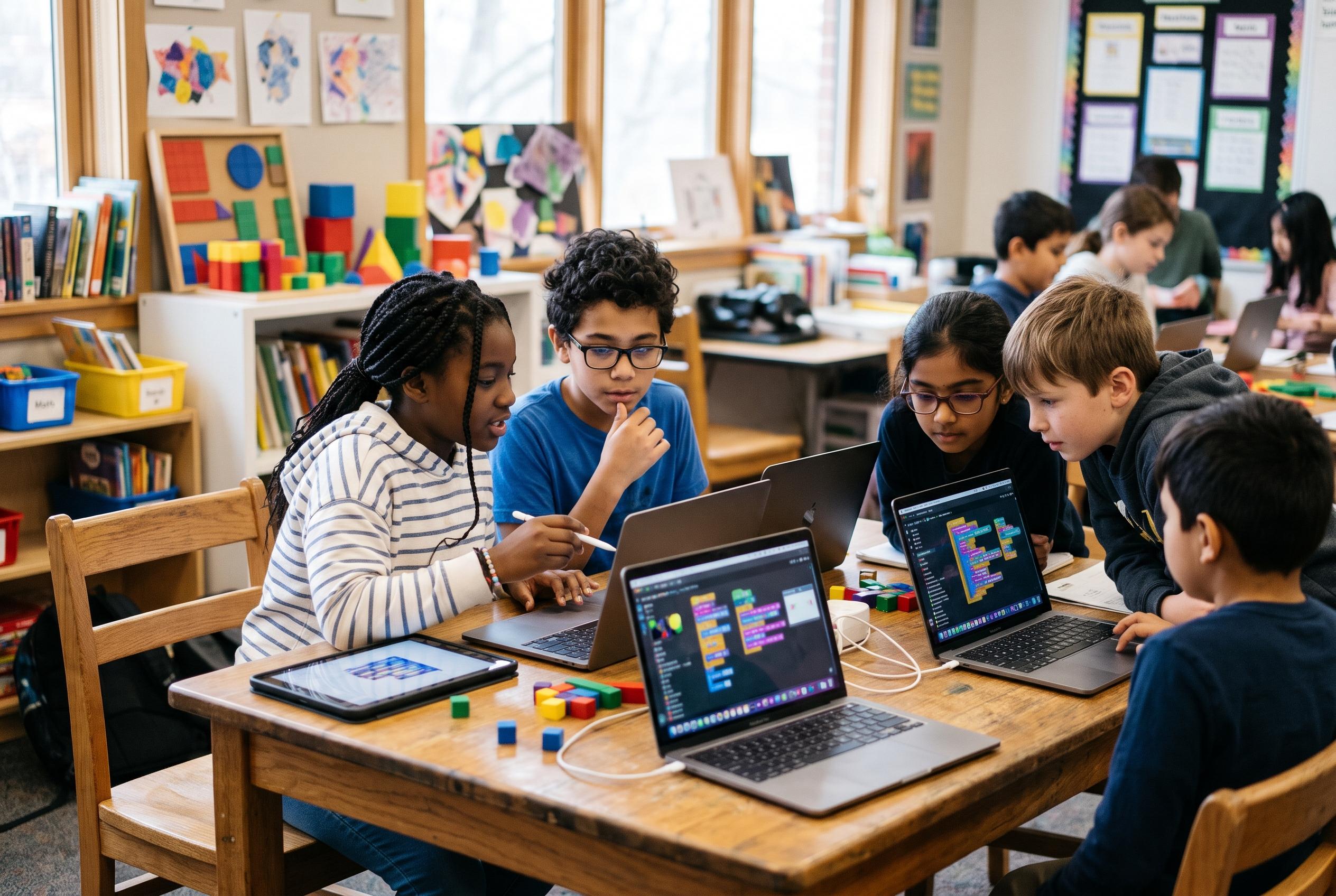

Research suggests programming can strengthen creative thinking, maths and reflective problem-solving, but its benefits transfer less reliably to literacy and overall academic performance.
Coding can do more than support maths lessons.It can help children build habits of mind that carry into other subjects, though the benefits are uneven. Research cited by MakerKids points to gains in creative thinking, metacognition, spatial skills and reasoning, with smaller improvements in literacy and overall school performance. In practice, that means programming is best seen as a way to strengthen problem-solving rather than a universal route to better marks.
That pattern fits what education researchers have found in larger studies. A 2019 meta-analysis by Ronny Scherer and colleagues, which brought together 105 studies and 539 effect sizes, found a moderate overall transfer effect from learning to programme. The strongest gains appeared in creative thinking, mathematics and metacognition, while literacy and broader academic achievement showed the weakest results. The findings suggest that coding helps most when the skills involved are close to the task itself.
The value of that transfer may lie in the way coding encourages children to check their own thinking. When a programme does not work, they have to trace the error, test a new approach and try again. That same process can help them review a maths answer, edit written work or prepare for a test. In other words, coding may sharpen the reflective habits that sit behind learning across the curriculum.
Ontario has already moved in this direction. The provincial mathematics curriculum for Grades 1 to 8 includes coding concepts, and the government says pupils should solve problems and create mathematical representations using coding skills. Other guides to the curriculum describe a gradual build-up from simple sequences in early primary years to more advanced uses, including data analysis by Grade 8. That means many children are already being introduced to coding in school, even before they take part in clubs or private classes.
Extra lessons can still matter if they give children more time to apply the same ideas in different settings. Providers such as MakerKids say their classes aim to connect coding, robotics, Minecraft and 3D design with classroom learning. The broader point for parents is that transfer does not happen automatically. It is more likely when adults help children name the connection between a coding task and a school assignment, whether that means debugging a game, planning a science project or building a history-themed activity.
Disclaimer: This content is for informational purposes only and is not intended to be a substitute for professional medical judgment, advice, diagnosis, or treatment.