

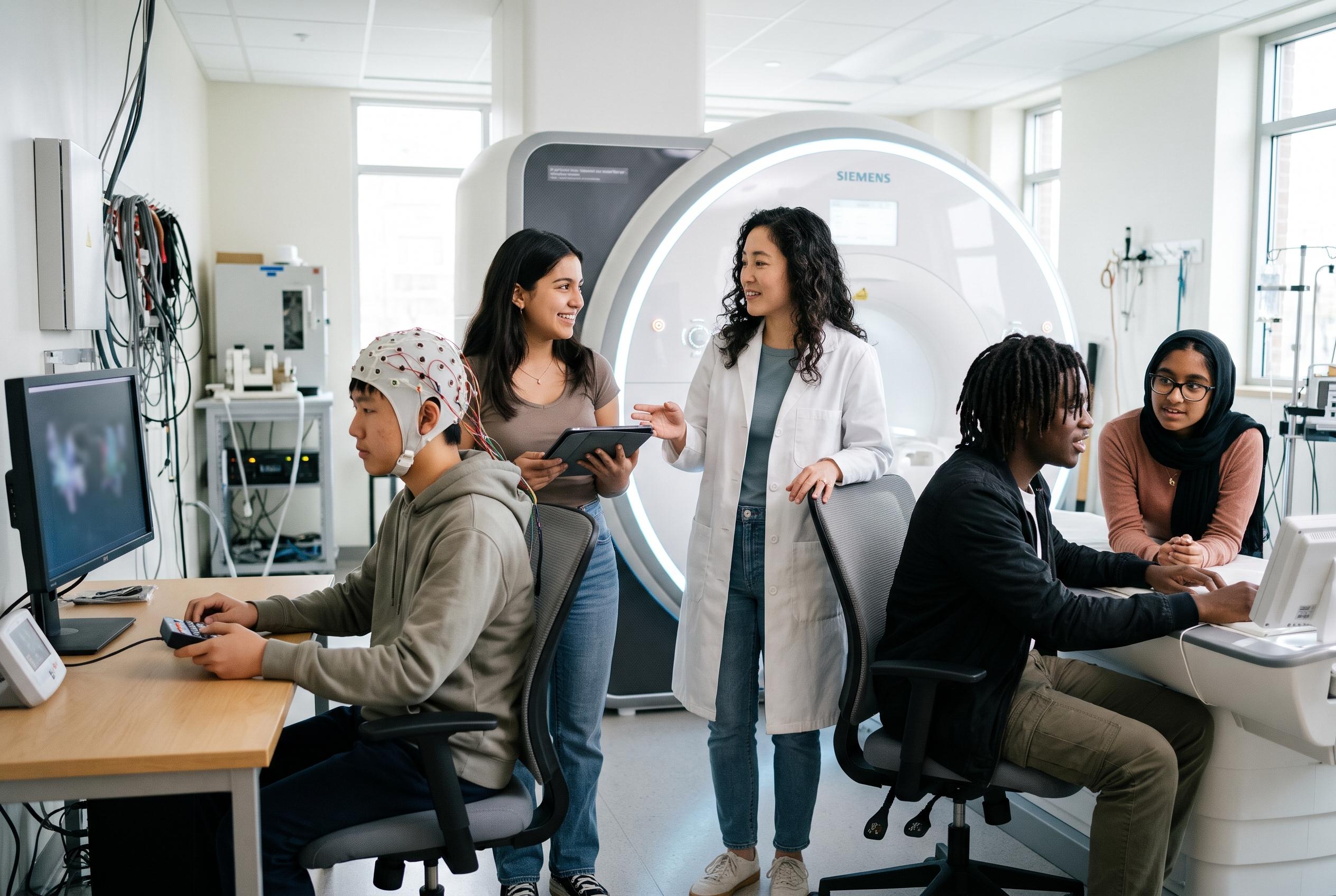

Researchers will track 450 young people over several years using advanced brain scans and behavioural assessments to examine how development shapes learning, wellbeing and social development.
Cardiff University researchers are set to play a leading role in a long-term study designed to map how the brain changes as children move through adolescence, a period when learning, emotions and behaviour can shift dramatically.
The Brain Exploration in Adolescent Minds, or BEAM, study will follow 450 young people over several years, combining repeated brain scans with games and other assessments. According to Cardiff University, the project is intended to build a far more detailed picture of brain development than is currently available, with a particular focus on how microscopic structural changes may shape cognition, social development and mental health.
The research team will study 350 typically developing children aged eight to 14, alongside 100 young people with 22q11.2 deletion syndrome, a genetic condition linked to a higher risk of developmental and mental health difficulties. The study is being funded by Wellcome and brings together researchers from Cardiff University, the University of Cambridge and the Donders Institute in the Netherlands.
Participants will be scanned at Cardiff University Brain Research Imaging Centre, known as CUBRIC, using its Connectom scanner. Cardiff says the system is one of only four in the world capable of capturing brain images at this level of detail. The centre’s microstructural imaging work is designed to look beyond standard MRI and examine the brain’s tissue architecture more precisely, helping scientists study white matter and other changes in the developing brain.
Dr Jessica Hall, a researcher on the project, told BBC Breakfast that puberty-related hormones explain only part of what happens in the teenage years. “If we think of the teenage brain as a complex highway, new roads are being built to make things more efficient, but it causes a huge amount of disruption for young people,” she said.
Hall said the team will pair scans with tasks carried out on an iPad so researchers can link brain development with emotional wellbeing, learning and social functioning. The study is co-led by Cardiff professors Derek Jones and Marianne van den Bree, alongside Sarah-Jayne Blakemore at Cambridge and Rogier Kievit at the Donders Institute.
Disclaimer: This content is for informational purposes only and is not intended to be a substitute for professional medical judgment, advice, diagnosis, or treatment.



