

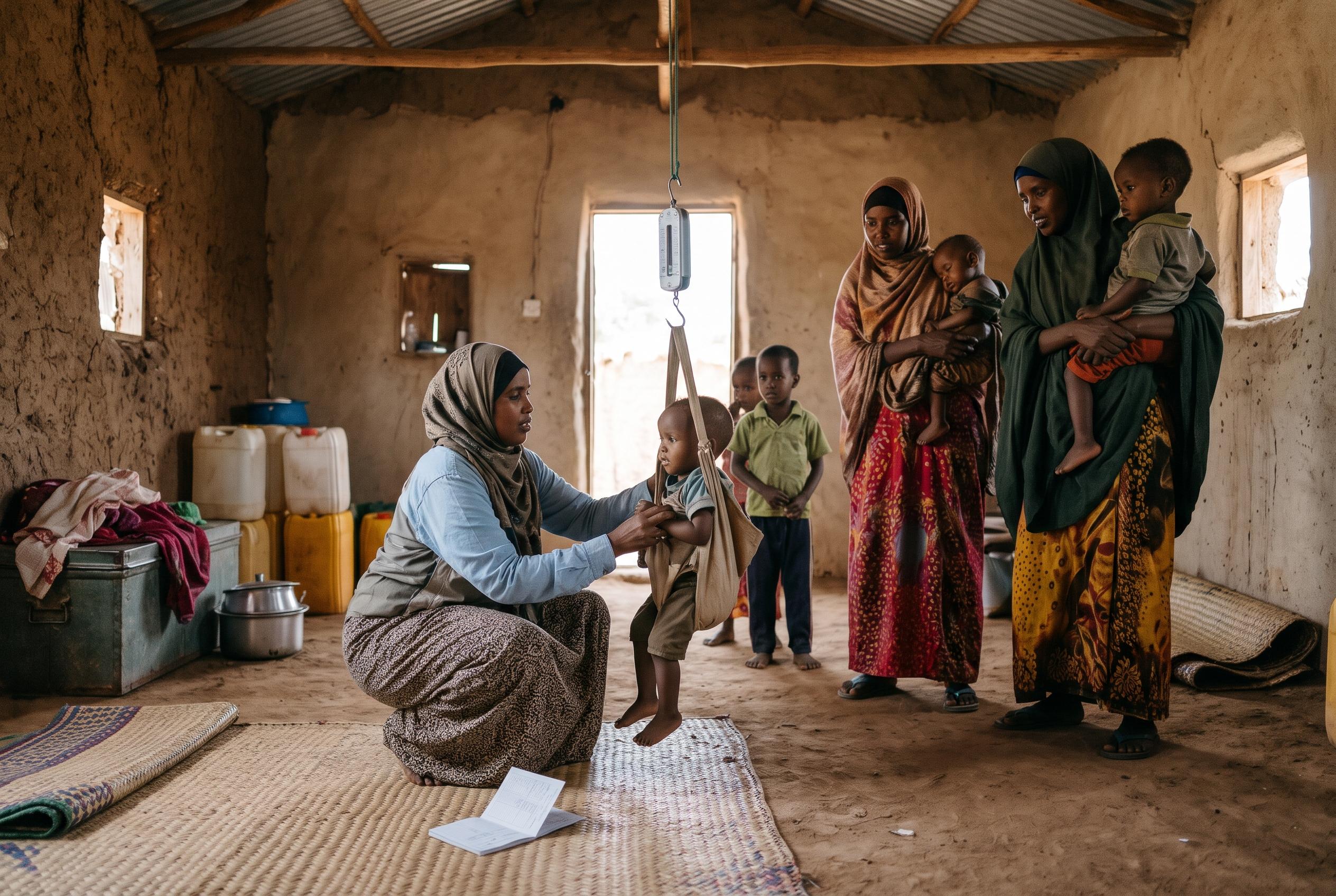

Research from Somalia suggests that preventing wasting, combining cash with caregiver support and tracking children after treatment could deliver greater gains than relying on treatment alone.
A new analysis of child wasting in Somalia argues that the global nutrition response has leaned too heavily on treatment and not enough on prevention. The authors say community-based management, simpler protocols and better therapeutic foods have made wasting more treatable, but progress in stopping new cases has been far slower, especially in countries facing prolonged crisis. Their central point is that acute malnutrition should no longer be viewed only as an emergency to be cured, but as a condition shaped by poverty, conflict, food insecurity, illness and weak services.
That wider framing matters because cash assistance alone has often delivered mixed results for child nutrition. Systematic reviews of cash transfer programmes have found that they can improve household food security, dietary diversity and some measures of growth, but the impact on wasting itself is usually small or absent. The studies suggest that money can help families buy food, yet it does not automatically change feeding practices, health-seeking behaviour, hygiene or the balance of decision-making within households. In other words, the transfer is only one part of the answer.
The Somalia evidence builds on that point by showing that integrated support can perform better than cash delivered on its own. In the adaptive cluster-randomised trial described by the authors, cash alone did not reduce wasting, but cash paired with social and behaviour change communication did. The package was also judged cost-effective. Qualitative findings from the same work suggest that caregivers found value in mother-to-mother support groups and cooking demonstrations, pointing to the importance of practical guidance alongside financial aid.
Somalia is a particularly revealing case because it combines several of the drivers now common in humanitarian crises: conflict, climate shocks, displacement, food insecurity and a strained health system. The authors argue that these pressures make it hard to separate nutrition from the wider environment in which families are living. They also note that humanitarian finance is tightening. Official development assistance fell sharply in 2025, with cuts in United States government funding accounting for much of the overall drop, raising the stakes for programmes that need to demonstrate value as well as effectiveness.
Another major issue highlighted by the Somalia studies is how wasting is measured. For years, practitioners have debated whether weight-for-height z-scores or mid-upper arm circumference is the better screening tool. The findings from Somalia add to the evidence that the two measures do not identify the same children, which means important cases can be missed if programmes rely on only one indicator. Expanding case definitions could improve detection, but it would also increase caseloads in settings where staff, supplies and funding are already stretched.
The studies also draw attention to a neglected problem after treatment ends: relapse. The authors found that nearly one in three children who had recovered from wasting relapsed within six months, with the highest risk soon after discharge. That finding challenges the common assumption that anthropometric recovery means the child is no longer vulnerable. Instead, it suggests that treatment should be followed by closer post-discharge support and that wasting should be managed as a continuum, not a single episode of care.
Taken together, the Somalia work argues for a broader shift in global nutrition policy. Treatment remains essential, but the evidence points to the need for programmes that link nutrition support with social protection, health services, food systems work and caregiver counselling. The authors stop short of claiming that they have solved the problem of wasting, but they make a compelling case that progress will depend on preventing children from becoming wasted in the first place, identifying risk more accurately and supporting recovery long after discharge.
Disclaimer: This content is for informational purposes only and is not intended to be a substitute for professional medical judgment, advice, diagnosis, or treatment.



