

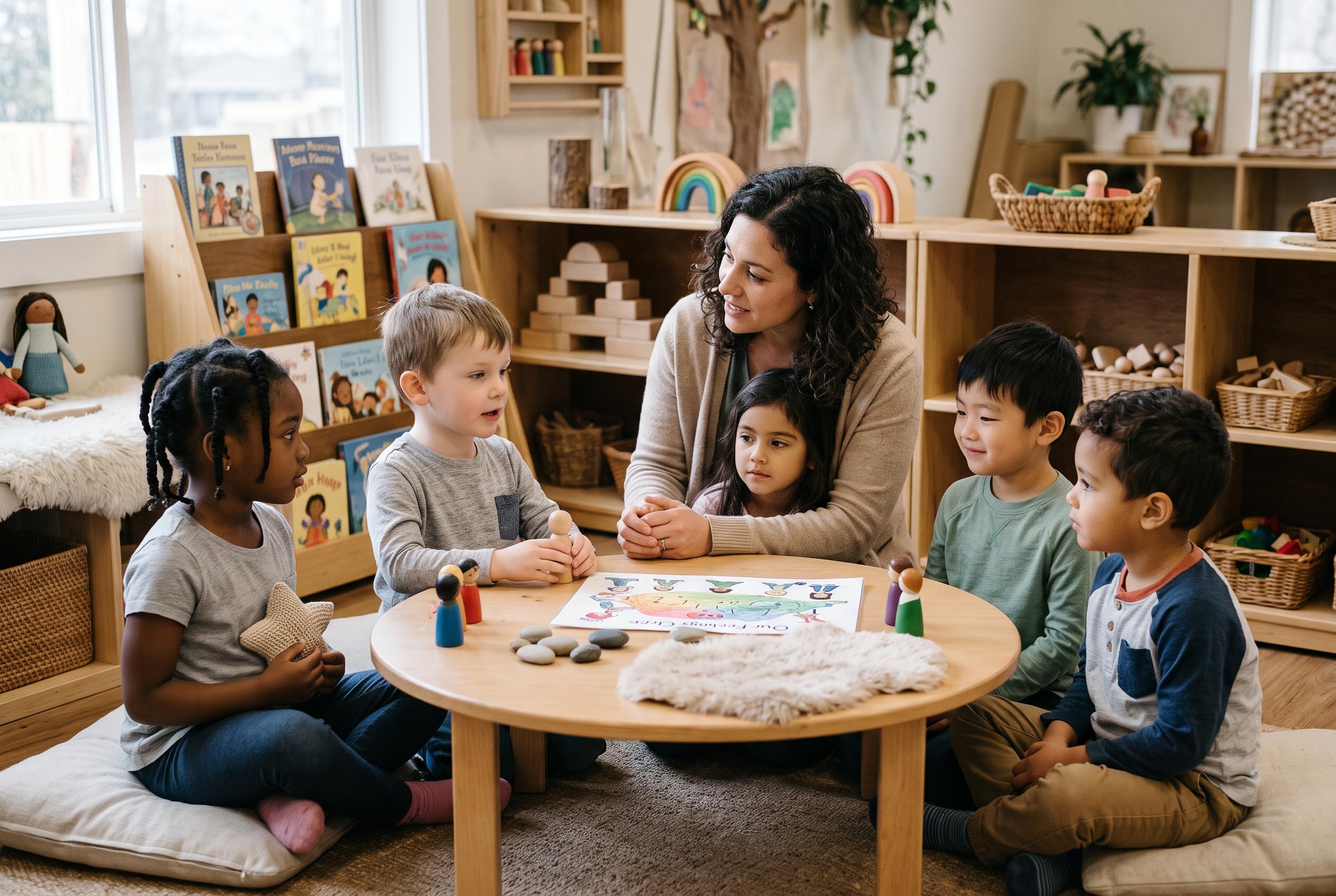

A study of 377 children in Málaga finds that emotional abilities develop alongside cognitive and communication skills, while remaining distinct from them.
A study of Spanish preschool children suggests that emotional intelligence develops in step with broader thinking, language and motor skills, but that it is not simply a mirror of those abilities. The research, published in Frontiers in Psychology, examined 377 children aged 48 to 83 months and found that performance-based emotional skills rose with age, though more modestly than general developmental abilities. Girls scored slightly higher than boys in emotion perception, while boys did a little better on cognitive tasks, but the gender effects were small overall.
The study is notable because it used a performance-based test of emotional intelligence rather than relying on teachers’ or parents’ reports, which can be shaped by perception and social desirability. Researchers used the Botín Foundation’s child-focused emotional intelligence test, which asks children to identify facial expressions, work out how characters feel in short stories and choose appropriate emotion-management responses. They paired that with the Battelle Developmental Inventory, a long-established assessment of cognitive, communication and motor development.
Across the sample, older children scored better on all the measured abilities, from cognition and language to recognising and managing emotions. The relationships were strongest for the general developmental domains and more modest for emotional intelligence. When the researchers tested whether age followed a curved trajectory rather than a straight line, they found only trivial gains from adding a quadratic pattern, suggesting that, between the ages studied, development was largely linear.
The links between emotional intelligence and general development were real but limited. Cognitive ability emerged as the clearest predictor, independently helping to explain emotion perception and, even more strongly, emotion management. Communication ability, meanwhile, predicted emotion understanding. Motor skills were associated with emotional intelligence at the simple correlation level, but they did not add anything once the other factors were taken into account. In practical terms, the authors argue that emotional learning in early years settings may work best when it is tied to age-appropriate language and thinking activities rather than treated as a separate subject.
The findings also add nuance to a long-running question about whether girls tend to outperform boys in emotional abilities. The answer here was only partly yes. Girls were slightly better at recognising emotions, but there were no meaningful gender gaps in understanding or managing feelings. The authors say that the stronger gender differences often seen in adolescence and adulthood may not yet be fully established in the preschool years.
The researchers caution that the study was cross-sectional, meaning it captures one point in time rather than tracking children as they grow. The sample was also limited to children in Málaga, and the models explained only a modest share of the variation in emotional intelligence. Even so, the paper adds to evidence that emotional skills are woven into wider development from an early age, rather than emerging in isolation.
Disclaimer: This content is for informational purposes only and is not intended to be a substitute for professional medical judgment, advice, diagnosis, or treatment.



