

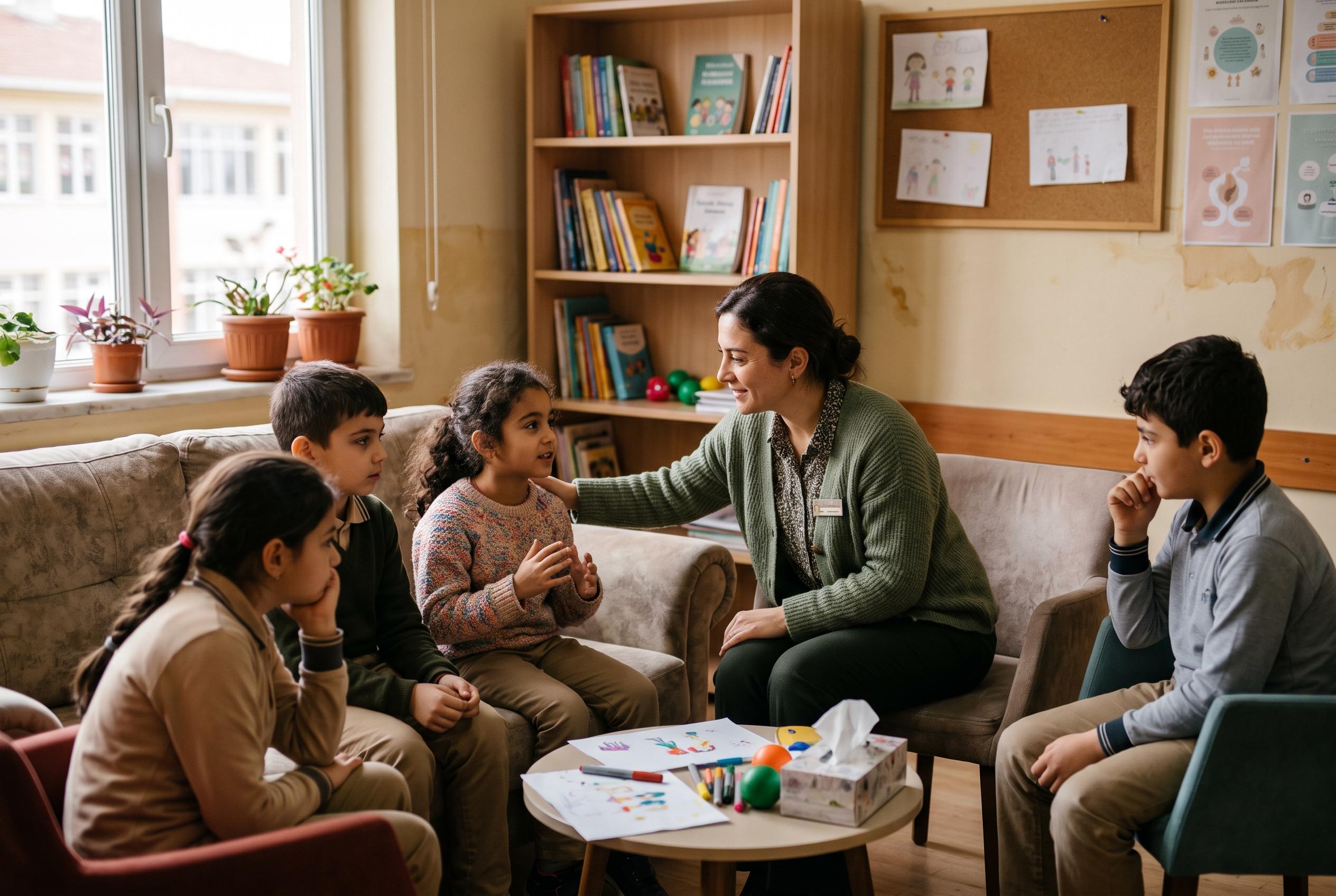

An education expert has called for every school in Türkiye to have a psychological counsellor, arguing that early support, empathy and family involvement are more effective than punishment alone in preventing violence and bullying.
An education writer in Türkiye is urging schools and families to move beyond punishment and place compassion, guidance and early support at the centre of efforts to prevent violence among pupils. In an interview published by Haber7, Ismail Yolcu argued that every school should have at least one psychological counsellor, saying that students’ emotional wellbeing, safety and academic progress are closely connected and cannot be separated from the wider work of education.
The interview with Mehmet Engin Deniz, a professor at Yildiz Technical University and head of the Turkish Psychological Counselling and Guidance Association, framed school counselling as a preventive service rather than a remedy reserved for crises. Deniz said guidance helps children understand themselves, recognise their potential, build healthy relationships and make better decisions. That approach closely matches school-based mental health models used elsewhere, including services described by the Tennessee Department of Education and the Tulare County Office of Education, which combine classroom guidance, counselling, crisis intervention, family consultation and referrals as part of a broader support system.
Deniz also drew a clear distinction between general aggression and bullying. Bullying, he said, involves a power imbalance, harmful behaviour and repetition or the likelihood of repetition, and it can take place online as well as in person. That definition reflects the emphasis found in school counselling programmes in the United States, where providers such as CORA Services and Youth Guidance include cyberbullying, social skills, stress management and school climate among their priorities. The interview stressed that a child being mocked, excluded, threatened or humiliated repeatedly may suffer serious psychological harm even when no physical assault takes place.
A central theme of the discussion was the role of empathy, kindness and self-compassion in preventing violence. Deniz said children should learn not only what to avoid, but also what values to practise. He described empathy as the ability to understand another person’s feelings, while compassion involves recognising suffering and wanting to ease it. He also said children need to learn kindness towards themselves, because a child who cannot tolerate mistakes or regulate emotions may struggle in relationships too. Programmes such as those described by Cityscape Schools and ERA ED similarly connect social and emotional learning with academic success, using counselling, behaviour support and parent training to help students cope with stress and strengthen their relationships.
The interview placed significant responsibility on families. Deniz said children absorb behaviour by watching how adults speak, argue and resolve conflict at home. Parents, he argued, should pay attention not only to grades but also to shifts in mood, isolation, anger and aggression, and should ask what may be happening beneath the surface rather than assuming every difficult behaviour is a direct sign of violence. The article also highlighted the importance of knowing what children encounter online, but said the aim should not be constant surveillance. Instead, it should be trust-based communication between parents and children.
Schools, Deniz said, must reinforce that work through a whole-school approach, with teachers, headteachers, counsellors, families and pupils all involved. He called for stronger preventive and developmental guidance services, better staffing and working conditions for counsellors, and clearer professional boundaries for the occupation. He said the Turkish Psychological Counselling and Guidance Association wants the profession’s scientific basis, ethical standards and public standing to be strengthened, along with wider access to high-quality counselling services outside schools. The wider message of the interview was straightforward: violence is less likely to take root when children are taught to understand themselves, respect others and use their strength without causing harm.
Disclaimer: This content is for informational purposes only and is not intended to be a substitute for professional medical judgment, advice, diagnosis, or treatment.



