


Birthdate cut-offs shape eligibility, but a child’s ability to manage routines, separate from caregivers and engage with others may matter just as much when choosing pre-K for 2026–27.
For many families, the question is not just when a child can start pre-K, but when they are ready for it. The answer depends on more than age alone. State rules, programme cut-off dates and a child’s developmental progress all shape the right moment to begin formal early learning. As one guide on early childhood education notes, most public pre-K programmes in the United States are aimed at four-year-olds, although some private and state-funded settings also take three-year-olds. Families planning for the 2026–27 school year are being urged to check the exact birthdate requirement with each provider, since eligibility rules differ by state, district and school.
That distinction matters because preschool and pre-K are not the same thing, even though the terms are often used interchangeably. Education providers and parent guidance from Mountainside Children’s Center, ABC Child Care, My Masters Academy and DaycarePal all describe preschool as the stage that usually serves younger children and centres on social development, independence and play. Pre-K, by contrast, is generally aimed at children closer to kindergarten and combines play with more deliberate school-readiness work. In practice, the difference often comes down to age, classroom structure, tuition and whether the programme is publicly funded.
For three-year-olds, the focus is often on separation, routine and learning how to function in a group. The goal is less about academics than about helping children build self-regulation, independence and comfort away from home. Many programmes encourage children to practise sharing, taking turns and following simple rules, while also developing comfort with sensory activities, block play and other forms of hands-on exploration. Potty training is not always a formal requirement, but it is commonly seen as a helpful milestone that makes the transition easier.
By the time children reach four, many are ready for a more structured pre-K setting. The emphasis shifts towards kindergarten preparation, with more intentional work on early literacy, number sense and classroom routines. Children in this age group are usually expected to follow multi-step directions, stay with group activities for longer stretches and begin solving simple problems with support from teachers. The aim is still play-based learning, but with a clearer academic purpose.
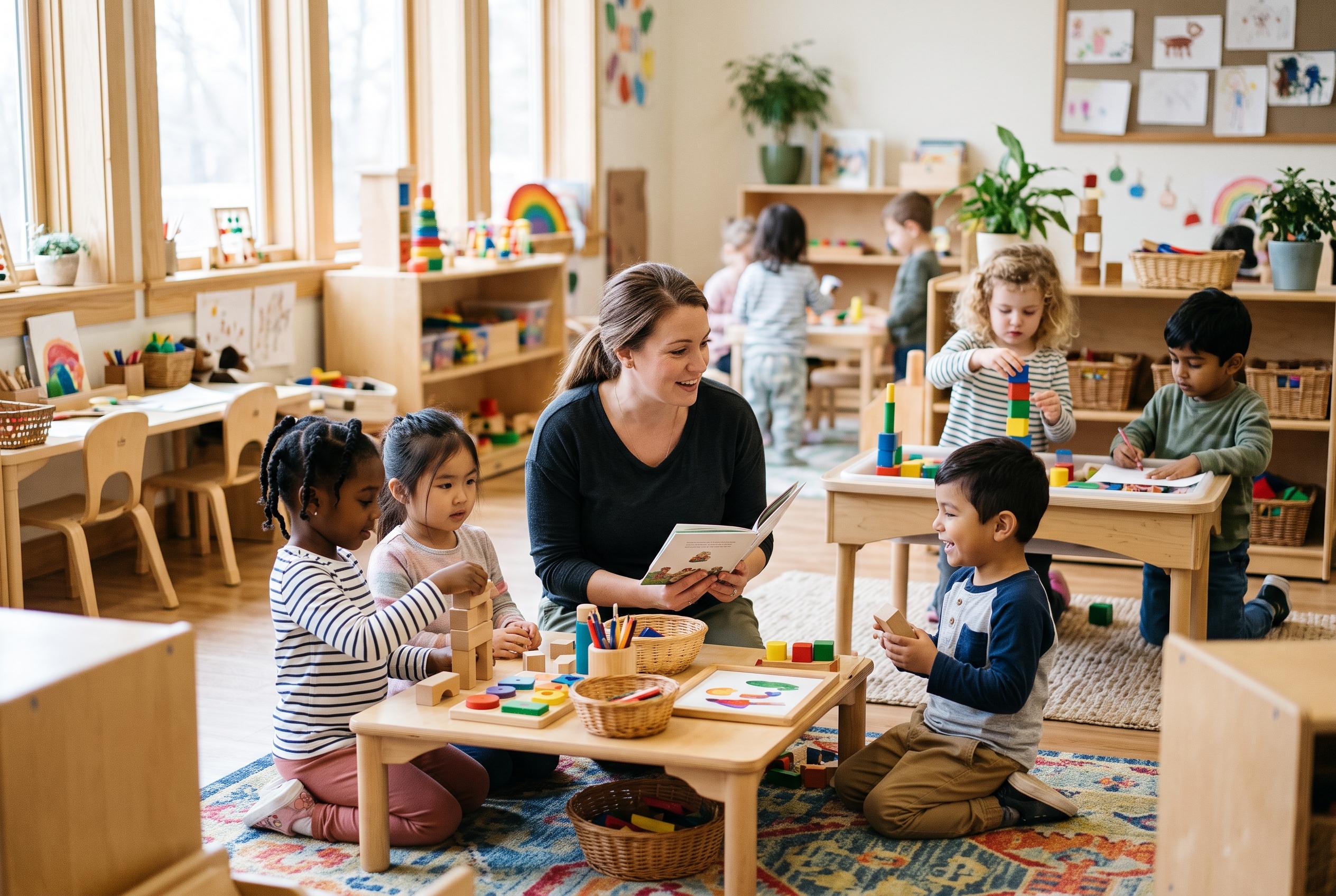
That approach reflects the broader consensus on high-quality early childhood education: children learn best when academic preparation is woven into active, exploratory play. In a strong pre-K classroom, a block-building exercise can support spatial reasoning, language development and cooperation at the same time. Fine motor skills are built through drawing, cutting and puzzles, while gross motor development comes from running, jumping and outdoor movement. Teachers also use stories, songs and conversation to expand vocabulary and build the language children will need later in school.
Social-emotional learning remains at the centre of that experience. Children in pre-K are learning how to name feelings, manage frustration and recover from disappointment. They are also practising practical independence, from washing hands and eating without constant help to dressing themselves and tidying up after activities. The early childhood guide also highlights executive function skills such as attention, memory and self-control, all of which are strengthened through guided play and predictable routines. These habits, while easy to overlook, often matter as much as early reading and counting.
State policy plays a major role in determining who gets access to these programmes. The guide points to Michigan’s Strong Beginnings initiative, which has expanded rapidly and is aiming to provide free, high-quality pre-kindergarten for three-year-olds. It also cites New Jersey’s long-running Abbott programme, which provides comprehensive pre-K in qualifying high-need districts. At the same time, access across the country remains uneven. Some places offer universal pre-K, while others limit places by income, residency or both. In some communities, demand still outstrips supply, leaving families to face waiting lists even when children are technically eligible.
Quality is another crucial factor. A strong programme is not defined only by its curriculum, but also by how it is staffed and managed. Lower child-to-teacher ratios allow for more individual attention, more effective behaviour support and stronger relationships between adults and children. The guide cites examples such as North Carolina’s 1:9 ratio and Arlington Independent School District’s cap of 22 children in a full-day pre-K 4 class, supported by both a certified teacher and an assistant. It also notes that many state programmes require qualified teachers, ongoing training and, in some cases, accreditation or classroom-quality assessments such as CLASS, which measures how well teachers interact with children.
For parents trying to decide whether their child is ready, the signs are often practical rather than dramatic. A child who can separate from a caregiver without extreme distress, follow simple instructions, express needs clearly and show interest in other children is usually better prepared for a pre-K classroom. Attention span matters too, even if it is only enough to listen to a story or stay with an activity for five to ten minutes. Families can also help by creating a more predictable routine at home, visiting classrooms in advance, talking openly about feelings and encouraging simple self-care skills. In the end, the best pre-K choice is the one that matches both the child’s developmental stage and the programme’s ability to support it.
Disclaimer: This content is for informational purposes only and is not intended to be a substitute for professional medical judgment, advice, diagnosis, or treatment.



