

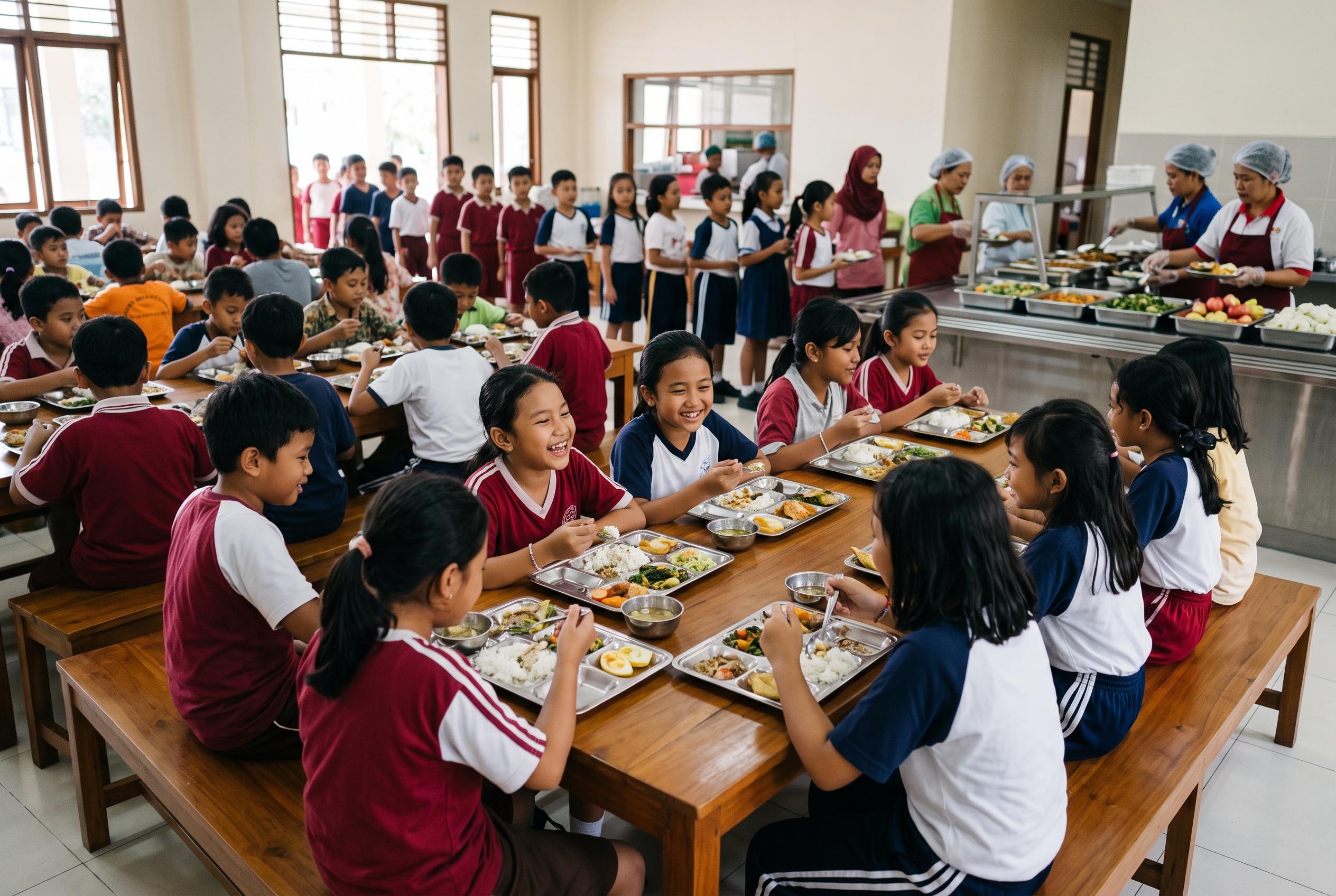

Indonesia’s Free Nutritious Meal programme has reduced the share of pupils arriving at school hungry from more than 56% to about 16%, as authorities expand coverage and tighten oversight of thousands of kitchens.
Indonesia’s Free Nutritious Meal programme is beginning to show measurable gains in classrooms, with the National Nutrition Agency saying the share of students who arrive at school hungry has fallen sharply. Tysa Novenny, a spokeswoman for the agency, said the figure has dropped from more than 56% to about 16% since the programme was introduced, while the proportion of pupils who feel full during lessons has climbed from 43% to 84%. She also said fruit consumption has risen from 26% to 84%, and protein intake, once estimated at between 30% and 40%, has increased to almost 80%.
The scheme, known as MBG, has expanded quickly since its launch and now reaches 57 million beneficiaries, including students, pregnant women, breastfeeding mothers and toddlers, according to the agency’s latest figures as of September 30. Novenny said the government’s wider aim is to help cut Indonesia’s child stunting rate to 18% by 2026 and ultimately move towards zero stunting. The programme has also become a major public spending item, with budget realisation reaching Rp153.2 trillion, or about $8.5 billion, representing 66.9% of the Rp229 trillion allocation.
As the roll-out accelerates, the authorities are also tightening oversight. Novenny said all kitchen units supplying the programme, known as Nutrition Fulfilment Service Units, have been told to connect their CCTV systems to the agency’s central monitoring network so officials can watch operations in real time and check compliance with standard operating procedures. The agency has also temporarily closed 1,276 kitchens that have not yet obtained hygiene and sanitation certificates, underscoring the government’s effort to strengthen food safety as the programme scales up.
Education officials say the benefits are extending beyond nutrition. The Ministry of Primary and Secondary Education has said the meals programme is helping pupils concentrate better in class, based on an integrated evaluation survey linked to the Seven Habits of Great Indonesian Children framework, which promotes healthy and nutritious eating habits. International organisations have also backed the initiative: the United Nations in Indonesia says the programme, launched in January 2025, is grounded in scientific evidence and international experience, while UNICEF and IPB University are among the partners supporting a national centre of excellence to improve implementation. The government’s longer-term ambition is to widen coverage to 72.4 million beneficiaries in 2027, and the expansion has already been associated with the creation of nearly one million jobs, with each kitchen employing about 47 workers.
Disclaimer: This content is for informational purposes only and is not intended to be a substitute for professional medical judgment, advice, diagnosis, or treatment.



