

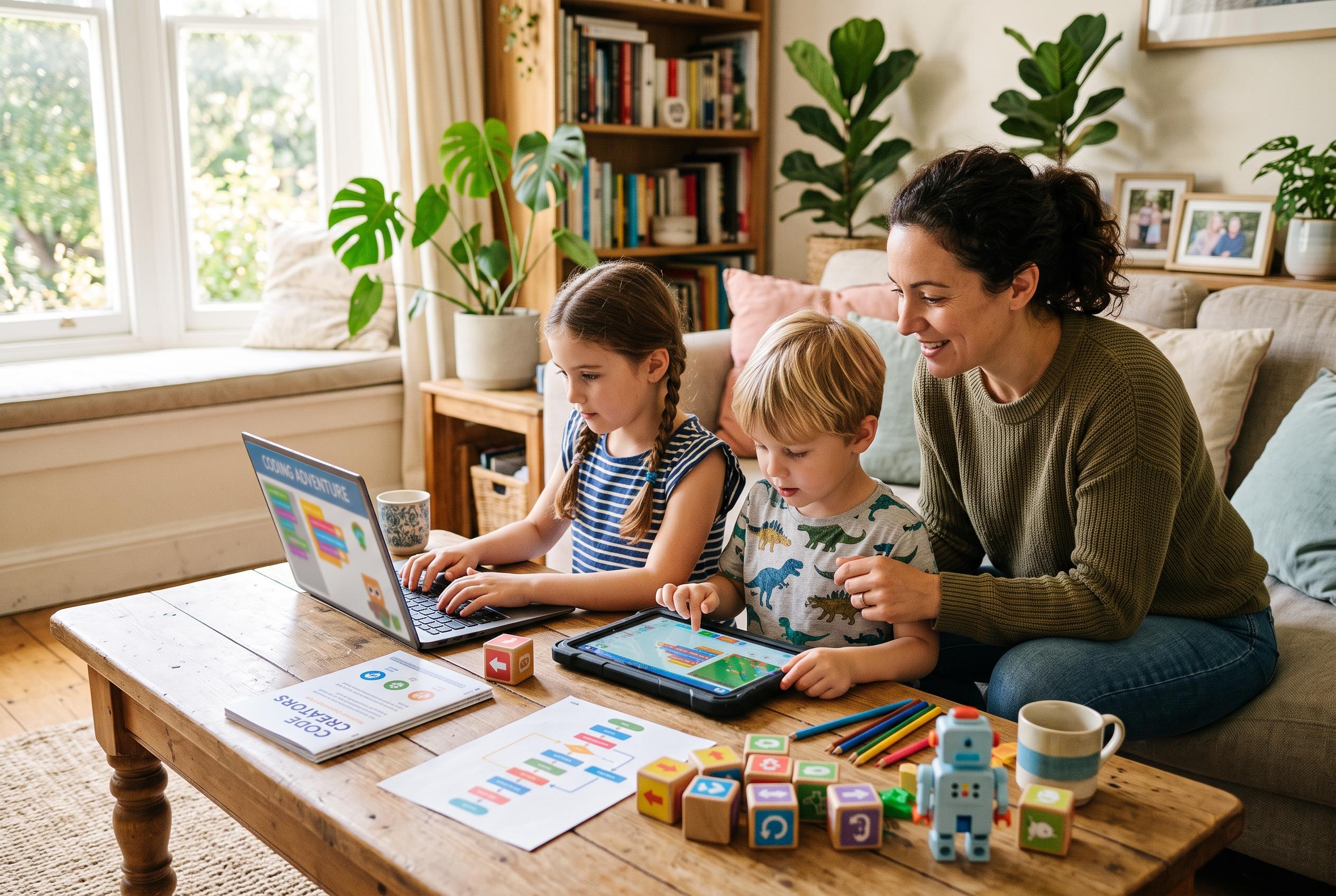

Families do not need programming expertise to introduce children to coding, with playful offline activities, short sessions and game-based tools helping turn passive screen use into creative learning.
Screens are now part of family life, but parents do not have to accept passive use as the default. A growing number of guides for families suggest that coding can turn a child’s screen time into something more active and constructive, especially when it is introduced in a playful way. The Mummy Fever article argues that even parents with no programming background can help children begin, and other guides aimed at families make the same point: you do not need to be an expert to get started.
There is a practical case for encouraging coding early. Kidscode.co.in says it can strengthen logical thinking, problem-solving and persistence by teaching children to break larger tasks into smaller steps and to keep going when something does not work first time. That is one reason schools have placed more emphasis on computing, while at home the process can also support confidence in maths, science and other subjects where step-by-step thinking matters.
For younger children, several parenting and education sites recommend beginning away from a screen. Simple games such as giving instructions to move from one room to another, or laying out arrows for a toy to follow, help children grasp the basic idea that computers only do exactly what they are told. Kubrio and Outschool both recommend this kind of imaginative, physical start because it makes the logic behind coding easier to understand before a child writes any actual code.
When families do move on to digital tools, the best options are usually the ones that feel like games. Clab School advises parents to choose free or low-cost platforms carefully, looking for age-appropriate activities with clear progression and little unnecessary distraction. For younger children, block-based systems that use drag-and-drop pieces can be a good fit, while older children may be ready for simple typed code. The common advice across the guides is to start with tools that are fun, structured and easy to follow, rather than trying to jump straight to advanced programming.
Routine matters as much as the platform. Codeyoung recommends short, regular sessions instead of long, irregular ones, saying that a predictable schedule helps coding feel manageable and prevents it from becoming a battle at home. That approach also gives parents a chance to sit alongside children, ask what they think will happen next and help them notice mistakes for themselves, which is often where the learning really takes hold.
The strongest case for coding at home may be that it gives children something they can make for themselves. Several of the guides say children are more motivated when they can build a quiz, an animation or a simple game to share with family or friends. And if a child loses interest, the experts quoted across these articles suggest stepping back rather than forcing the issue. The broader message is clear: coding does not have to feel like homework. Done well, it can be one of the most useful forms of screen time a family can choose.
Disclaimer: This content is for informational purposes only and is not intended to be a substitute for professional medical judgment, advice, diagnosis, or treatment.



