

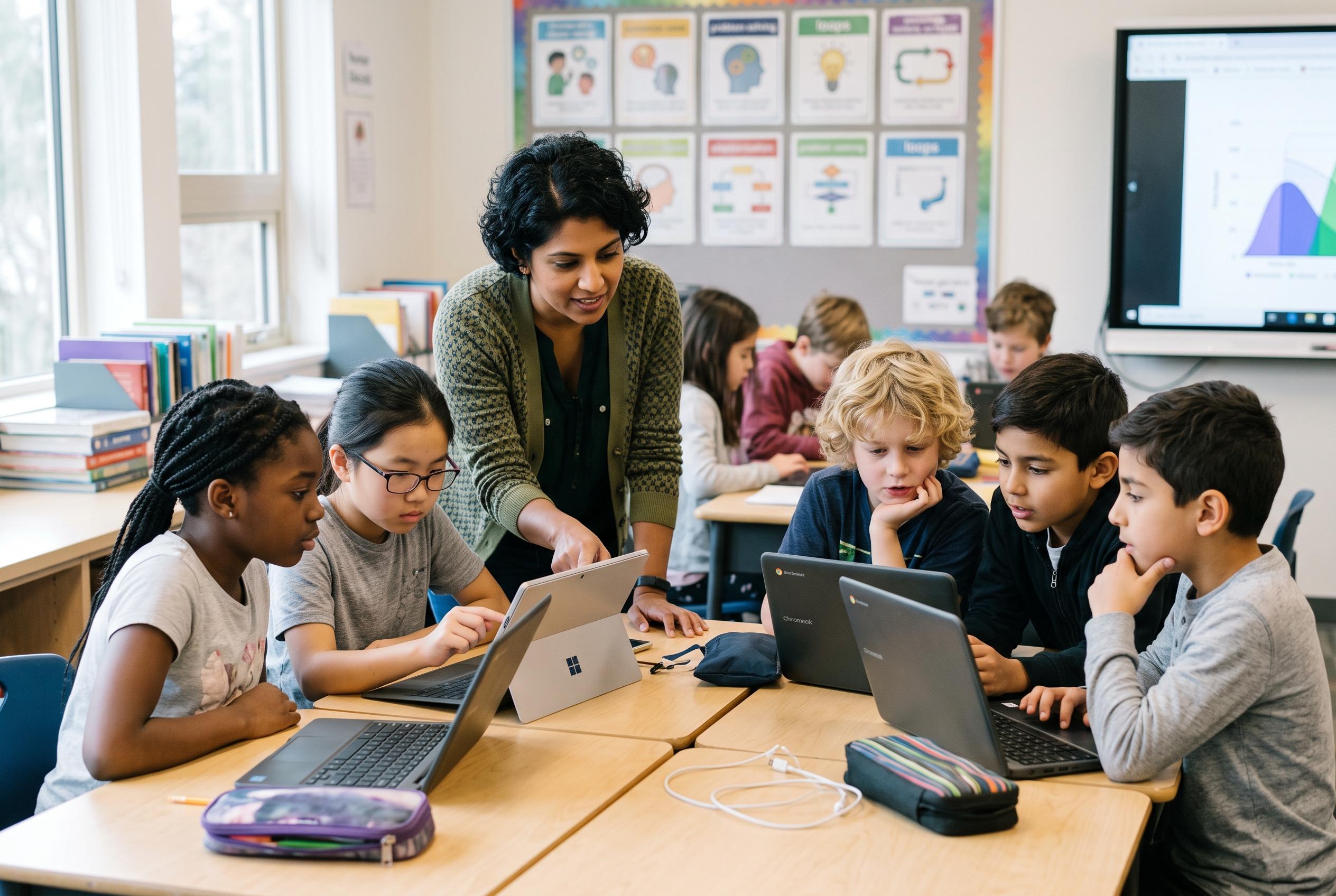

A gradual approach can help pupils understand how AI works, recognise its limits and use it responsibly, from early computational thinking to discussions of bias, privacy and deepfakes.
Artificial intelligence is already woven into children’s daily routines, from search results and streaming recommendations to voice assistants, games and learning apps. That makes AI literacy less of a specialist topic than a basic part of modern education. CodeMonkey argues that the goal is not to turn every child into a programmer, but to help pupils understand what AI is, where it appears in everyday life, how it works at a simple level and why it sometimes gets things wrong. The most effective teaching, it says, is gradual and age-appropriate rather than a one-off lesson or a rushed introduction to the latest chatbot.
For younger children, the priority is awareness rather than technical detail. At about five or six, children can learn the difference between people and machines, what computers can do, how they follow instructions and why they do not “think” like humans. That stage is also a natural entry point for computational thinking: sequencing, patterns, simple debugging and giving clear instructions. Several curriculum providers make a similar case, including Day of AI and BrightKit, which both frame early AI education around basic reasoning, pattern recognition and simple classroom activities rather than coding-heavy content.
By ages seven and eight, children are ready to handle more structure. CodeMonkey recommends introducing algorithms, decisions, inputs and outputs, alongside simple automation. The idea is to show that computers are not magical; they follow rules and process information in a predictable way. BrightKit and OMG Land both take a comparable approach, using games, puzzles and other interactive exercises to teach children how step-by-step instructions work and how patterns can be recognised. This is also a good age to connect AI concepts with classroom coding, so pupils begin to see how loops, sequences and conditional logic underpin digital systems.
Around ages nine and ten, the emphasis shifts towards data and prediction. Children can start to understand that AI systems learn from examples, use patterns in data and make guesses based on what they have seen before. CodeMonkey suggests simple sorting and classification activities, such as grouping animals by features, to make the idea concrete. That is also the right moment to teach that AI can make mistakes and that its answers should be checked, not trusted automatically. This focus on critical questioning is echoed in Kids AI Tools and Day of AI, which both stress that children should learn to verify output rather than assume that a machine is always correct.
Middle-school pupils, roughly ages 11 and 12, can begin to work with generative AI more directly. CodeMonkey says students at this stage should learn about prompts, training data, bias, privacy, copyright and the limits of large language models. The company also argues that prompt-writing should be only one part of the lesson: pupils need to understand why an AI system behaves as it does, not merely how to coax a better response from it. That view aligns with Certiva’s framework, which places ethics, responsible use and AI techniques within a broader progression of AI literacy competencies, and with HiKIDAI’s emphasis on helping children shape AI rather than just consume it.
By ages 13 and 14, the curriculum can become more analytical and creative. CodeMonkey recommends covering machine learning, neural networks at an introductory level, classification, prediction, computer vision, natural language processing, misinformation, deepfakes and the ethical questions surrounding AI in real-world settings. At this point, students can discuss whether AI should help make medical or financial decisions, and who is responsible when systems cause harm. That broader approach is reflected in Certiva’s K–12 pathway and in Day of AI’s spiral model, where concepts are revisited over time with increasing depth. The aim is to move pupils from passive users towards informed makers who can evaluate AI systems with confidence.
Across all ages, the strongest programmes treat AI literacy as part of a wider computer science journey rather than a separate novelty topic. CodeMonkey says schools should begin with computational thinking, move into coding and then use those skills to help pupils understand AI. That progression is similar to the models offered by BrightKit, HiKIDAI, Certiva and Day of AI, all of which emphasise gradual learning, hands-on activities and age-appropriate concepts. For parents and teachers, the message is consistent: children do not need every technical detail at once, but they do need repeated opportunities to ask how AI works, when it can fail and how to use it responsibly.
Disclaimer: This content is for informational purposes only and is not intended to be a substitute for professional medical judgment, advice, diagnosis, or treatment.



