

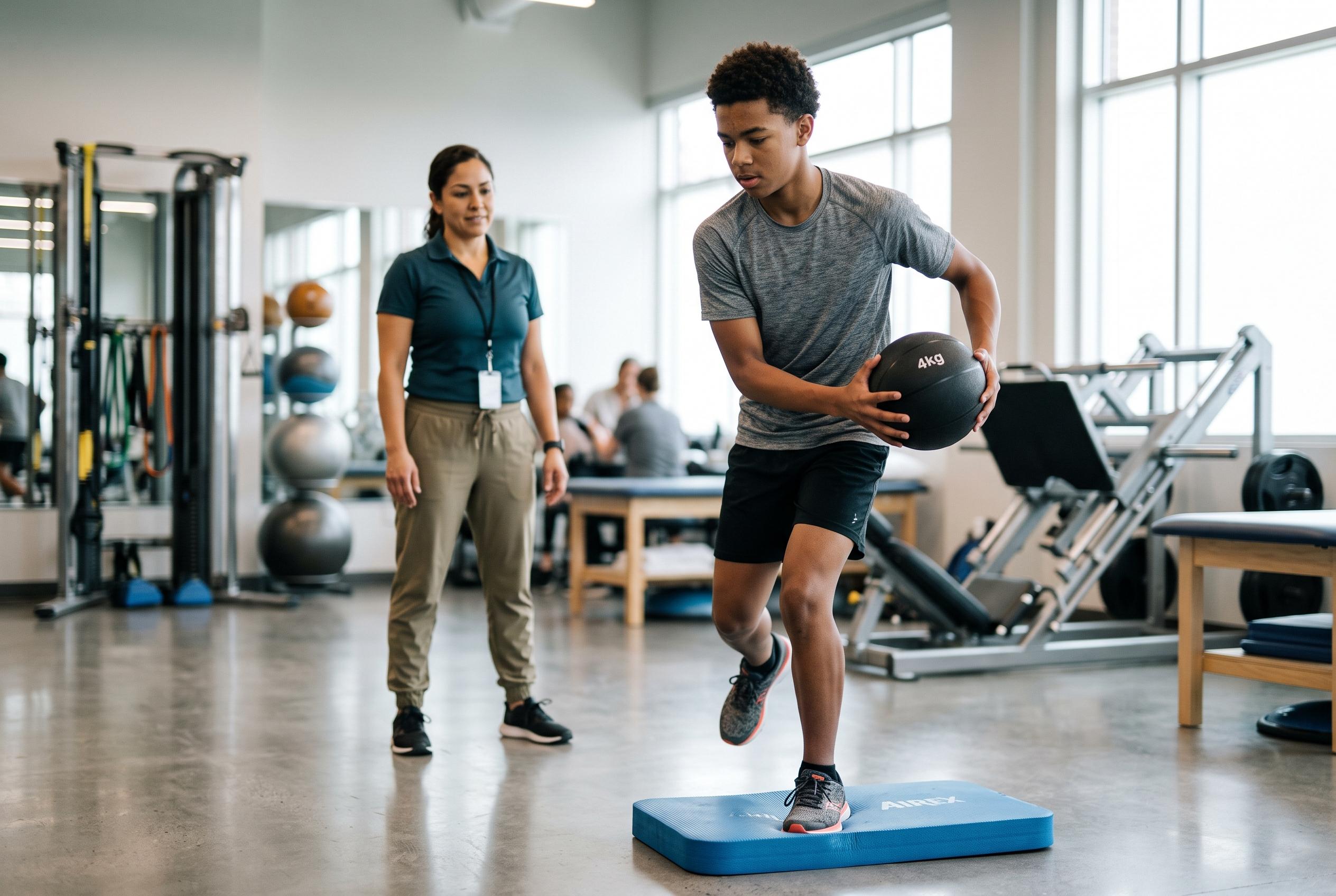

Feeling better is only one part of recovery: athletes should rebuild strength, control and sport-specific load tolerance before returning to competition.
Returning to sport after an injury is seldom a matter of counting down to a fixed date. A knee can feel fine during ordinary walking and still be unready for sudden turns on a football pitch. A shoulder may move freely yet fail to provide the control needed for a tennis serve or heavy lifting. The more useful question is not how many weeks have passed, but whether the body has regained the strength, control and load tolerance needed for the demands of the sport.
For active adults and teenagers, time away from training can be frustrating because it disrupts fitness, routine and confidence. Yet resuming competition too soon can prolong recovery or turn a manageable injury into a lasting problem. Physio Actif and Osso both stress that return to sport should be treated as a staged process rather than a single event, with each phase building on the one before it.
Pain alone is not a reliable guide. Swelling may have eased and everyday tasks may feel comfortable, while the injured area still lacks strength, balance or the ability to cope with impact. That is why many rehabilitation guides emphasise objective measures such as strength testing, hop tests, movement quality and joint stability, particularly after injuries such as anterior cruciate ligament damage. Recovery should be judged by what the body can do, not just by how it feels at rest.
The safest route usually begins with symptom control and protection of the injured tissue, then moves through gradual strengthening, movement retraining and sport-specific work. Leeds Community Healthcare describes this kind of progression as moving from cautious reintroduction to fuller activity, while Injury Atlas frames it around readiness questions covering pain, symmetry, movement and confidence. In practical terms, a runner may progress from walking to jogging, then intervals and faster efforts, while a footballer may move from straight-line running to changes of direction, non-contact drills and finally match play.
That progression should be matched to the sport itself. A badminton player needs repeated lunges and sharp changes of direction. A rugby player needs contact readiness as well as speed and power. A golfer needs rotational control and tolerance for repeated swings. There is no universal clearance test that suits every athlete, which is why many rehabilitation resources argue for sport-specific milestones rather than a one-size-fits-all timeline.
Confidence matters too. Fear of reinjury is common after serious problems such as a ligament tear, fracture or dislocation, and it can make athletes move cautiously or compensate without realising it. A clear plan, objective checkpoints and a gradual increase in training load can help rebuild trust in the injured area. On the other hand, persistent swelling, joint instability, locking, sharp pain or numbness should prompt reassessment before unrestricted sport is resumed.
The right time to return depends on the injury, the treatment received, the sport and the level of competition. A recreational runner preparing for a short race does not face the same demands as a competitive basketball player or a contact-sport athlete. Specialists at HC Chang Orthopaedic Surgery say the goal is to combine clinical examination, imaging where needed and an understanding of the athlete’s goals so that recovery is measured not by the first day back, but by the ability to stay active safely and consistently.
Disclaimer: This content is for informational purposes only and is not intended to be a substitute for professional medical judgment, advice, diagnosis, or treatment.



