

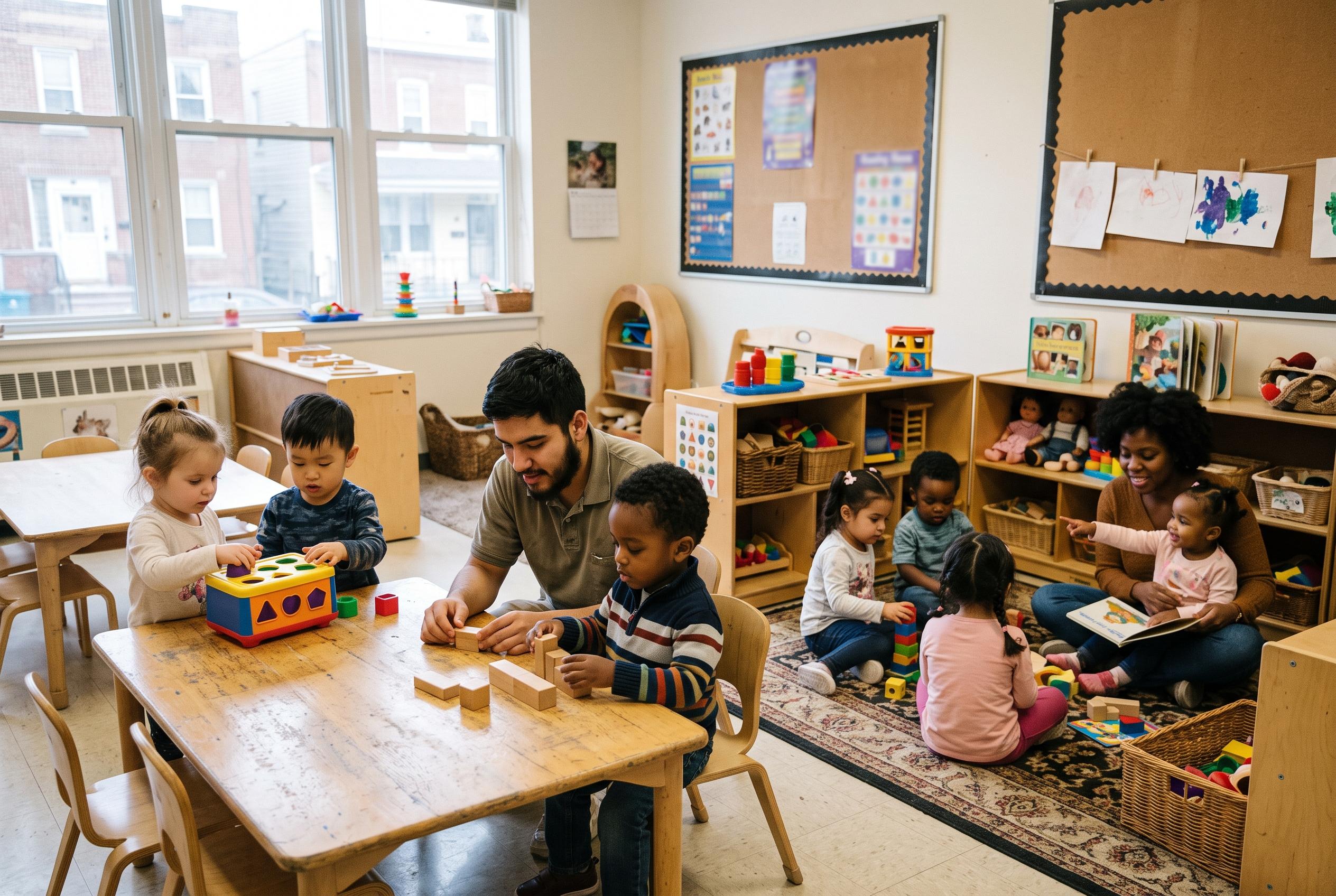

A decade after De Cero a Siempre became law, researchers say Colombia must shift from expanding access to ensuring consistent, high-quality care across its deeply unequal territories.
Colombia’s flagship early childhood policy, “De Cero a Siempre”, marks a decade since it became law, but a new review suggests the country’s central challenge is no longer reach alone. The question now is whether a system designed to protect children from pregnancy through age six can deliver consistent quality in every part of the country. A group of 14 researchers linked to universities including Los Andes, the Universidad del Norte, the National University, Oxford, Harvard and New York University spent months examining the policy’s record by interviewing officials, academics and civil society experts, and by reviewing available data and scientific literature.
Their conclusion is that Colombia has made real progress in expanding access. When the strategy began in 2011, it covered about 1.2 million children. By 2024, that figure had risen to 2.6 million, and by December that year 82% of children were receiving at least six of the 10 priority services considered essential for healthy development, according to the report. The state groups those services under its integral care route, which is meant to coordinate health, nutrition, protection and other support. But the researchers argue that the policy’s next phase must focus on what happens after access is secured: whether children are receiving care that actually helps them develop.
Jorge Cuartas of the University of the Andes, one of the report’s co-editors, said the country’s shortfall lies in quality rather than design. The researchers point to evidence showing that what matters most for a child’s development is not the building itself, but the interactions they have with the adults who care for them. One study in the collection, led by Juan Camilo Cristancho of EAFIT University, examined community childcare homes in Bogotá and Cartagena and found that violence nearby could affect the tone and quality of classroom interactions. When a homicide occurred within 500 metres, an average-quality classroom could fall sharply in quality for as long as a month and a half, suggesting that stress outside the centre can shape the experience inside it.
That finding fits a broader pattern identified by the group: a child’s prospects in Colombia often depend heavily on geography. Ana María Restrepo-Sáenz of Oxford University, another co-editor, said the national average masks deep territorial gaps. In rural areas, just 54% of children receive the policy’s core services, and the figure is 56% in the 170 municipalities covered by the Development Programmes with a Territorial Focus, created after the peace deal to address areas hardest hit by conflict. The researchers describe this as a kind of “geographical lottery”, because opportunities vary dramatically depending on where a child is born.
The inequality is stark in the latest child poverty data from Colombia’s National Planning Department. In 2025, 24.7% of minors, about 3.5 million children and adolescents, faced several forms of deprivation at once, including poor nutrition, the absence of adult care or lack of internet access. The rate was 16.1% in cities, but 45.8% in the countryside. In Guainía, Vaupés, La Guajira and Chocó, the share topped 60%, while in Vichada it exceeded 90%. Health indicators tell a similar story. National vaccination coverage still falls short of the 95% target, and severe acute malnutrition remains concentrated in places with large Indigenous and rural populations, particularly La Guajira, Chocó and Vichada.
The report argues that Colombia’s policy architecture struggles because it is managed centrally, while local governments enter with very different technical, financial and staffing capacities. In many regions, the people working directly with children are hired on short-term service contracts, which leads to frequent turnover. The problem is compounded in poorer areas, where conflict, climate threats and displacement often overlap. Restrepo-Sáenz, who led the migration section of the study, said families under pressure can find it harder to sustain the play, conversation and stimulation that young children need. She also warned that shrinking international aid risks undermining not only programmes but the expertise built around them.
The researchers say the country also needs better ways to measure progress. The last national assessment of childcare centre quality was in 2017, when the score was a modest 2.34 out of 4. Data from the review show that only 51% of educators in the ICBF’s childcare centres hold a professional degree, compared with 95% of teachers in school transition classes. The group says Colombia still lacks a national household survey that tracks language, motor or emotional development in early childhood, and the last national nutrition survey dates back to 2015. Cuartas argues that this is a serious blind spot, because the state cannot improve what it does not measure.
The policy review calls for four priorities: measuring quality through adult-child interaction rather than infrastructure alone, agreeing on shared indicators and opening data, improving coordination between institutions and territories, and securing stable funding instead of annual contracts. The ICBF’s own portal says the strategy is meant to align governors and mayors around an integrated care route, technical assistance and annual reporting, while a separate territorial implementation platform emphasises local capacity-building and intersectoral work. Recent institutional updates, including Decree 695 of 2023, were meant to strengthen that governance structure. For the researchers, however, the next test is not whether Colombia has a strong policy on paper, but whether it can turn that framework into reliable, high-quality care in every municipality.
Disclaimer: This content is for informational purposes only and is not intended to be a substitute for professional medical judgment, advice, diagnosis, or treatment.



