

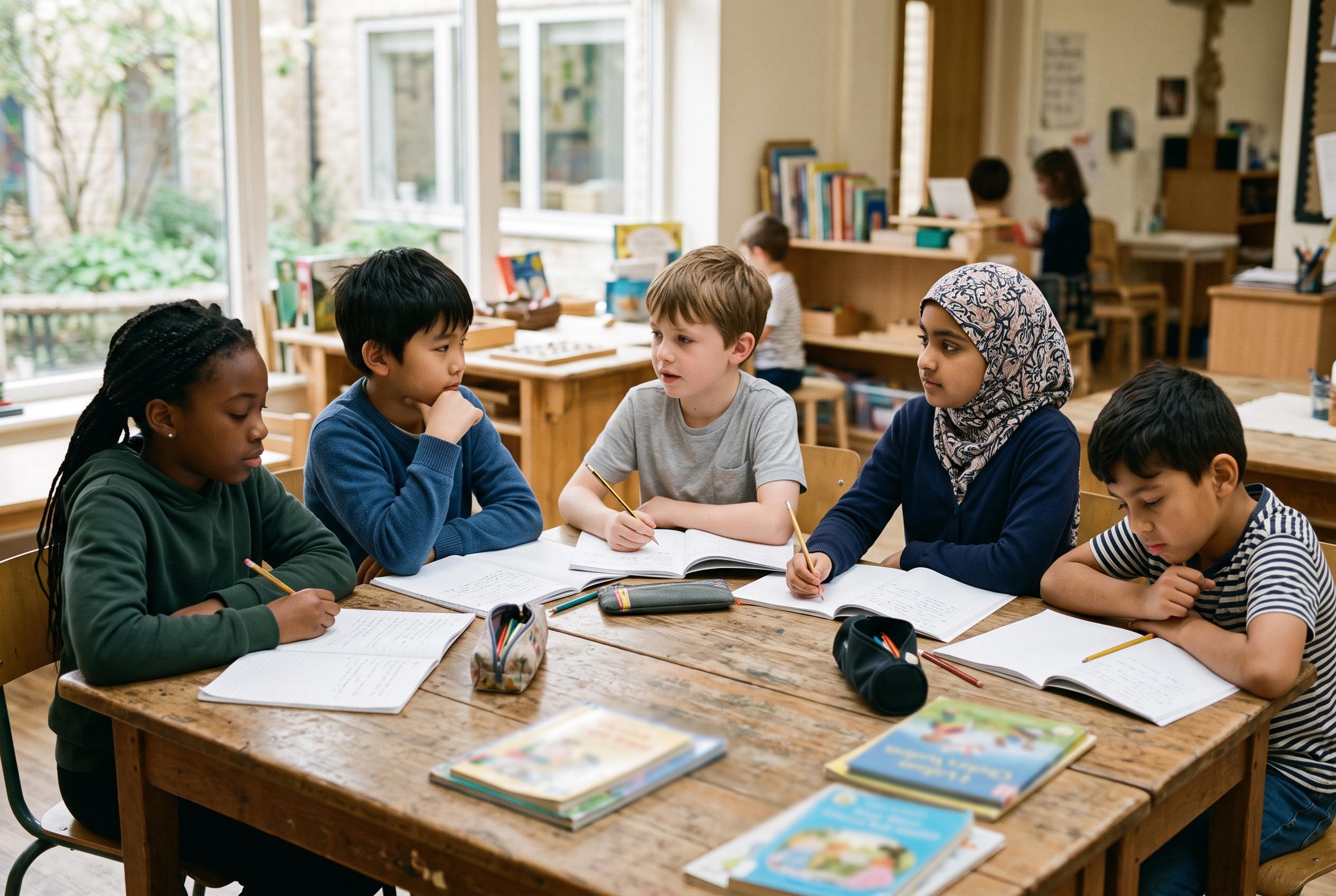

Memory work and retrieval practice are not ends in themselves: they give children the knowledge and mental fluency needed to understand, question and apply new ideas.
A simple classroom routine and a giant artificial intelligence system may seem to belong to entirely different worlds. Yet the comparison is useful: both depend on a foundation being in place before more advanced work can begin. In the same way that a data centre must be built before an AI system can function at scale, children need a store of knowledge before they can reason deeply about a subject.
That idea lies at the heart of classical education, particularly as it is practised in the home by parents who value memory work, recitation and repetition. The aim is not to turn children into information banks. It is to give them something to think with: dates, facts, vocabulary, grammar, maps and sequences that can later support analysis, judgement and expression. A timeline song will not explain why an empire collapsed, but it can place that empire in time so that the question becomes worth asking.
Research supports that emphasis on prior knowledge. Donna Recht and Lauren Leslie found in a study of junior-high students that children who knew more about baseball remembered and organised a passage about a baseball game more effectively than those who knew less. The point was not that memorisation alone produces understanding, but that comprehension is shaped by what a reader already brings to the text. In other words, knowledge is not decorative; it is structural.
That principle also helps explain why fluency matters. John Sweller’s cognitive load theory argues that working memory has limited capacity, so tasks become harder when too many elements demand conscious effort at once. In practical terms, if a child has to struggle to recall multiplication facts while also solving a larger problem, the extra effort can crowd out higher-order thinking. The same is true in reading: when word recognition is slow and laborious, there is less mental space left for meaning.
The lesson is not to chase speed for its own sake or to treat difficulty as failure. It is to teach in ways that lower unnecessary strain and support recall through well-designed practice. Studies associated with cognitive load theory have also shown that repeated study is not the same as retrieval: children tend to remember more when they practise pulling information from memory than when they simply re-read it. That distinction matters in classrooms and at kitchen tables alike. A child may recite a grammar chart perfectly, but the knowledge becomes more useful when the same pattern is used to write a sentence, correct an error or explain a choice.
This is why classical educators often move from memory to use. A student may sing a timeline, trace a map or memorise a science fact first, then later be asked to reconstruct the material, compare it with what was learned before and apply it to a new question. The goal is not to stop at retention. It is to build the habits of thought that allow children to question, interpret and revise what they know. Knowledge is the beginning of understanding, not the end of it.
The larger claim is a modest one, but an important one: children do not need to memorise everything, yet they do need enough knowledge to think responsibly. That knowledge should be accurate, useful and open to correction. Classical education, at its best, treats facts as preparation for wisdom rather than as a substitute for it. Children should not merely store information. They should be given enough of it to understand the world, test ideas against it and speak about it with care.
Disclaimer: This content is for informational purposes only and is not intended to be a substitute for professional medical judgment, advice, diagnosis, or treatment.



