

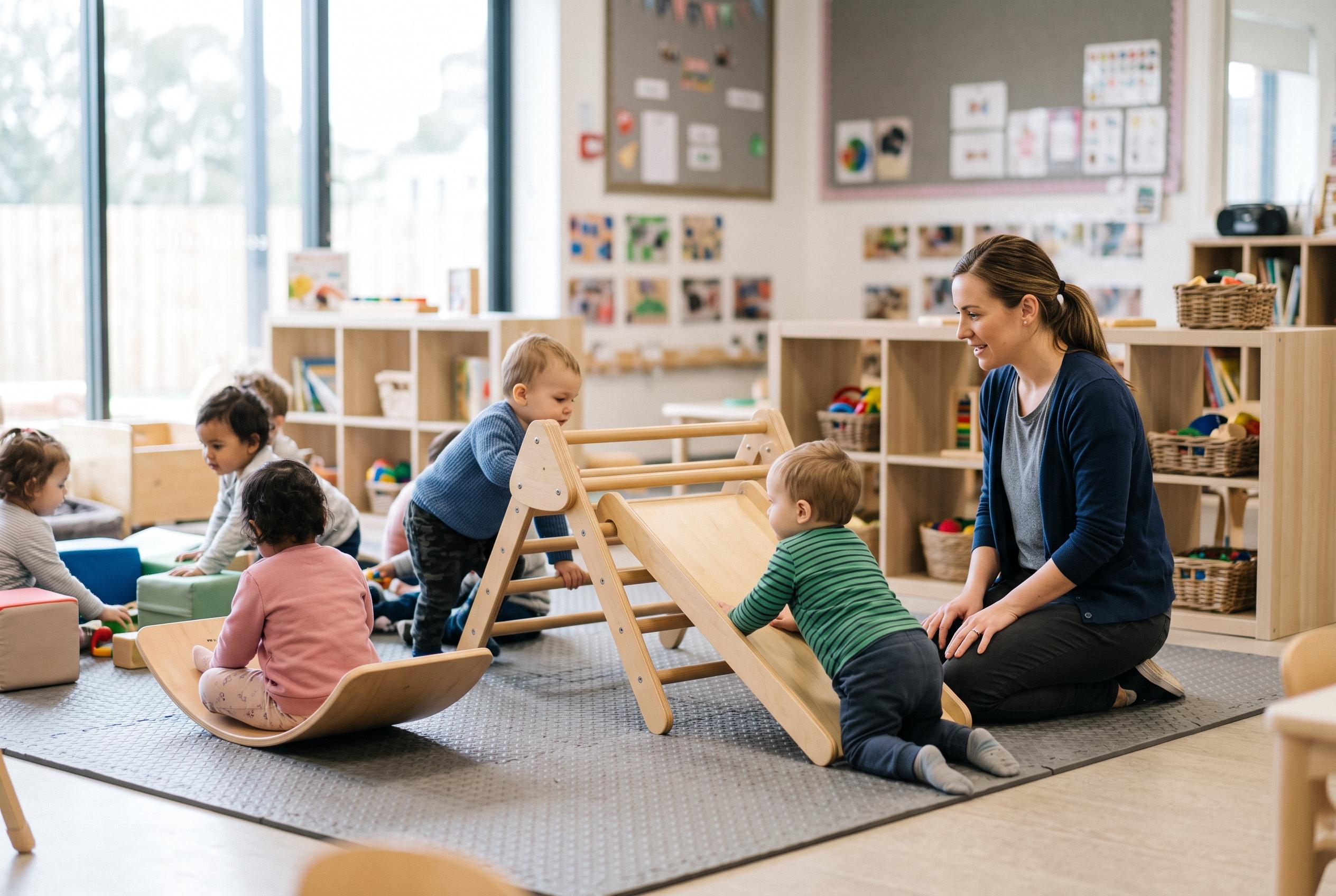

From crawling and climbing to rocking and carrying, ordinary play helps young children develop balance, body awareness and self-regulation , without turning every developmental difficulty into a diagnosis.
Helen Battelley’s account of primitive reflexes and sensory development makes a simple but important case: movement is not a bonus in early childhood, but part of the foundation for learning, self-regulation and physical confidence. The argument is echoed in developmental research, which describes primitive reflexes as automatic movements present before and around birth that help organise early brain and motor development. As the nervous system matures, these reflexes are normally integrated into more controlled movement, allowing children to sit, reach, balance and coordinate with greater purpose.
The article also widens the familiar idea of the five senses by highlighting vestibular, proprioceptive and interoceptive processing. In practical terms, these systems help children judge balance, body position and internal states such as hunger, fatigue or discomfort. Research on sensory profiles in preschool children suggests that when primitive reflex activity remains unusually strong, it can be associated with sensory-motor immaturity and difficulties in everyday functioning. That does not mean every movement or behaviour issue has a sensory cause, but it does support a more careful reading of how children respond to their surroundings.
Battelley is cautious about overstating the role of retained primitive reflexes, and that caution matters. Educational and therapy sources note that while primitive reflexes should generally fade in infancy, persistent activity is only one possible factor among many in a child’s development. The article’s emphasis on curiosity over diagnosis is consistent with this wider view: when children struggle with attention, posture, coordination or regulation, adults should look first at patterns, triggers and context rather than rushing to a label.
The most useful part of the piece may be its reminder that ordinary play is often developmental work in disguise. Crawling through tunnels, climbing, rocking, pushing, carrying and moving to music all give children repeated practice in planning movement, using their muscles and joints, and organising themselves in space. Neuroscience summaries describe primitive reflexes as part of the sequence of early brain development, while studies of general movements suggest these early patterns can act as sensitive markers of neurological integrity in infancy. Taken together, that evidence supports Battelley’s central message: the route to later classroom readiness runs through the body as much as through early literacy or numeracy.
For parents and early years practitioners, the practical takeaway is clear. Children need varied, regular opportunities to move, explore texture, test balance and build body awareness. They also need adults who notice sensory seeking or sensory avoidance without turning every difficulty into a behaviour problem. In that sense, the article is less about reflexes as a specialist concept than about a broader change in perspective: seeing movement, play and regulation as closely linked parts of healthy development.
Disclaimer: This content is for informational purposes only and is not intended to be a substitute for professional medical judgment, advice, diagnosis, or treatment.



