

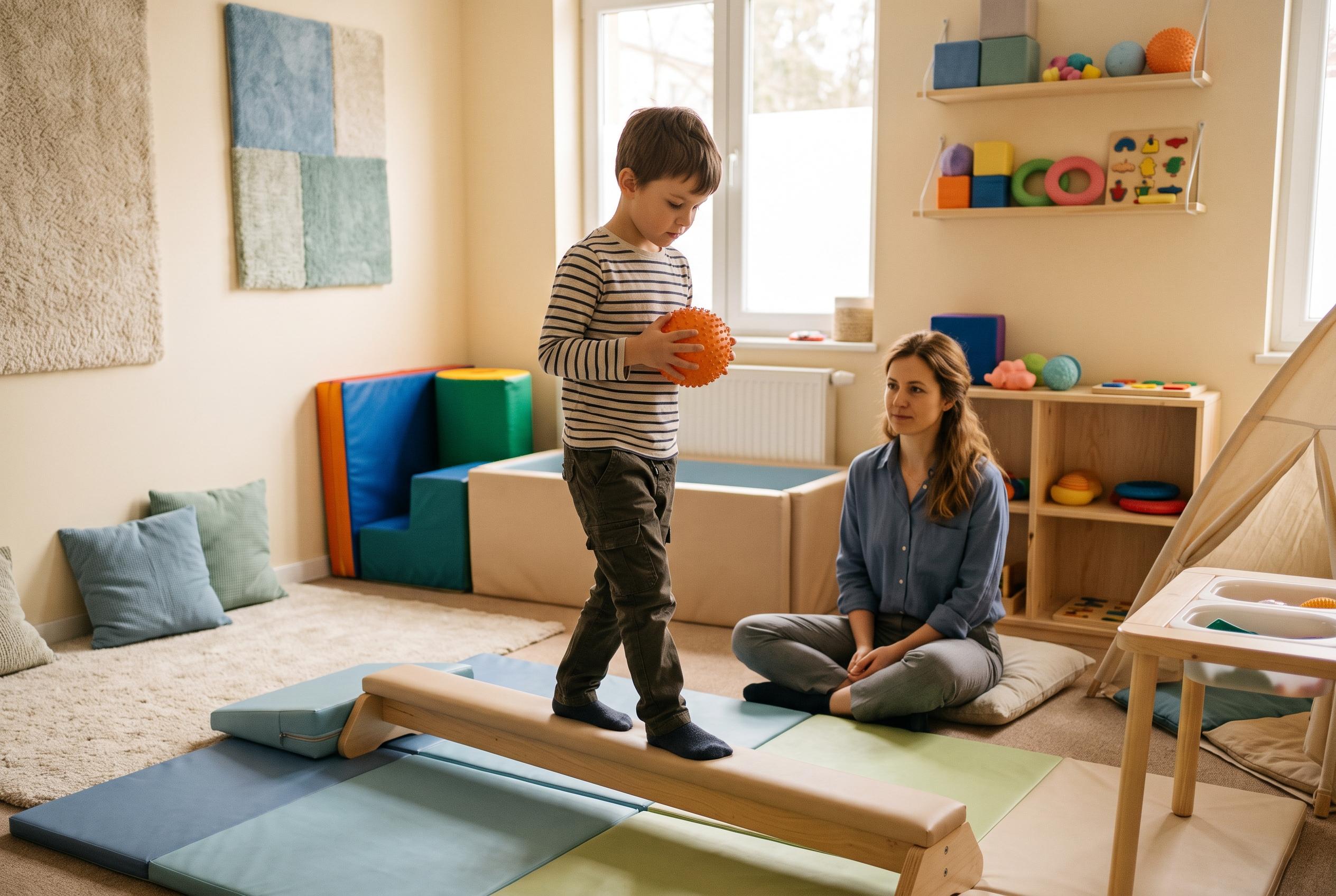

A small Italian controlled study found no broad behavioural or sensory benefits from a 12-week Motor Sensory Room programme, with personal autonomy the only measure showing a significant improvement.
A structured sensory-motor programme for children with autism spectrum disorder appears to have produced a narrow benefit rather than a broad one, according to a new controlled study from researchers in Italy. In the 12-week trial, children who took part in the Motor Sensory Room sessions were no more likely than a comparison group receiving usual care to show overall gains across behaviour, communication, sleep, feeding, play or social interaction. The one domain that did stand out was personal autonomy, suggesting a possible link between the intervention and better everyday independence, but not a general treatment effect.
The study, published in Frontiers in Psychology, followed 54 children aged two to 11 years. Forty-four received the Motor Sensory Room programme alongside their usual educational and therapeutic support, while 10 continued treatment as usual. The children were not randomly assigned, and the authors say that makes it impossible to rule out selection bias or other confounding factors. Even so, the analysis found that personal autonomy was the only behavioural measure that remained significant after correction for multiple comparisons, with the intervention group improving while the comparison group did not. The researchers describe that result as preliminary and say it should be tested again in a randomised trial using a validated adaptive-behaviour measure.
The room itself was designed as a standardised multisensory setting with a fixed sequence of activities: settling-in routines, free exploration, guided sensory-motor exercises, time in a heated sensory pool and a gradual return to baseline. Children attended two individual sessions a week for 12 weeks. The programme was framed as being informed by Ayres Sensory Integration principles, but the authors note that it was not delivered as a formal Ayres protocol. They also say all children remained in their usual therapies, including speech and language support, psychoeducational input and behavioural programmes, which makes it difficult to separate the room’s effects from ongoing care and natural development.
The sensory findings were also more limited than they first appeared. Four touch- and temperature-related items showed statistically different patterns between the two groups, but the researchers caution that the raw scores do not tell a simple story of improvement because the meaning of a change depends on whether a child is hypo-reactive or hyper-reactive at baseline. In other words, the data showed different trajectories, not clear clinical gains. The authors say this is important because it argues against claims that the programme broadly improves sensory processing. Instead, they conclude that the evidence points to a selective effect on personal autonomy, with no solid support for wider behavioural or sensory change.
That cautious reading fits with the broader research landscape. Past studies have suggested that sensory differences are common in autism and can affect daily participation, but the strength of evidence for multisensory or sensory-integration interventions has varied widely. The new study adds to that debate by using a comparison group and multiplicity correction, yet its small size, non-random design and study-specific measures mean the findings remain exploratory. For families and clinicians, the message is less about a sweeping new therapy effect and more about the need for better-designed trials that can show whether targeted sensory-motor work can reliably improve independence in everyday life.
Disclaimer: This content is for informational purposes only and is not intended to be a substitute for professional medical judgment, advice, diagnosis, or treatment.



