

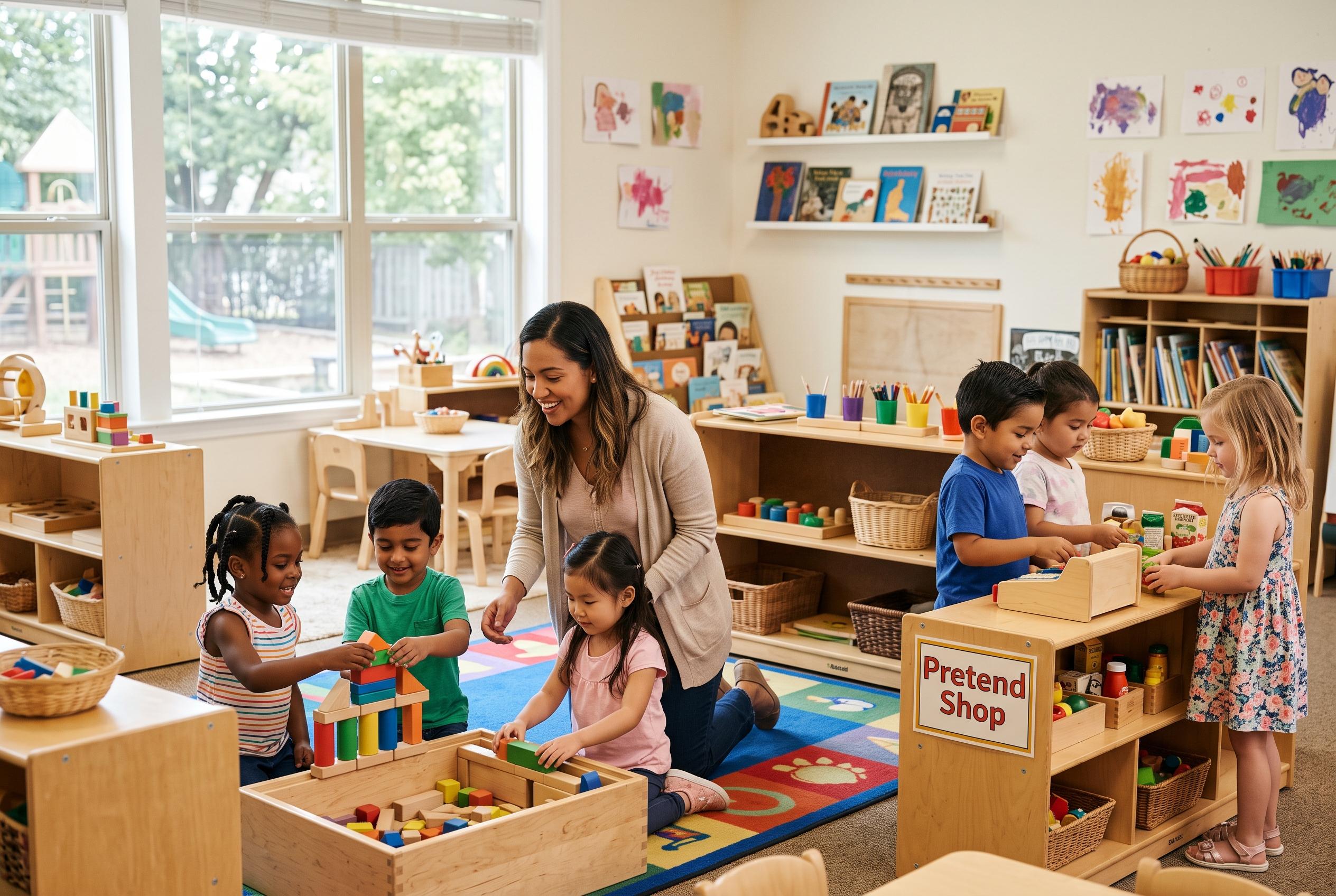

From block-building to pretend shops, play-based learning helps young children develop language, problem-solving and self-regulation while giving educators room to guide discovery.
Young children rarely sit still for long, and that is often a strength rather than a problem. When children are given time to stack blocks, role-play a shop or pour water from one container to another, they are not simply keeping busy; they are learning how to think, talk, plan and adapt. Childcare.gov says play supports cognitive, physical, social and emotional development, while HealthyChildren.org notes that it also helps children build language, maths and self-regulation skills.
That is the basic promise of play-based learning: children stay active in the lesson. According to the Institute of Education Sciences, the approach can include free play, guided play and structured games, with each form giving children room to make choices while adults shape the environment around them. Purdue Global describes it as a teaching method in which learning happens through child-led exploration, teacher guidance or more structured activities, rather than through direct instruction alone.
The benefits reach across several areas at once. Building a tower or bridge from blocks can strengthen fine motor control while introducing ideas such as balance, shape and early engineering. Pretend play can deepen vocabulary and social understanding, as children negotiate roles, count objects and explain what they want. Outdoor games help with coordination and following directions, and Healthline says play also supports memory, critical thinking and an understanding of cause and effect. The Education Endowment Foundation adds that play-based interventions have shown a moderate positive effect on learning outcomes, although the evidence base remains limited.
Educators play a crucial part in making that learning purposeful. The Encyclopedia on Early Childhood Development says teachers can extend play by choosing materials carefully, observing what interests a child and adding prompts that broaden the activity without taking it over. A child fascinated by animals, for example, might be offered books, sorting materials or natural objects that open the door to discussions about habitats, textures and categories. The challenge is knowing when to step in with a new word or a manageable problem, and when to let children work things out for themselves.
Parents can do the same at home without buying expensive toys. A cardboard box can become a bus, a shop or a house. Socks can be sorted by size or colour, and cooking can turn into a counting and sequencing exercise. Open-ended materials such as paper, blocks, crayons and reusable containers often work best when there are not too many choices at once. The most valuable ingredient is usually time: enough for a child to imagine, test an idea, change course and discover what happens next.
Disclaimer: This content is for informational purposes only and is not intended to be a substitute for professional medical judgment, advice, diagnosis, or treatment.



