

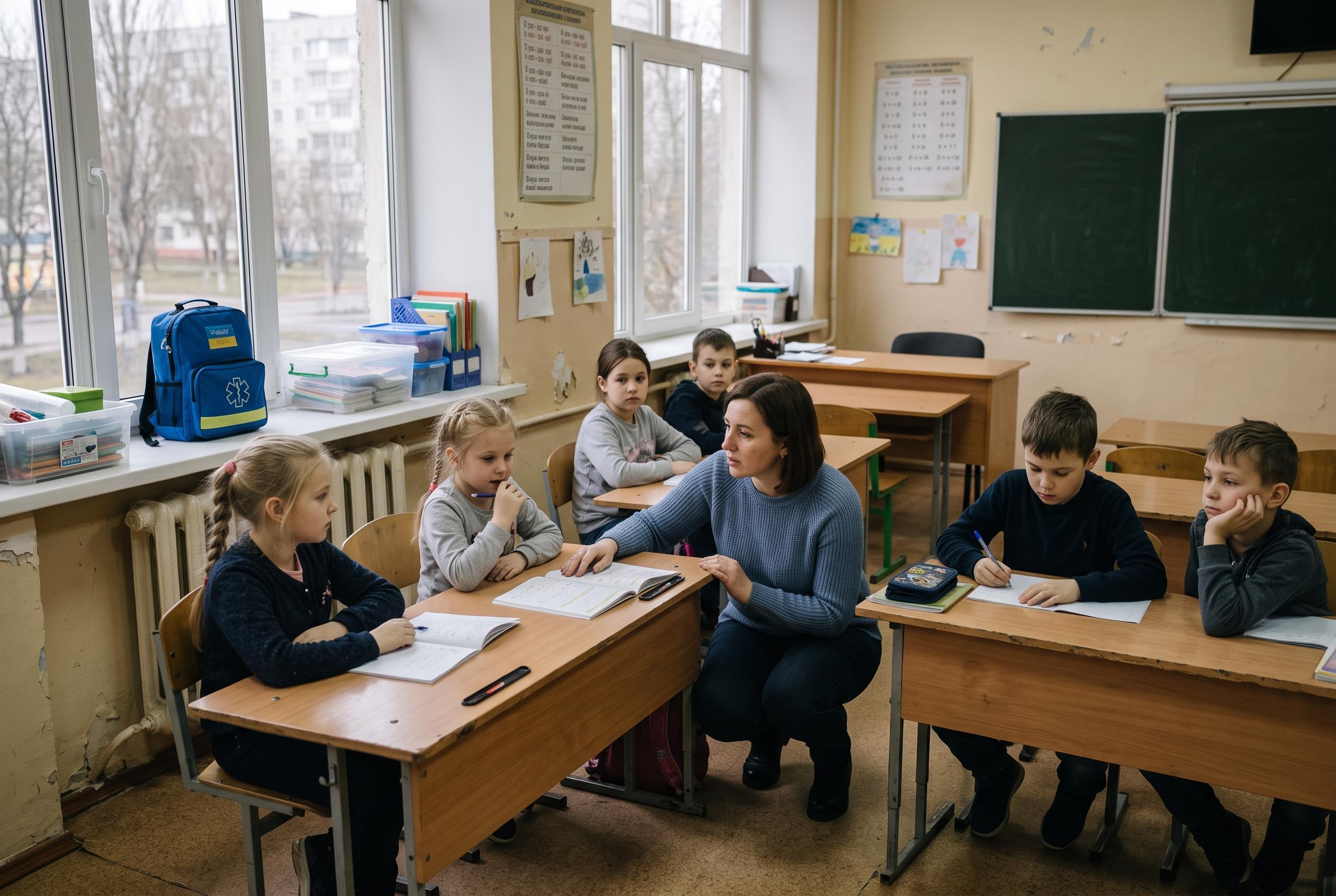

Air-raid alerts, remote classes and chronic fear are reshaping how Ukrainian children learn, remember and communicate, an expert warns.
Ukraine’s children are growing up under conditions that would challenge even the most resilient adult: air-raid alerts, disrupted routines, prolonged online classes and the constant strain of living with war. Oksana Fedchenko, a social pedagogue with SOS Children’s Villages Ukraine, says the problem is not only that children are learning remotely, but that they are doing so while carrying chronic fear and uncertainty. In her view, those pressures are now shaping how pupils think, remember and interact with others.
Fedchenko said remote learning can work well for pupils who are already organised, self-motivated and able to manage their own time. But she argued that it is far less suitable for younger children, and for families in which adults cannot supervise schoolwork throughout the day. The deeper issue, she said, is that stress can overwhelm the mental processes children need for learning. Research on children exposed to war and displacement has long shown that insecurity and trauma can damage development and lead to lasting mental health problems, which is why experts recommend trauma-informed support at several levels, from screening to targeted therapy. According to the American Academy of Pediatrics, armed conflict is also linked with higher rates of post-traumatic stress disorder, anxiety, depression and behavioural problems, while parental mental health strongly influences how children cope.
She said fear pushes the brain into survival mode, reducing access to the parts responsible for analysis, planning and self-control. Fedchenko described the hippocampus, which helps move information into long-term memory, as particularly vulnerable to persistent stress, while the amygdala becomes overstimulated by a constant stream of threatening news and alarms. That helps explain why children may struggle to retain material, even when they appear to be present in class. A review in the US National Library of Medicine similarly notes that stress can alter attention and learning, although the effect depends on context and on how well adults manage the environment around the child.
Fedchenko also warned against hiding the truth from children. She said parents should explain what is happening in language suited to the child’s age, rather than leaving them to fill in the gaps with frightening fantasies. For younger children, she said, silence can be more alarming than honesty, because they hear the noise, see the fear and notice the adults’ behaviour without understanding the cause. Clear explanations about sirens, shelters and what to do next can reduce anxiety by turning chaos into a routine. UNICEF has said that war in Ukraine has created a severe learning and mental health crisis for children, many of whom have lost stability, family members or direct access to schooling and support services.
The effects are especially visible in shelters and other improvised classrooms, where concentration is difficult even under the best conditions. Fedchenko said younger pupils are still developing the ability to focus deliberately, and the noise, movement and constant awareness of danger make that harder. Yet she also said children can adapt with remarkable speed when they are given a predictable response. In her work with preschool children, she has seen very young pupils learn to collect their things and move to safety almost automatically when an alarm sounds. That kind of drilled routine, she said, can reduce panic and help children feel a small measure of control.
Her warning extends beyond academic performance. Fedchenko said parents should watch for sudden changes in mood, a sharp fall in grades or an unusual obsession with schoolwork, as well as withdrawal, irritability, aggression or retreat into online worlds such as games and anime. She also pointed to a growing tendency among teenagers to avoid face-to-face communication, preferring text or even artificial intelligence chatbots because they find live interaction too demanding. That loss of real-world practice, she said, weakens social skills, emotional intelligence and the ability to read body language, tone and facial expression.
The physical costs can be just as significant. Fedchenko, who also has training as a speech therapist, said limited movement and long hours with devices can weaken the muscles used for speech, contribute to poor posture and affect the development of the jaw and bite. She said children who spend too much time indoors and too little time talking, reading and moving often have a thinner vocabulary and less ability to express themselves in full sentences. Movement, she added, is not a luxury but a way for the body to release stress. Despite the strain on families, she said attitudes towards mental health care have improved, with fewer parents fearing psychological support and more now seeking help early, though she noted that much of the daily burden still falls on women caring for children while partners are at war.
Disclaimer: This content is for informational purposes only and is not intended to be a substitute for professional medical judgment, advice, diagnosis, or treatment.



