

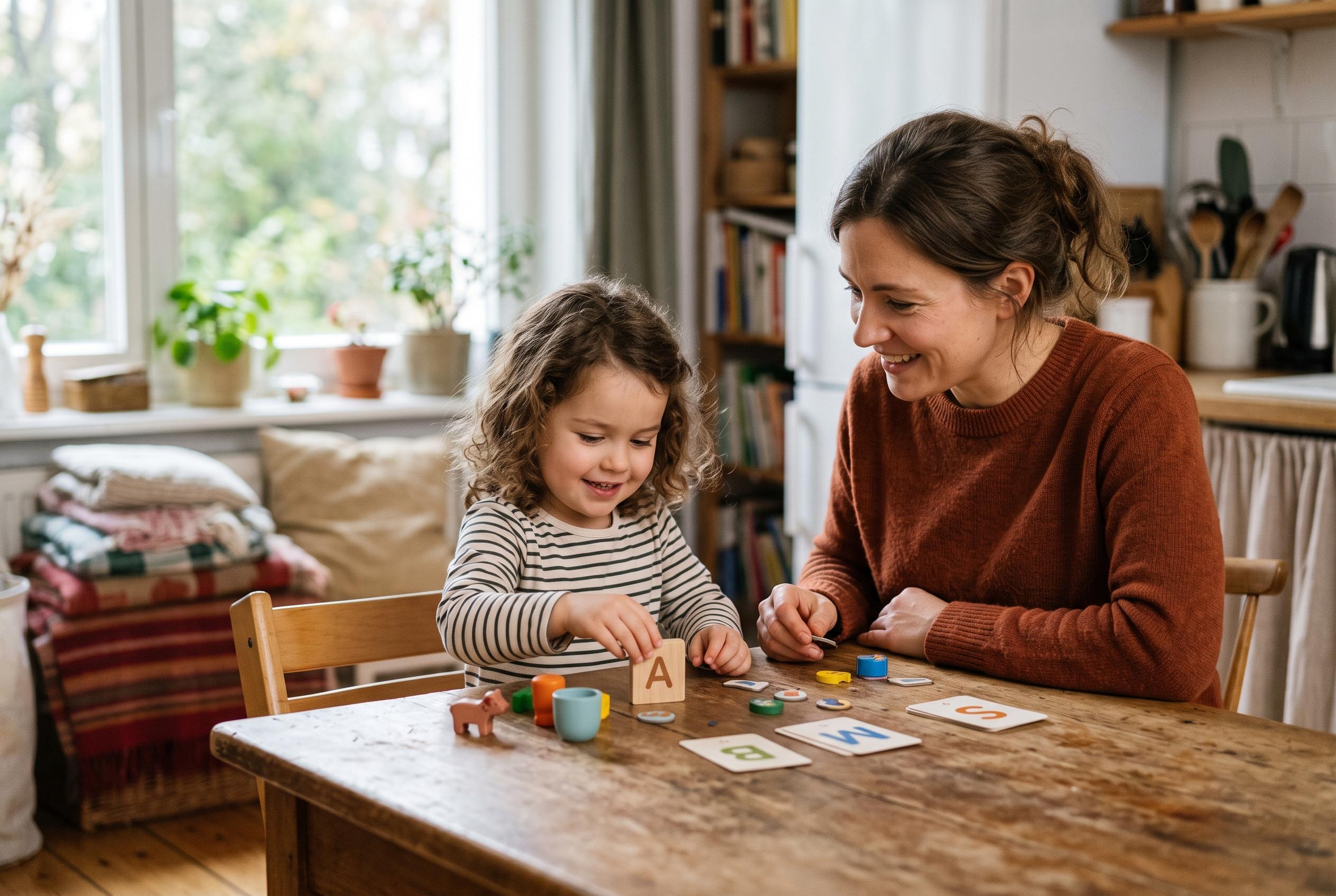

Short, playful activities that help children hear, manipulate and link sounds to letters can build the foundations for confident reading at home.
Phonics works best when children can hear, say and play with sounds before they are asked to read them on a page. Short, lively activities at home can help bridge that gap, especially for children who are just beginning to recognise letters and the sounds they make. Educational resources from Phonicademy, Open & Go Phonics and Phonics.org all point to the same broad principle: early literacy improves when children practise small, structured sound-based tasks regularly rather than relying on occasional worksheet sessions.
For younger children, the simplest games are often the most effective. An “I Spy” game built around sounds rather than letter names helps children tune in to the first sound in a word. A sound treasure hunt can do the same job in a more active way, asking a child to search the home for objects that begin with a chosen sound. Phonics.org also recommends phonemic awareness activities for children as young as three, because the ability to hear and isolate sounds comes before matching those sounds to printed letters.
As children grow more confident, picture sorts and letter-sound games can make the next step feel manageable. Sorting pictures by their first sound helps them hear differences between words, while bingo-style games strengthen the link between a spoken sound and its written form. Resources from SplashLearn and Open & Go Phonics suggest that this kind of repeated practice is especially useful for children aged four to seven, when many are ready to start connecting spoken language with letters, short vowels and simple blends.
Hands-on movement can also make phonics stick. A child who drives a toy car over letters on a paper road, or hops through a grid of sounds drawn in chalk, is not just playing; they are rehearsing how sounds connect into words. Building and changing words with magnetic letters gives the same lesson in another form. A child who makes “pig” and then changes one letter to form “pin” or “pan” begins to see how small sound changes alter meaning, which is a key step towards reading independently. Phonicademy and Duck English both highlight the value of structured phonics practice that is easy to repeat at home or in class.
Once children can blend sounds and recognise common word endings, activities can move towards reading. Sound boxes, rhyming games and word-family houses help children notice patterns such as “-at” in “cat”, “bat” and “sat”. Digraph hunts, in which children search for letter pairs such as “sh”, “ch” and “th”, prepare them for more complex spelling patterns. The final stage is decodable reading: short books written mainly with the sounds children already know. That is where all the earlier games come together, turning practice into actual reading success.
Parents do not need long sessions to make progress. Five to ten minutes a day is usually enough for young children, especially if the activity stays playful and focused. It also helps to keep to the sound sequence used at school, so home practice supports classroom teaching. Reading aloud should continue even after children start to read alone, since listening to fluent reading still builds language and comprehension. If a child finds phonics difficult, it is often better to return to listening games and keep practice brief than to push ahead too quickly. The broader message from phonics specialists is consistent: early reading grows fastest when children hear the sounds, play with them, and then see them in print, one small step at a time.
Disclaimer: This content is for informational purposes only and is not intended to be a substitute for professional medical judgment, advice, diagnosis, or treatment.



