

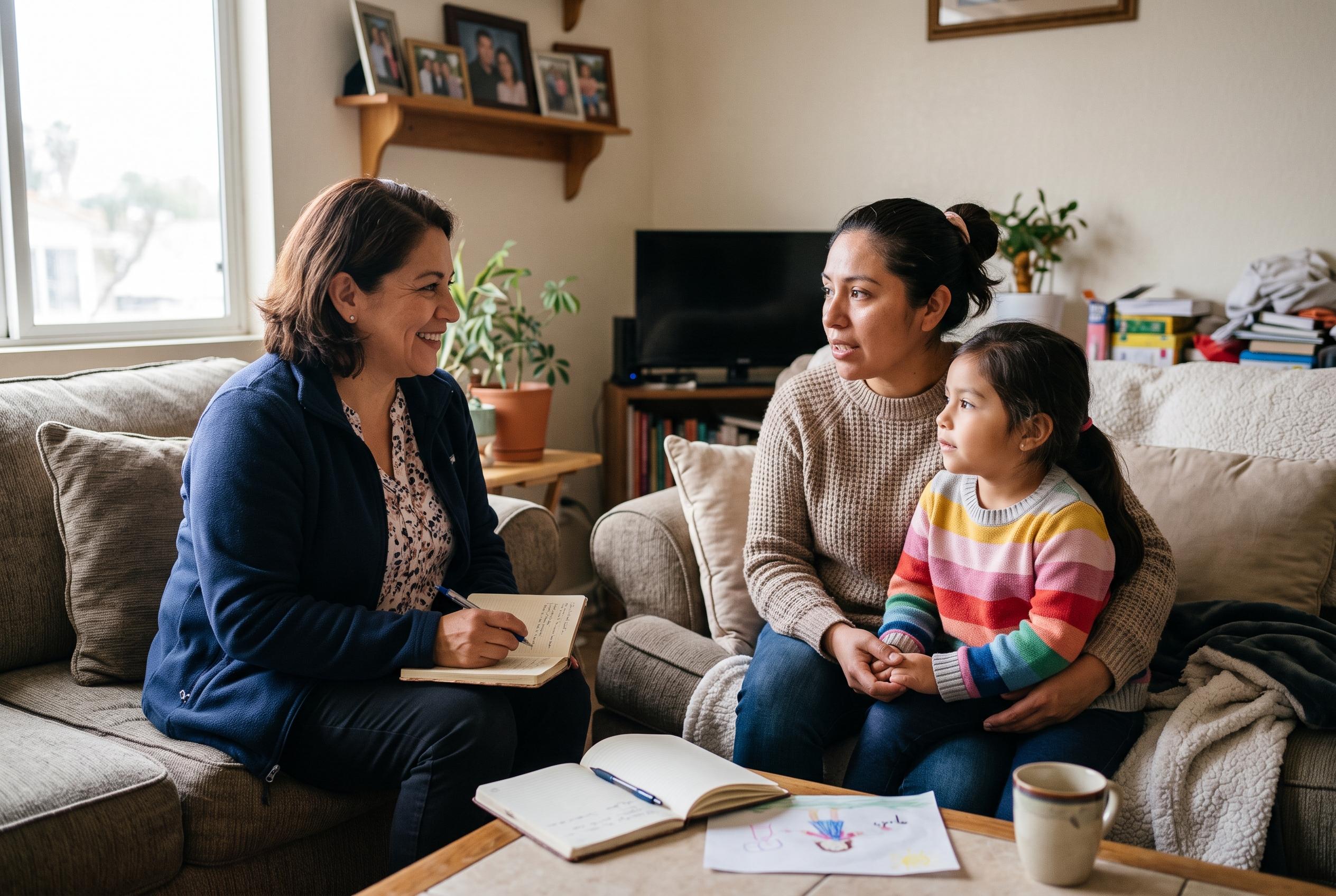

Early alliance-building by community health workers was linked to stronger engagement and homework completion among low-income Latino families using telehealth child therapy.
Community health workers may play their most important role in child therapy before a family has had time to decide whether it will stick. A new study in Frontiers in Child and Adolescent Psychiatry suggests that the earliest contact between these workers and caregivers can shape whether parents stay engaged in Parent-Child Interaction Therapy, a well-established behavioural parent training programme used to help young children with disruptive behaviour.
The research focused on low-income Latino families taking part in a telehealth model that pairs standard PCIT with support from community health workers, or CHWs. In this approach, therapists deliver the core treatment while CHWs help parents practise skills at home, overcome practical obstacles and find their way through problems such as transportation, technology, food insecurity, housing instability and immigration-related needs. The study was led by Hanan N. Salem of the University of California, Santa Barbara, with collaborators at the University of Miami and the community group ConnectFamilias.
To understand what CHWs were doing that might explain better engagement, the researchers adapted an observational coding system originally designed to track therapist behaviour. They reshaped the tool so it could capture the work of CHWs more accurately, adding items that reflected how lay workers often build trust by drawing on shared experience, meeting caregivers where they are and helping families navigate schools, health systems and social services. They also simplified the rating scale to make the observations clearer and more consistent for coders.
The team then analysed recorded sessions from 26 families, nearly all of them Latino or Hispanic, with most of the CHW sessions conducted in Spanish. The findings showed that CHWs used a broad set of engagement strategies, but some approaches were especially prominent. Psychoeducation about child services and recognition of caregivers’ strengths were among the most common. Other strategies, including barrier-solving and extended discussion of child behaviour problems, appeared less often in the recorded sessions.
What stood out most was the importance of the first session. The study found that alliance-building behaviours in that opening meeting were linked to stronger caregiver engagement, better agreement about therapy tasks and more homework completion early in treatment. Individual first-session behaviours such as expressing positive regard and explaining child behaviour problems also predicted stronger perceptions of alliance. By contrast, similar strategies observed later did not show the same relationship, suggesting that early rapport may carry disproportionate weight in CHW-supported therapy.
The results also raise a caution about how psychoeducation is used. While it was associated with better attendance, more frequent discussion of child behaviour problems was tied to weaker gains in positive parenting skills. The authors say that may reflect the way attention is directed during therapy: in PCIT, caregivers are taught to notice and reinforce positive child behaviour, so even well-meant discussion of difficulties could pull focus elsewhere. Because the study was small and observational, it cannot prove cause and effect, but it does point to a practical training issue for programmes that rely on CHWs.
The sample was limited to 26 families and three CHWs, and the researchers observed only two sessions per family, which means much of the broader relationship-building and problem-solving work may have gone unseen. Even so, the study adds rare direct evidence to a field that has often relied on interviews or broad outcome measures. It also builds on earlier work showing that trained community helpers can improve engagement in PCIT, reinforcing the idea that culturally responsive, trusted support may be especially valuable for families who have long faced barriers to child mental health care.
Disclaimer: This content is for informational purposes only and is not intended to be a substitute for professional medical judgment, advice, diagnosis, or treatment.



